Tag: NYC

JHISN Newsletter 02/28/2026

Dear friends, 

It has been a wild winter in New York City since our last newsletter, and we hope this finds you warm and well. Our previous newsletter also landed in your inbox the day, January 24, that Alex Pretti was murdered in the street by Customs and Border Patrol (CBP) in Minneapolis. Alex Pretti and Renée Nicole Good, both US citizens, join six immigrants who died in ICE custody in January—Luis Gustavo Núñez Cáceres, Geraldo Lunas Campos, Víctor Manuel Díaz, Parady La, Luis Beltrán Yáñez-Cruz, and Heber Sánchez Domínguez—to make January 2026 a dreadful, deadly start to this new year of mass deportations.  

Today’s newsletter looks at the ongoing campaign to pass NYS legislation, the NY4All Act, that would strengthen protections for immigrants in the face of federal government attacks. Our second article reflects on how local sanctuary policies can help defend against the many border transgressions the Trump regime carries out in its selective “border war” against immigration.

Newsletter highlights:
  1. New York for All legislation: Can the New York State Assembly stand up?
  2. Protecting the borders we need: Local sanctuary against ICE incursions.


1. Pass NY4All Act Now, Or NY Will Have Normalized the Trump/Miller Agenda

“Silence is complicity. Inaction is complicity. We have the tools to protect our immigrant communities and we must use them. Federal immigration enforcement is cruel, chaotic, and unconstitutional. New York will not be complicit.” —Kristen Gonzalez, NY State Senator.

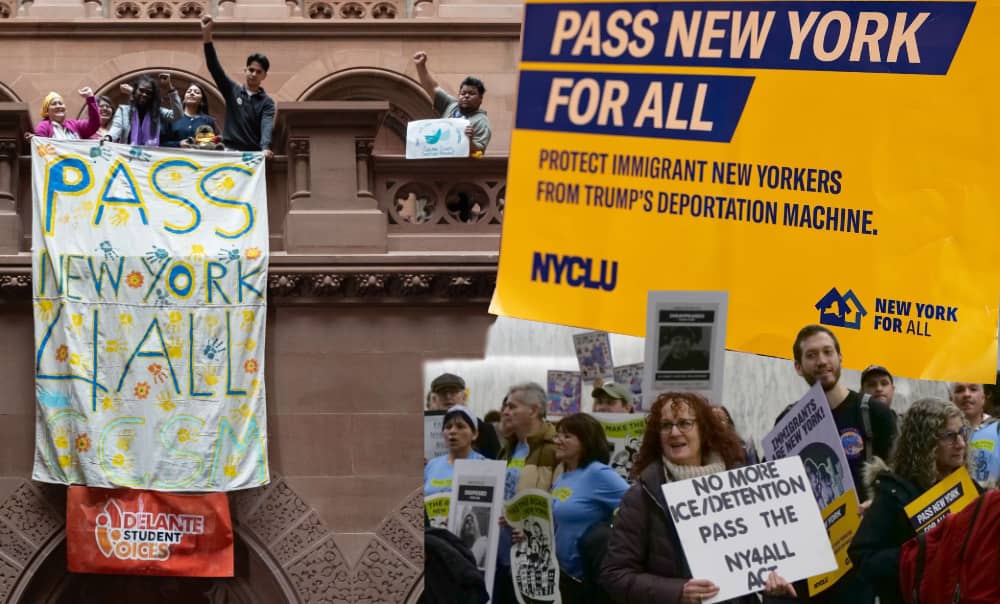
A February campaign by the NYCLU stated: “Pass the New York for All Act. Fight back against Trump’s mass deportation agenda and protect immigrant communities in New York.” That was back in 2020. The NY4All Act, if passed, would have prohibited the use of New York’s local and state resources to support federal immigration enforcement. That could have helped us stand in the courts with more challenges to the escalating inhumanity of the US deportation operations. The campaigns documented the social and economic benefits we would gain if New York’s communities did not cooperate with ICE. But no legislative action was taken.

Throughout the last six years, the cruelty of the detention and deportation machine has increased. Advocates like the New York Immigration Coalition, Make The Road New York, The Bronx Defenders, the Immigrant Defense Project, labor unions, the Association of Legal Advocates and Attorneys, and many other groups have continued to lobby Albany. They all demand the passage of the New York for All Act. In February 2025, NY legislators even reintroduced the Act because the guidance from NYC’s then-mayor Eric Adams was legally confusing. But no legislative action was taken.

On January 12, 2026, after the murder of Renee Good by ICE agents in Minneapolis, a NY For All: March For The Disappeared rally took place in Albany. Advocates returned once again to the state capitol on January 26–just days after the ICE murder of Alex Pretti–to demand passage of NY4All. Then, at the end of last month, Governor Kathy Hochul suddenly proposed her own Local Cops, Local Crimes Act. The purpose of Hochul’s act is to end the ‘weaponization’ of local police against their own communities by banning the 287(g) agreements that require them to cooperate with ICE. Even though many organizations, like the Asian American Federation, support this as a first step, the overwhelming preference of all groups is to pass the more substantial NY4All Act. 

There is concern that Hochul’s proposal might, in fact, preempt the NY4All Act and its more robust protections. As Assemblymember Dr. Anna Kelles pointed out, the 287(g) agreements that Hochul focused on are just one of the many proposals in the NY for All Act. Missing from Hochul’s proposal are additional safeguards, “designed to prevent immigration enforcement from happening through routine questioning, record keeping, database practices, probation operations, and behind-the-scenes information sharing.”

In addition to the NY4All Act, there are even more legislative proposals that Albany can pass to protect NY residents:

These many proposals are ready for the legislature to pass: let us demand our elected officials do more than just create media bites opposing ICE and, instead, take legislative action to protect our communities. A new proposal was even added this month, by Westchester’s State Senator Shelley Mayer, to prohibit ICE from gaining access to schools without a judicial order. The NYCLU, with the New York for All Coalition, published a press release urging Assembly Speaker Carl Heastie and Senate Majority Leader Andrea Stewart‑Cousins to work with the NY4All bill’s sponsors. One of the sponsors of the original 2020 New York for All Act said she had no explanation for why state Democrats have not pushed to vote on the bill:

“There is no reason to delay its passage any longer. As lawmakers, we have an obligation to not just speak out, but to actually pass legislation that will protect our immigrant communities.” —Julie Salazar, State Senator.

WHAT CAN WE DO?

2. Sanctuary Keeps Us Safe: The Borders in Our Backyards

On a recent Saturday afternoon, you may have seen them on 37th Avenue or Northern Boulevard: neighbors out in front of local TD Banks, flyering. You may have taken a flyer in English, or Urdu, or Spanish, or Hindi or Chinese or Bangla. You may have gone into the TD Bank, as the flyer suggests, to complain to a manager about TD Bank allowing ICE to use their parking lot on Northern as a staging area for harassing and arresting neighbors in Jackson Heights, Corona, and Elmhurst.

The Trump regime’s mass deportation campaign—hyperfunded by citizens’ and immigrants’ tax dollars—is violating a whole lot of borders as they escalate their border wars against migration. The border between local private property and federal un/lawful operations is transgressed when ICE or CBP (Customs and Border Patrol) uses TD Bank or Home Depot property to launch the targeting and arrests of community members. The border between municipal policing and Department of Homeland Security (DHS) agents’ activities is violated when the federal government tries to coerce local police to participate in federal enforcement. (Governor Hochul, as reported above, has recently proposed legislation that would bar NYS police from cooperating with ICE).

Most profoundly, the border between targeting crime—of so-called “illegal” aliens—and systematically committing crimes is blown up when Trump’s ICE/ CBP minions engage in breaking and entering, jailing people who are never charged with a crime, murdering US citizens, and illegally holding thousands of US residents in detention deemed unlawful by US courts.

What is at stake in this reckless violation of borders between private and public, local policing and federal persecution, or fighting crime and carrying out crimes? The politics of state terror and generalized fear require that none of us feel there is refuge or a reliable haven from arbitrary, even fatal, federal government violence. A key reason that sanctuary laws are under attack by this federal government is precisely because they promise refuge from government harassment, surveillance, and targeting.

Sanctuary laws, including in New York City, try to affirm and regulate the border between community safety and federal immigration enforcement. Drawing on the power and sovereignty granted by the Tenth Amendment of the US Constitution, local jurisdictions argue that sanctuary laws protect immigrant witnesses and victims of crime, and encourage all of us to participate in police and judicial processes without fear. While there is a wide range of sanctuary policies across different cities, counties, and states, almost all are aimed at promoting economic vibrancy and public safety within local communities, preventing local or state agencies from sharing protected data about citizenship status with the federal government, and allowing local or state governments to determine their own priorities and resource allocations. None of the policies actively prevent federal immigration authorities from carrying out their lawful operations.

Now the Trump regime is challenging sanctuary cities and states in the courts. Why? To stomp across the borders that we have drawn around community safety and immigrant solidarity. The DOJ dragged New York City into court in July 2025, and just last week New Jersey was sued by the DOJ for its sanctuary policies. 

This week, NY’s Attorney General filed an amicus brief defending New York City’s laws, stating, “Our city was built by immigrants, and this administration’s attempts to overturn local laws that protect them are unjust and unconstitutional.” On February 6, Mayor Mamdani signed an executive order strengthening the city’s sanctuary policies, requiring city agencies to comply with all relevant laws, and prohibiting ICE from entering city properties (schools, hospitals, shelters) without a judicial warrant.

“We keep us safe.” Let’s protect the borders between public assault and private space, between local jurisdiction and federal overkill. Between community safety and authoritarian threat.

WHAT CAN WE DO?

  • Support Jackson Heights Indivisible’s (JHI) email campaign asking TD Bank to not allow ICE staging operations in its parking lot. Email TD Bank at CustomerAdvocacyandInsights@td.com or Thomas.Rigg@td.com
  • Check JHI’s public calendar for local immigrant solidarity actions.
  • Attend NYIC’s Neighborhood Defense / KYR training at LaGuardia Community College on March 17 from 12 – 1:30 pm


In solidarity and with collective care,

Jackson Heights Immigrant Solidarity Network (JHISN)


Follow @JHSolidarity on Facebook and Twitter and share this newsletter with friends, families, neighbors, networks, and colleagues so they can subscribe and receive news from JHISN. 


JHISN Newsletter 01/24/2026

Dear friends,

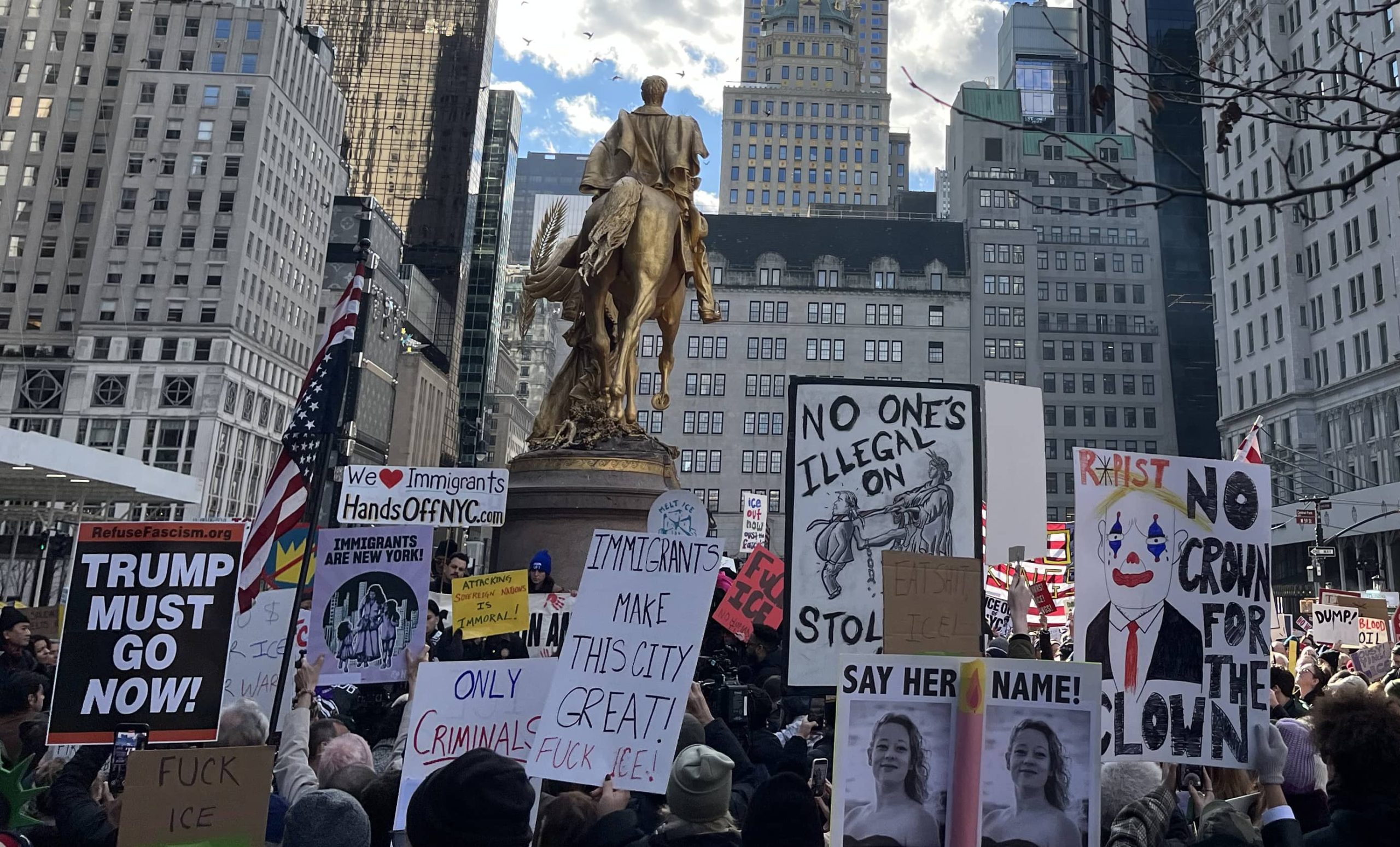
Yesterday, New York City joined protests around the country, standing with striking Minnesotans who have risen in the cold as a powerful anti-ICE voice. They represent a people’s resistance against the always escalating, harmful, militarized tactics of Homeland Security. The entire nation watched a federal agent shoot and kill Renee Gooda poet, mother, and citizen who refused to ignore the inhumane federal deportation operations in her Minneapolis neighborhood.  The president, and others in the administration and blamestream media, peddled the lie that Good was a domestic terrorist who was the cause of her own death. The person who clearly killed Renee Good was not a newly hired agent who lacked training: Jonathan Ross served more than 10 years in ICE’s elite Special Response Team.

While many agree that ICE (established less than 25 years ago) should be abolished, most Democrat leaders appear to be following the guidance of a “Don’t Say Abolish ICE” memo. Written by a former Customs and Border Protection official who is now a corporate consultant for the defense and surveillance sector, the memo advises reforming and retraining ICE. Fortunately, our new Mayor, Zohran Mamdani, remains strong in his stance. He stated on ABC’s, The View, “I am in support of abolishing ICE…We’re seeing a government agency that is supposed to be enforcing some kind of immigration law, but instead what it’s doing is terrorizing people”. 

Today’s newsletter reports on NYC’s now ex-mayor’s veto, just as he left office, of City Council legislation promoting immigrant and economic justice. We then offer an update on battles over Temporary Protective Status (TPS), including the good news of a recent court decision that reverses the Trump regime’s cancellation of protections for Nepali TPS holders. 

Newsletter highlights:
  1. Eric Adams vetoes immigrant justice in cruel exit act
  2. Temporary Protective Status (TPS) under attack: Update


1. Eric Adams’ Last Betrayal

“It is unsurprising that this mayor is ending his term by demonstrating, once again, that protecting and supporting working-class New Yorkers is not his priority. His vetoes put special interests above greater affordability and opportunity for hardworking New Yorkers, and public safety.” — Outgoing City Council Speaker Adrienne Adams

On his last day in office, Eric Adams—a mayor we have long criticized for scapegoating immigrants—vetoed three key pro-immigrant legislative packages that had been passed by large majorities in the City Council. The bills were among a total of 19 measures Adams vetoed, as a final New Year’s Eve “drop dead” to the lawmakers and the people of New York.

One of the vetoed packages aims to regulate and reform street vending. Among its provisions is the long-delayed raising of the cap on the number of vending licenses. Local Councilmember Shekar Krishnan had praised passage of the package as “a historic day for workers.” The legislation became urgent after Mayor Adams, who had promised to raise the cap and dial down punitive enforcement against vendors, made a quick 180-degree turn, joining with right-wing forces in a campaign to uproot and intimidate vendors in Corona Plaza, Roosevelt Avenue, and other parts of the city.

Another veto casualty was Tiffany Cabán’s Safer Sanctuary Act. This would outlaw the establishment of ICE offices on Rikers Island, something that has been contentious throughout Adams’ tenure. That act would also close a loophole in the city’s sanctuary laws, making it clear that the restrictions they place on cooperation with federal authorities would apply to all immigration enforcement agencies, not just ICE.

Adams’ third anti-immigrant veto gave a thumbs down to badly-needed legislation defending deliveristas from a wave of arbitrary “deactivations”—firings—initiated by delivery app companies. The Council measure requires that delivery workers be given a reason for deactivation, the right to appeal, and a 120-day notice before permanent deactivation.

According to city law, once the vetoes were formally registered, which happened on January 7, the Council has 30 days to override them, a process which requires a 2/3rds majority vote. The clock is ticking, with many other priorities competing for legislators’ attention in the new year.

New Council Speaker Julie Menin can strongly influence the fate of the vetoed bills, since she largely controls legislative scheduling and agendas. In practice, she seems unlikely to run out the clock on these three measures, which were all passed with “veto-proof “ majorities. For instance, the measure lifting the vendor license cap was passed by a margin of 39-9, as was the Safer Sanctuary Act. The bill defending deliveristas passed 40-8. Menin is a supporter of sanctuary laws, and was actually a co-sponsor of the street vendor bill.

However, Menin has refused to commit to overriding all of Mayor Adams’ vetoes, saying only that “the Council will consider next steps on these bills.”

NYC lawmakers have been given further impetus to act by ICE’s arrest of one of their own staffers, Venezuelan immigrant Andres Rubio Bohorquez, at a routine asylum interview. Menin and many other Council members have expressed concern and anger at ICE over the data analyst’s detention. This attack on one of their own employees is likely to concentrate the Council’s attention, bringing home how much is at stake for immigrants in their deliberations.

WHAT CAN WE DO?


2. The Ongoing Weaponization Of TPS

“The harm already caused by the administration’s cruel, lawless actions cannot be undone, but we are hopeful that, with this ruling, the new year will bring a measure of justice and peace to the TPS holder community.” Jessica Bansal, attorney at the National Day Laborer Organizing Network (NDLON)

The new year started positively for Adhikaar, the Queens-based group that serves and supports the Nepali-speaking community in NYC. They shared welcome news that a Northern California District Court judge ruled that the Trump administration had illegally ended TPS for Honduras, Nepal, and Nicaragua. Adhikaar applauded the work of the National Day Laborer Organizing Network (NDLON) and other members of the National TPS Alliance who argued the legal case, which affects around 60,000 people nationwide, including thousands of Queens residents.

Ama Frimpong, the Legal Director of CASA, stated that the ruling clearly showed TPS cannot be terminated based on racialized political narratives. Frimpong continued, “This decision is not only a victory for TPS holders from Honduras, Nicaragua, and Nepal, but an encouraging signal for TPS holders from Venezuela, Cameroon, Afghanistan, and beyond who are fighting to protect their families and their futures.” 

Two days later, after US forces captured and removed the president of Venezuela, Homeland Security Secretary Kristy Noem announced that Venezuelans in the US under TPS had the opportunity to apply for refugee status. There was no hint as to how more than 600,000 people could do that when the US government has limited the total number of refugees per year to just 7,500. A few hours after her announcement, the Homeland Security eX-twitter account denied that Noem had ever said that, and instead reaffirmed that she had ended TPS for more than 500,000 people. The post suggested that, “now they can go home to a country that they love.” Even those Venezuelans who are happy about Maduro’s removal say returning is an extreme risk.

Minnesota has the largest Somali population in the US. Just days after a weekend of national protest in the wake of the ICE murder of Renee Nicole Good in Minneapolis, and Homeland Security’s brutal tactics in the Twin Cities, Trump announced the termination of TPS for Somalis. Ignoring the economic destabilization it will bring, he declared legal protections for Somali nationals enrolled in the TPS program will be ended in two months, on March 17. He claimed that country conditions had improved, an opinion easily contradicted by the work of Freedom House, which has monitored the state of global freedom for 85 years: currently, they give Somalia a Global Freedom Score of 8 out of 100; the US score is 84

The day after Trump’s Somalia announcement, the US Ninth Circuit Court of Appeals heard oral arguments for the second of the National TPS Alliance lawsuits, defending Haitians and Venezuelans. A Federal Judge has indicated she will not rule on the Haitian TPS case until February 6, which is just one day before that protection is set to expire. Just as the year began, and our article started with hope from NDLON, so these recent fraught weeks have ended with Ahilan Arulanantham, the Co-Director of UCLA’s Center for Immigration Law & Policy (CILP) stating, “We hope the court will insist the administration comply with the law as Congress intended it to by engaging in an objective assessment of the country conditions in Venezuela.” 

We wonder, is “hope” really enough?

WHAT CAN WE DO?

In solidarity and with collective care,

Jackson Heights Immigrant Solidarity Network (JHISN)


Follow @JHSolidarity on Facebook and Twitter and share this newsletter with friends, families, neighbors, networks, and colleagues so they can subscribe and receive news from JHISN. 


JHISN Newsletter 12/20/2025

Dear friends,

Warmest greetings to our readers as the winter solstice arrives, giving us the dark gift of the longest night of the year. Together with many non-Western and indigenous cultures, we remember that the dark is a place of rest and dream, of healing and the first life of buried seed. May you be well, this winter season.

December confronts us with the growing presence of ICE in our neighborhoods. Our newsletter this month is devoted to citywide and community-based organizing to defend against the federal government’s paramilitary deportation operations. And we report on the first, though likely not the last, breach of masked federal agents with assault weapons on our streets in Jackson Heights on December 4. “We keep us safe,” says Black Lives Matter. May we keep safe together.  

Newsletter Highlights:
  1. Reportback on Hands Off NYC trainings
  2. ICE and federal agents’ operations in Jackson Heights


1. Hands Off NYC Bolsters Neighborhood ICE Watch

“Protests are great, but they are not enough. We need sustained neighborhood responses.”—Hands Off NYC trainer

On a recent Saturday afternoon, around 500 people rode an escalator past a wall inscribed with these incomplete words of MLK Jr., “FREEDOM IS NEVER VOLUNTARILY GIVEN BY THE OPPRESSOR”. The sentence continued, in his 1963 Letter from a Birmingham Jail, “it must be demanded by the oppressed.” Four hours later, the crowd left energized and educated by the articulate women-led activism trainers of Hands Off NYC, a coordinated initiative supported by over 100 community groups, union and worker organizations, and immigrant, human rights groups, and faith-based groups. They shared tactics and guidance for everyone to take action in their New York City neighborhoods to oppose the injustices that grow more egregious every day, including collective defense against the mass deportation campaign led by ICE. They talked about the Authoritarian Playbook of 2025, described “The People’s Response” as a culture of defiance, and concluded with a Know Your Rights (KYR) overview described as a way for us all to embody democracy. The day ended in smaller breakout groups for people who live in shared neighborhoods to meet together and plan next steps.

The training was geared particularly at people new to activism and immigrant justice struggles, and did not highlight the local organizing going on for decades by immigrant-led groups. Attendees were disproportionately retirees, women, and predominantly white. In one breakout room, just one man sat among 25 women; all of them willing to take to the streets to support the freedoms supposedly guaranteed to immigrant neighbors being snatched from local courthouses, streets, and homes, and now from interstate flights by the TSA, or threatened in hospitals, schools, and churches by masked and militarized government enforcers working for, or with, ICE. 

As the training began, the presenter noted an ICE raid was reportedly underway. The key to successfully opposing these federal incursions, she said, is to preempt, to prepare, and to stand up. Local action cannot come from the large groups like Hands Off NYC. Instead, local people must build within our own neighborhood communities for mass action and rapid response. We must create spaces where we protect one another. For this, effective communication will be vital. A retired woman in the crowd shared that she holds vigil with a silent protest outside her local subway stop—she stands holding posters of people ICE has kidnapped. The people walking by have been taking notice—slowing down and looking. A crucial first step is getting people to pay attention.

Another presenter stressed that a pillar of organizing is to do the work in places where you have influence. That is your power. That is how you reach people and make change. Yes, it was invigorating to see that the Hands Off NYC protests grew from 75,000 attendees to 125,000, and then to 300,000. The crowds reveal growing opposition to MAGA oppression; however, it is you, not that massive crowd, who can teach the people close to you about what we can do to prepare before ICE escalations occur. She suggests you take signs for businesses to hang up that clearly state which spaces are designated as private; that sign quickly shows federal enforcers where they cannot go without a warrant. You can choose the people you can influence. Talking to neighbors builds a Culture of Defiance, as shown when a group recently challenged the callous actions of ICE agents in Staten Island

One critical concept is the importance of bogging ICE down. Non-cooperation means you make things harder for the enforcers who rely on people abdicating their rights when faced with domineering actions. This also works for corporate accountability protests, such as the ice scraper slowdown at an LA Home Depot and, this past weekend, in NYC

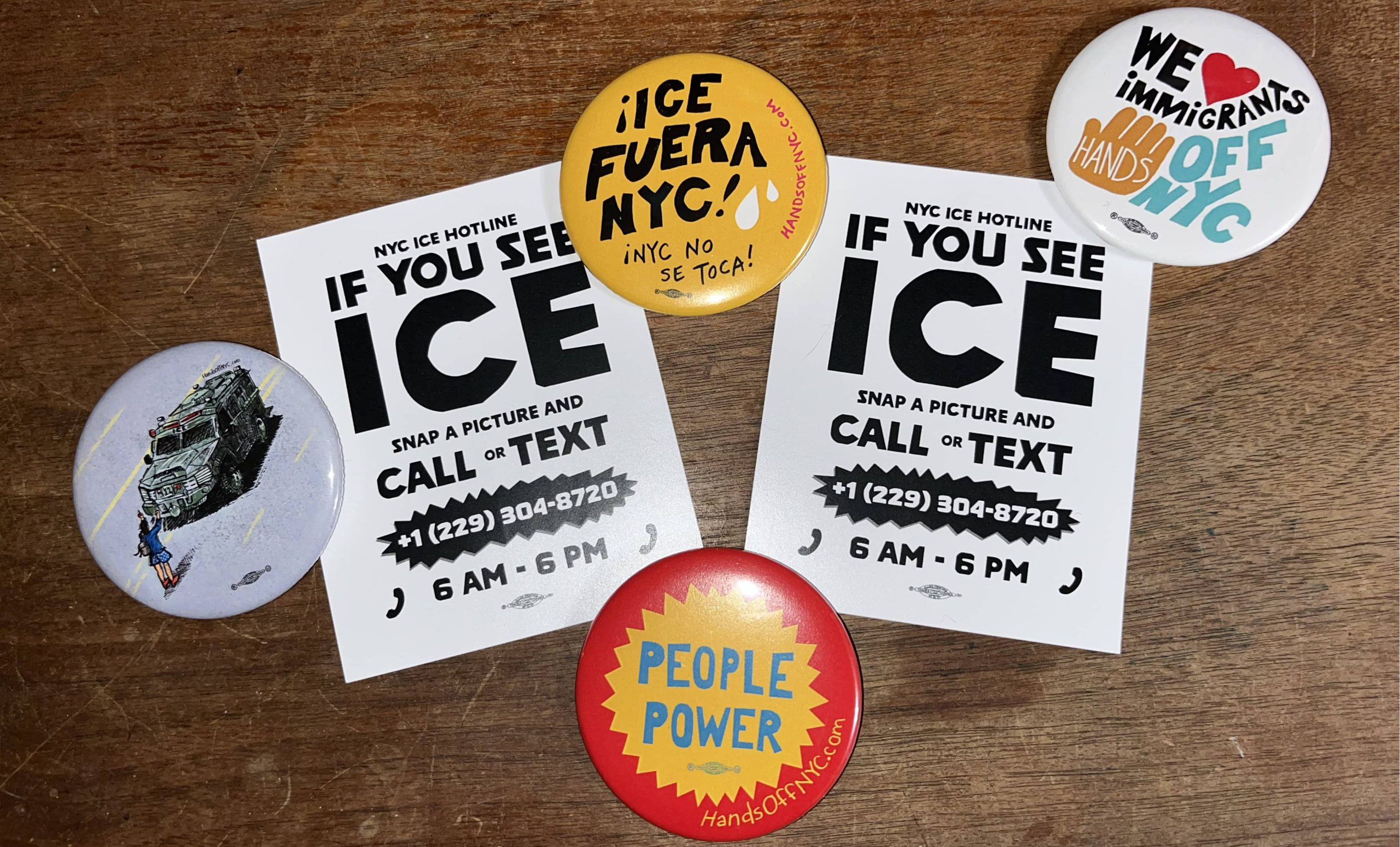
Use your whistles to attract a crowd at the scene to reveal the problem. If it is between 6 am and 6 pm, then call the dispatch hotline 1-229-304-8720 to report the ICE activity. When others gather around, use chants like “Shame, Shame, Shame” or “Let Them Go! Let Them Go!”, shouted at the abductors. That has been a powerful way to reduce the aggression of the federal agents. It breaks their expectation that people will be docile out of fear. As a result, ICE has sometimes given up and left.

The trainers advised us, while documenting a raid, to film what is going on, focus on the facts, not emotions. Record, narrate, and describe the agents (not the abductee), including their clothing, their vehicles, their weapons. Use the SALUTE method to report what you have seen to local ICEWatch groups that you have found and joined. If the agents confront you with any questions, it is helpful to model the KYR response that you do not need to answer their questions. Importantly, they say, do not call the police: adding more armed enforcers to a group of armed enforcers is an escalation, not a slowdown. 

It is important to note that Federal agents are not immune from state prosecution. When appropriate, activists can upload videos and photos of the abductions, along with a SALUTE summary, to the NY State Attorney General’s Federal Action Reporting Form. You do not need to provide your own contact information.

Last weekend, in Queens, another well-attended borough-based training was held. The turnout allowed people to start discussing actions they can take in their designated neighborhood groups: Astoria; Woodside with Jackson Heights; Long Island City with Sunnyside; Forest Hills with Rego Park; Corona, Elmhurst, and East Elmhurst with Oakland Gardens; and another group for those from over 20 more Queens neighborhoods. On the following day in Jackson Heights, for two hours, ten people came together for the first time to create whistle packages for distribution to businesses and individuals. Local action is growing.

Serious challenges, of course, remain. It is immigrants themselves who must lead NYC’s battle with ICE. As the Hands Off NYC coalition itself insists, it is up to local communities to build networks and organize the fightback. A decisive role in our area will likely be played by the deeply rooted local immigrant justice organizations, who may have their own analyses of the situation, and their own tactics.

Yet Hands Off NYC has, in a way, “broken the ice,”  unleashing the energy of, and offering resources to, thousands of New Yorkers who are eager to oppose ICE. They have also given activists in various neighborhoods a framework for meeting and figuring out the way forward together.

To close, we offer a humble extension to the MLK Jr. quote that opened this article:

Freedom is never voluntarily given by the oppressor; It must be demanded by the oppressed; who must be defended by the people.

WHAT CAN WE DO?

2. Neighborhood ICE Raids: Update

“This is the first time we’ve seen something like this in Jackson Heights, on this level.” –neighbor, quoted in Queens Daily Eagle (12/4/25)

The news travelled fast and many of our readers may have heard: In the early morning of Thursday, December 4, dozens of federal agents armed with assault weapons arrived in unmarked vehicles and a helicopter to conduct a raid on a residential building near 34th Ave and 88th St. Many of the agents wore black masks and HSI uniforms (Homeland Security Investigations, an investigative arm of ICE). A video of the raid, circulated by State Senator Jessica Ramos, shows a militarized swarm of agents with rifles in our streets. Two residents of the building were taken away in handcuffs, while neighbors also swarmed the pre-dawn scene to verbally confront the armed agents.

The names of the people taken, where they are now, the target and rationale for the militarized spectacle of arrest remain unknown. But we do know this: one Jackson Heights resident reported “incredible pride at how many people showed up at six in the morning and just yelled in the faces of ICE agents on the street.”

In the hour before the December 4 raid, the masked federal agents blocked local traffic and set up a checkpoint for cars at a residential intersection. “Taken together, these raids and roadblocks build a steady drumbeat of fear and spectacle, even when there are no cameras around,” notes Epicenter news. The Jackson Heights operation, they explain, fits a broader pattern where we see ICE increasingly conduct “semi-covert” and quick “surgical actions” across the NYC boroughs, rather than the more publicized, dramatic raids we have seen documented on social media nationwide. “The effect is the same, if not greateran atmosphere of constant fear and uncertainty for immigrants who live, work, congregate and raise families on these blocks.” 

As JHISN reports in our article above, people are getting angry and getting organized as a stunningly reckless, sadistic, and lawless mass deportation campaign ramps up and gets all too real. But we also join with longstanding immigrant justice groups, embedded in local immigrant communities, to caution against a singular focus on the threat and terror of visible ICE raids. We are reminded that solidarity includes honoring the existing immigrant networks of collective defense and community knowledge—invisible to those of us outside the networks—that have been doing the work behind the scenes to educate, communicate, defend, and support. We are asked to consider extending our commitments beyond whistles and rushing to the latest ICE sighting, to also include:  

  • Fundraising and donations: Organize aware friends and family into a rotating monthly donation pool. Fundraise in your pool for immigrant-led local groups who are doing direct mutual aid and support with impacted families around legal fees, rent, or lost income due to detentions.
  • Legal support: Attend legal webinars and monitor the constantly changing legal landscape for people who are detained. By supporting families or individuals through ongoing legal cases, we can learn hands-on what is needed and what is possible. 
  • Relations with activists living near detention centers: Reach out to and support the work of activists and allies who are geographically close to immigrant detention centers in New York and New Jersey or elsewhere. What actions can facilitate support for people being released from detention, or families trying to visit loved ones who are detained?  

As one respected Queens-based immigrant justice group notes: “The deportation machine is big and has many parts, we must match it with our skillsets and numbers.”

In just this past week, there have been reports of ICE using the vacant Rite Aid parking lot on Northern Blvd for a staging ground, and multiple ICE sightings in East Jackson Heights and Corona, with one arrest near the corner of Junction and Roosevelt. As responding to local threats becomes more urgent, let’s keep sharing what works. Let’s reflect on what we are best positioned to do. Let’s remember that all of this is also emotion work that needs to be grounded and sustained. And let’s collectively attend to how power is distributed within our cultures of defiance and our communities of care. 

WHAT CAN WE DO?


In solidarity and with collective care,

Jackson Heights Immigrant Solidarity Network (JHISN)


Follow @JHSolidarity on Facebook and Twitter and share this newsletter with friends, families, neighbors, networks, and colleagues so they can subscribe and receive news from JHISN. 


JHISN Newsletter 11/22/2025

Dear friends, 

It is now a fact. Zohran Mamdani won the NYC mayoral election—by an enthusiastic margin. He will be sworn in on January 1, 2026, as the immigrant mayor of this city built on immigrant labor, dreams, and community. Our own Jackson Heights-based DRUM (Desis Rising Up & Moving) sibling organization, DRUM Beats, mobilized its South Asian and Indo-Caribbean membership to play a major role in Mamdani’s successful campaign. 

Given the threats this week from Thomas Homan, Trump’s so-called ’border czar,’ the most important part of today’s newsletter may be our WHAT CAN WE DO? section at the very end. We report first on ICE’s recent escalation of attacks here in Queens, and next, on your responses to our reader survey on how to prepare for ICE invasions in our own neighborhood. We conclude with actions you can take, and trainings and groups you can join, to collectively defend our communities. Please join us in learning what solidarity will look like in our immigrant-led New York City. 

Newsletter highlights:
  1. Our neighborhood faces escalating ICE raids
  2. Reportback on JHISN reader survey: Actions and suggestions to confront ICE


1. ICE Is Here–How Do We Respond?

It seemed inevitable. After a months-long brutal mass deportation campaign at the Federal Plaza courthouses in Manhattan, ICE has now started ramping up street raids in Queens, knowing that almost half of us (over one million residents) were born outside the US. 

In the first week of November, 97th Street and 41st Avenue in Corona became the main focus of a major ICE dragnet, resulting in the confirmed abductions of 12 neighbors. Other parts of Corona were also hit. As reported by Queens Neighborhoods United (QNU), these were not targeted arrests of individuals using judicial warrants. Instead, Latinos walking down the street, sitting in their cars, or riding bikes were racially profiled and arrested by swarms of agents. ICE used deception tactics—for instance, rotating out agents who might be recognized, or pretending to be done for the day, then suddenly returning to trap more residents. 

We note that ICE has been active in our community for some time. According to one well-informed activist, an average of two people a day were already being detained in the Jackson Heights, Corona, and Elmhurst area prior to the 97th St. raids. ICE has recently been sighted, banging on doors on 79th Street near Roosevelt Avenue at 5:00 AM, presumably trying to serve a warrant. However, QNU says, “ICE is escalating. They are using more elaborate ruses and traps. We must respond.”

Parts of the Corona assault were recorded on video, and some local residents tried to warn pedestrians using whistles. These efforts need to grow into a mass response by our whole community. We need well-organized ICE Watch and rapid response teams to monitor federal agents and keep our neighborhoods informed. We need a widespread whistle campaign so that every resident can take part in sounding an alert when ICE appears. We need enough people in the street to make it hard to trap anybody. 

This counter-escalation has started to emerge. We encourage our readers to be active according to your capabilities. Please see our What Can We Do? section at the end of our next article.


2. JHISN Reader Survey: Take Local Action Against ICE’s Illegal Activity

[T]hey were here and they were everywhere. Smash and grab jobs happening across the city nearly simultaneously. But the things being stolen aren’t jewels, they’re lives. Off streets, from yards. One roofer plucked off a ladder. A landscaper thrown to the ground, tackled by a half-dozen men in camo with weapons …. What I need you to understand is that nobody is letting them go quietly. The Feds’ every movement is announced by a chorus of whistles, by a parade of cars honking in their wake, neighbors rushing outside to yell to film to witness these kidnappings that are unfolding in front of us. Neighbors running towards trouble.” Dan Sinker, “What I Need You to Understand, Notes from Chicago in Late October”

In our last two newsletters, JHISN invited feedback from our readers through our NYC Prepares for ICE Invasion survey—we thank all of you who participated for your thoughtful responses. While most of you said you had already participated in actions to show opposition to the outrageous abductions by ICE agents, more than a third of you indicated that you are ready to take action for the first time. We applaud you and will continue to use the newsletter, as best we can, to encourage more people to take even more steps. We suggest that readers review the reports on grassroots resistance coming out of Chicago by Dan Sinker and Kyle Kingsbury, a.k.a “Aphyr”—they show what NYC could become when we face ICE attacks like those in Chicago. 

Our survey also asked about the challenges facing our readers and suggestions for what can be done next. Overwhelmingly, our respondents shared that their biggest challenge is not being aware of actions they can take, even as several readers reported on actions they have already done: 

  • Distribute Know Your Rights (KYR) information to businesses and people
  • Make phone calls and complete petitions to politicians 
  • Accompany immigrants to court appointments or participate in court watching
  • Donate to immigrant support organizations

The main challenges our readers reported were a fear of physical risks and that work hours and mobility issues associated with age prevent participation in actions. One person responded simply: “Fear”.

But for every challenge identified, survey respondents also offered two suggestions for future actions. Unawareness can be fixed through greater information sharing. One person suggested that we learn from other groups, such as DIRE (Deportation and Immigration Response Equipo) in New Jersey. Another suggested “Distribute whistles and publicize when/how to use them for rapid response. Like in Los Angeles and in Chicago, there has been a grassroots effort to distribute orange whistles that people can blow if they see ICE.” Another said, “Have a chat group | Patrol the neighborhood | Make noise to alert our neighbors.” 

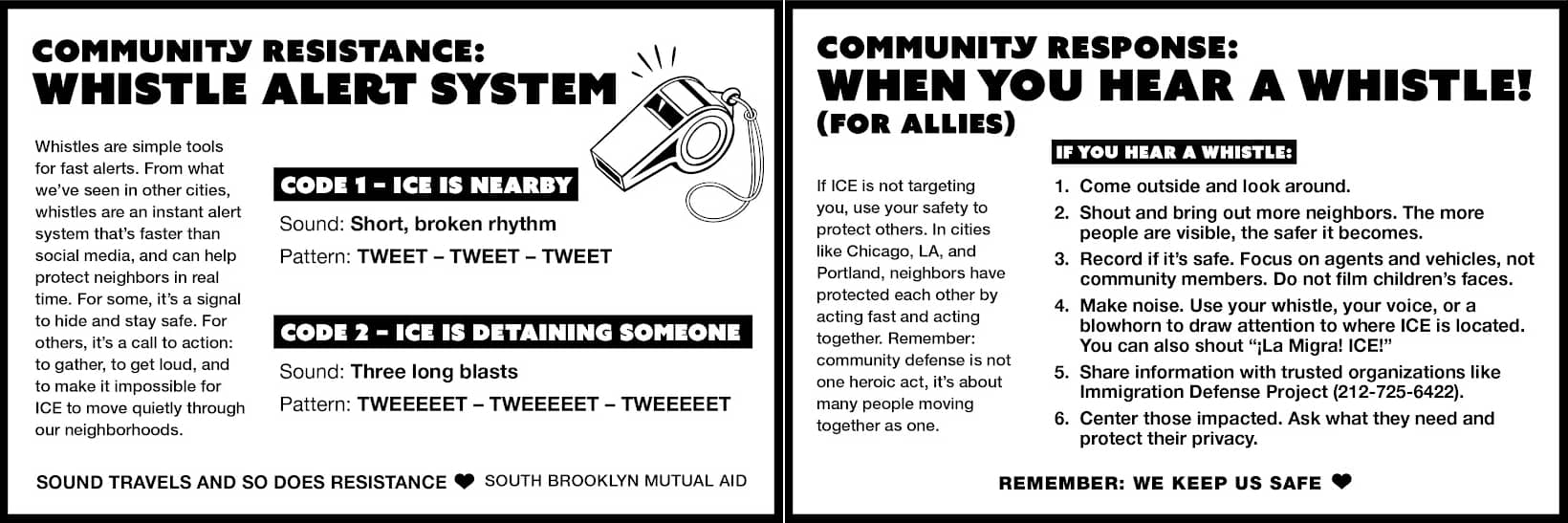
JHISN has now posted instructions about whistle use as Community Resistance Tools on our blog, borrowing flyer information from South Brooklyn Mutual Aid. If you have been at the Jackson Heights Greenmarket on 34th Ave., between 79th & 80th, you may have seen activists distributing whistles and instructions to our community. Whistles played a role in the recent day-long ICE raid in Corona, and Hands Off NYC has now distributed well over 10,000 whistles throughout the city. Last weekend, JH Indivisible joined with 10 people from the neighborhood (including JHISN members) to distribute ICE Packs to business owners, including a whistle, instructions in English and Spanish for how to use the whistle, and red cards with KYR information. 

Some of our active readers have connected with local ICE Watch groups. Most of these local groups create their own direct messaging communication methods to the immigrant population they serve; only trusted sources, who have been able to verify that ICE action is underway, post to the ICE Watch lists. So, although the federal government demanded Apple and Google remove the ICEBlock app from their app stores, which they did, most local ICE Watch groups were not significant users of that app. 

One of our respondents made a straightforward comment: “I think we all have to help each other out in whatever ways we can.” Some of us can march in weekend events. Some of us can donate money to support immigrant-led groups or the many GoFundMe pages of families seeking support to fight their deportation case (please support the pages of those you know to be local to Jackson Heights).  Some of us can wear a polka dot dress and block an ICE Humvee to slow its progress. Some of us can take successful legal action against discriminatory practices that intimidate immigrants with the threat of deportation. Some of us can tell NYC assembly members to get ICE OUT! Some of us can get ICE barred from operating in Rikers

One of us cannot do everything, but many of us, doing what we can in different ways, can make the difference between quiet surrender or effective solidarity.

WHAT CAN WE DO? 
  • Get trained by Hands Off NYC, a coalition of over 50 action-taking groups, to learn Know Your Rights, ICE Watch, and organizing and mobilization strategies. Sign up for their Queens training on Saturday. Dec. 13, 12 – 4 pm.
  • Attend one of the New York Immigration Coalition’s many Neighborhood Defense Training webinars.
  • Attend the monthly Zoom meeting of Jackson Heights Indivisible and get involved with their local actions. 
  • Join the Visibility Brigade (also known as the Rush Hour Resistance) every Wednesday evening from 6 – 7 pm in Jackson Heights.
  • Notify activists if you see ICE: 
  • NYC ICE Watch – DM via Instagram @nycicewatch – use the SALUTE page to quickly format your post
  • Call the Immigrant Defense Project’s NY/NJ ​Rapid Response Network Emergency ICE Raid hotline at 1-800-308-0878, or in New York City,​ call 1-212-725-6422.
  • Prepare yourself, your neighbors, and others by being familiar with Make The Road New York’s Deportation Defense Manualespecially read Part Two: Rapid Response to Raids; appendix D; and appendix F. (Note this is from July 2022, and many things have changed since then).

In solidarity and with collective care,

Jackson Heights Immigrant Solidarity Network (JHISN)


Follow @JHSolidarity on Facebook and Twitter and share this newsletter with friends, families, neighbors, networks, and colleagues so they can subscribe and receive news from JHISN. 


JHISN Newsletter 07/26/2025

Dear friends,

Like many of you, we find ourselves at risk of being overwhelmed every week, sometimes daily, by immigration news. Much of it bad and some of it almost unbelievable. We continue to publish our monthly newsletter with a local focus whenever we can—looking at both the forces aligning against immigrant lives, and those allied with solidarity, resistance, and community-based care. None of it makes any sense without you, our readers, taking this news and acting when and where you can, for immigrant justice and power. Thank you for continuing to read the newsletter—and for using it as a tool in our common struggle.

Today’s issue takes on systematic wage theft—disproportionately experienced by immigrant workers—while highlighting how common it is in our own neighborhood. The newsletter also returns to the urgent issue of the Trump regime’s attempts to cancel Temporary Protective Status (TPS) for hundreds of thousands of legal immigrant US residents, including many in the Nepali community here in Queens.  

Newsletter highlights:
  1. Wage theft is all around us
  2. Temporary Protective Status (TPS) under assault: an update


1. Wage Theft is All Around Us

Wage theft is rampant in industries that employ large numbers of immigrant workers. These include agriculture, building maintenance, garment assembly, hotel, restaurant and food service, construction, nursing homes, nail salons, warehouses and car washes. Inequality.org states the obvious: “Undocumented workers are particularly vulnerable to wage theft as they are often the least likely to report violations due to fear of retaliation, job loss, or exposure of their immigration status.” This has become an even more pressing consideration as the terror of the Trump regime’s mass deportation accelerates.

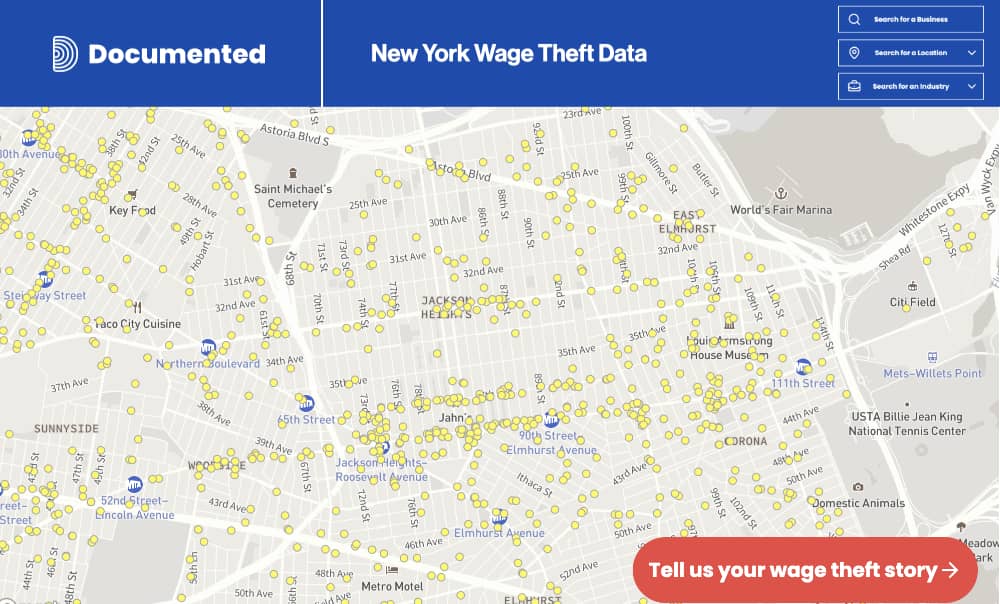
The Center for Popular Democracy reports that “An estimated 2.1 million New Yorkers are victims of wage theft annually, cheated out of a cumulative $3.2 billion in wages and benefits.” Wage theft among New York City’s 300,000 low-wage workers is reported to be roughly $18.4 million per week. The widespread nature of wage theft in the state and city can be visualized by clicking on Documented’s Wage Theft Monitor. The Monitor is based on state and federal data acquired through Freedom of Information requests. It records thousands of final wage theft settlements—large and small, in every neighborhood—including hundreds of findings against businesses in our area. 

Examples of wage theft in Queens alone seem endless:

  • In 2020, Desis Rising Up and Moving (DRUM) organized a large protest outside Sona Chaandi, one of the largest jewelry stores on 74th Street. Demonstrators accused the owners of sexual harassment, as well as wage theft. Nargis, an immigrant DRUM member and former employee, told the rally that she was harassed, paid $50 to $75 for 10 hour days, and forced to take care of the owner’s elderly parent without pay. The Documented Wage Theft Monitor shows that Sona Chaandi was eventually ordered to pay $65,000 to two unnamed workers.
  • Some local eating and drinking establishments with immigrant work forces have faced large wage theft settlements. El Picosito Bar on Roosevelt was ordered to pay $237,621 to 10 workers a few years back. La Boina Roja Steakhouse was recently ordered by the state to pay $221,130 to 11 workers, according to the Wage Theft Monitor. National chain restaurants are also implicated. For instance, Chipotle on Northern Boulevard was ordered to reimburse 85 workers in a wage theft case filed in 2023.
  • In 2022, Attorney General Letitia James announced a settlement of more than $90,000 in favor of several Astoria laundry workers. The Laundry Workers Center, which primarily represents immigrant women of color, did the initial investigation on the case and pushed it to the AG’s office.
  • That same year, James also won a $130,000 settlement for two building superintendents in Flushing who were paid no wages at all—the owners had decided that a rent-free apartment would serve as their only compensation.
  • Last year, Make the Road New York was instrumental in publicizing and filing a disturbing wage theft complaint by Ecuadorian migrants at a tobacco packaging factory in Queens. Workers assert that they were paid about $4 an hour, working in sweatshop conditions 10-13 hours a day, seven days a week.
  • This summer, Assemblymember Shekar Krishnan took the lead in trying to terminate lucrative city contracts handed out to Griffin’s Landscaping, a firm accused of repeated wage theft and other illegal behavior.

Unfortunately, many ripped-off immigrant workers never get a legal settlement, or any kind of justice. Even those bold enough to file complaints with state or federal authorities face an uphill struggle. They may win their cases, which often take years, and yet the employer stalls, refuses to pay the judgement, hides, or declares bankruptcy.

“Hildalyn Colón Hernández, deputy director of New Immigrant Community Empowerment, a New York-based worker advocacy organization, said, ‘Employers are operating with no consequences’….Colón Hernández added that her organization now trains its employees on how to investigate wage theft because it would take too long if they had to rely on federal or state investigators to recover back wages.”  —ProPublica, 8/22/23

WHAT CAN WE DO?

2. The Impact of TPS Changes for NY

“The law is very clear that once the TPS extension has been granted, it cannot be taken away en masse. This is the first time in the 35-year history of the TPS statute that anyone’s ever tried to do that.” Ahilan Arulanantham, co-director, Center for Immigration Law and Policy, UCLA School of Law

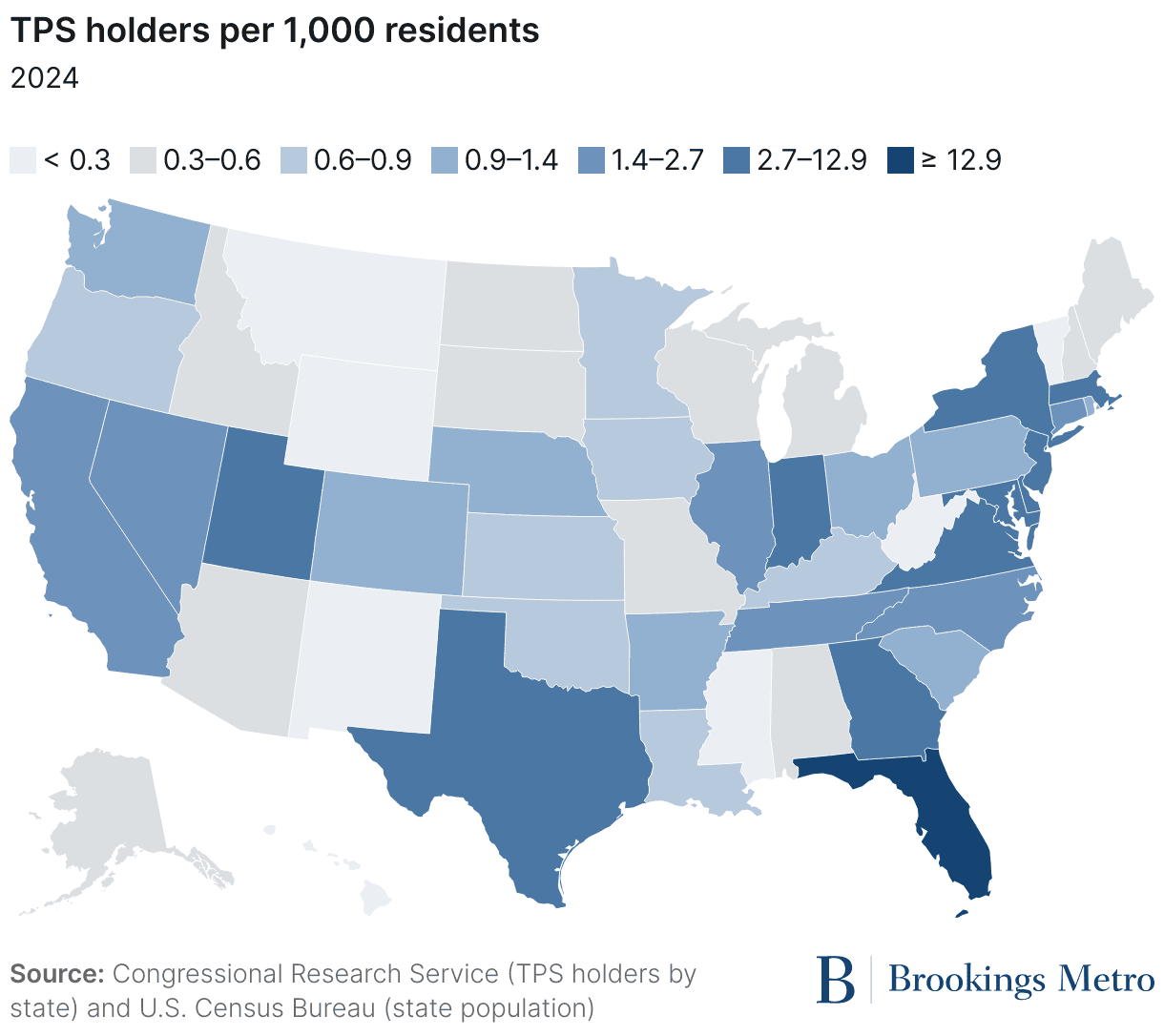
The Brookings Institute warned that Trump’s campaign promises targeting immigrants “would have disproportionate impacts on U.S. cities and urban areas, given that most foreign-born individuals live and work in these places.” Among US counties with undocumented populations, Queens is ranked the sixth-largest and has over three TPS holders per 1,000 people. (With a population of about 2,250,000, that amounts to over 6,750 TPS holders.) The Trump regime, led by Stephen Miller’s hard-line propaganda, aims to abruptly end TPS status for hundreds of thousands of US residents, which disproportionately threatens people living here in Queens and NYC.  

About 40% of the migrants who arrived in NY in 2022-23 came from Venezuela under TPS protections. New York City has the second-largest TPS-eligible Haitian population in the nation, which comprises about 3% of the city’s population. Among other TPS recipients, New York City also has the largest Honduran population and, residing in both Woodside and Jackson Heights is the second-largest Nepali migrant population in the country. Around Flushing and Kew Gardens, there is a large population of Afghan immigrants in Queens. 

These groups combined comprise 87,000 TPS holders in New York state who are specifically under threat from the questionable legal actions spearheaded by the Trump administration to strip their legal authorization to remain and work in the US, making them all detainable and deportable. The inappropriately named One Big Beautiful Bill, which barely received enough votes to become law, supplements these attacks by requiring higher fees for individuals to submit forms necessary to file in court to fight against potential deportation. The Showcase of Nepalis in New York (NepYork) published the full details of these cost increases. NepYork also reported on a recent NJ event organized to discuss increased deportation threats and the imminent termination of TPS for Nepalese immigrants. 

“TPS is ending on August 5 [for Nepal], and thousands of lives are hanging by a thread. We organized this not just because the law is changing, but because our families are suffering silently. Many don’t know their rights. Many are scared. We have organized this event to help them find a way and let them know they are not alone.” Dr. Bishnu Maya Pariyar, Program Director at Hudson S.P.E.A.K.S.

Pushback against TPS terminations includes Maryland Senator Chris Van Hollen’s SECURE Act, introduced last month along with 30 other senators. The bill would secure a pathway to permanent residency and is supported by numerous unions, CASA, the National TPS Alliance, and the National Network for Arab American Communities. Additionally, in February, the Dream and Promise Act was resubmitted—a bipartisan bill supported by nearly 200 representatives that would protect DACA recipients as well as TPS holders.  

On Monday, July 28, Queens Borough President Donovan Richards will hold a rally at 6:00 PM at Queens Borough Hall to support community members who are deeply affected by the terminations of Temporary Protected Status. Haitian-American City Councilmember Farah Louis has also spoken out against the efforts to end TPS. She notes that people fled their dangerous home countries, came here for a better life, they work for local businesses, and invest in the economy here—and now all that is about to be snatched away. Brad Lander, the NYC Comptroller, has published Protecting Our Neighbors, describing the humanitarian costs of cancelling TPS. His report also highlights the defunding by the Trump and Adams administrations of vital legal services used to protect over 1,800 children whose lives will be disrupted by this change.

Hundreds of thousands of TPS recipients, along with family members and supporters, await the outcome of the numerous challenges made in court by the National TPS Alliance, CASA, Haitian Americans United Inc., and the Haitian Evangelical Clergy Association as the clock ticks down towards deadlines that threaten to end their legal status. 

Country Designation Date Most Recent Action Expiration Date # Individuals
Afghanistan* May 20, 2022 Termination (5/13/25) July 14, 2025 11,700
Cameroon* June 7, 2022 Termination (6/4/25) August 4, 2025 5,200
Haiti* Jan. 21, 2010 Termination (7/1/25) Sept. 2, 2025 348,187
Honduras* Jan. 5, 1999 Termination (7/8/25) Sept. 8, 2025 72,000
Nicaragua* Jan. 5, 1999 Termination (7/8/25) Sept. 8, 2025 4,000
Nepal* June 24, 2015 Termination (6/6/25) August 5, 2025 12,700
Venezuela* Oct. 3, 2023 (re-designation) Termination (2/5/25) Not applicable 348,202

Table compiled by bhfs 7/22/2025
* Asterisks denote ongoing litigation 

WHAT CAN WE DO?
  • Local group DRUM has been organizing for 25 years and supports the Nepali population under threat from TPS terminations. Join their 25×25 campaign and have 25 of your own contacts donate $25 to support their work.
  • The National TPS alliance includes, among others, the National Day Laborer Organizing Network (NDLON), Adhikaar and the Haitian Bridge Alliance. If you are able, consider donating to any or all of these organizations.
  • Attend the rally this Monday, July 28, at 6pm at Queens Borough Hall to demand continued TPS protections for immigrant neighbors. 


In solidarity and with collective care,

Jackson Heights Immigrant Solidarity Network (JHISN)


Follow @JHSolidarity on Facebook and Twitter and share this newsletter with friends, families, neighbors, networks, and colleagues so they can subscribe and receive news from JHISN.


JHISN Newsletter 06/28/2025

Dear friends,

The recent primary election of Zohran Mamdani as the Democratic party candidate for New York City Mayor was a defeat for the tired ideas, negativity, and Trump-lite style of divisiveness of Andrew Cuomo’s campaign. During his victory speech, Mamdani spoke of how the power of the Mayor can be used to “reject Donald Trump’s fascism, to stop masked ICE agents from deporting our neighbors and to govern our city as a model for the Democratic Party.” 

Our first article examines a possible national turning point as New Yorkers pit themselves against inhumane immigration enforcement being wielded against families and neighbors. We follow with an article about the decision to suddenly strip thousands of Nepali immigrants in Queens and beyond of their legal status in the US, and how the local group Adhikaar continues to be a strong voice against the drastic changes being made to the TPS program.

Newsletter highlights:
  1. Immigration Court Deportations Provoke Outrage 
  2. Local Nepali TPS Holders Suddenly Stripped of Legal Status   


 Copyright Stephanie Keith


1. Is NYC’s Federal Plaza struggle a turning point?

The Trump regime’s mass deportation campaign has arrived in New York City, and its spearhead is the deception and abduction of peaceful residents at the immigration courts in Federal Plaza. The Department of Homeland Security is blindsiding immigrants attending supposedly routine appointments by suddenly dismissing their cases. This unusual legal maneuver is meant to short-circuit the due process protections that immigrants normally retain as they petition for asylum or other legal status. In many cases, court dismissal exposes immigrants to “expedited removal”. The immigrants most at risk of immediate deportation are those who have been in the US for less than two years. This includes more than 900,000 people who entered the US with explicit government permission using Biden’s mobile app and appointment program, CBP One. (Trump’s DHS has twisted it into a self-deportation app called CBP Home.) 

What’s happening in the immigration courthouses in Federal Plaza is essentially an ambush. DHS picks out vulnerable immigrants, and the courts instruct them to come in for what seem like normal check-in appointments. Immigration “judges” (who are employees of the federal Department of Justice) are instructed to dismiss cases as soon as the government lawyer makes the request, without allowing the usual two-week time period for a legal response. Swarms of masked ICE agents, prepped with lists and photographs of their targets, lurk in the hallways to handcuff immigrants (including an 11th grader from Queens) and take them away to detention.

Abducted immigrants are jammed into crowded bedless holding cells, bathrooms, and offices inside the Federal Plaza buildings. They are reportedly forced to sleep on the floor or while sitting upright, denied showers, changes of clothes, medical care, communication with their families, legal representation or proper food for days before being transferred to immigration jails. Although members of congress have the legal right to inspect immigration detention facilities, ICE has denied US representatives access to the Federal Plaza holding areas, claiming they are “sensitive transit zones.”

Immigrants who are quick to overcome shock, fear, and language barriers, who are prepared in advance, or who are fortunate enough to have legal counsel with them, can sometimes avoid or delay expedited removal. They are advised by advocates to object immediately to the unexpected dismissal of their case, making it clear that they reserve the right to appeal the decision. They are counseled to say that they are afraid of returning to their country, to request asylum, and to request a fear interview. But as a fact sheet from the Asylum Seeker Advocacy Project makes clear, it can be difficult to prevent expedited removal, depending on the judge, the timing, and other circumstances, including the availability of community support.

The brutal ICE arrests of law-abiding immigrants in NYC, along with parallel workplace and street raids in Los Angeles, have set off a wave of public revulsion and militant protest. They have further exposed the dishonest premises and cruelty of mass deportation, and in particular demonstrated how broadly it affects all residents.

Most New York families include at least one immigrant. About 40% of NYC residents were born outside the US. One million New Yorkers live in a household that includes an undocumented person. To Trump and Stephen Miller, that makes the city look like a target-rich environment for mass deportation. But for millions of immigrant residents, and millions more who care about them, the spectacle of masked Homeland Security thugs tricking, arresting and brutalizing law-abiding immigrants attending scheduled check-ins is galvanizing. The current demonstrations outside immigration courthouses include many highly motivated family members, intent on protecting their loved ones. Concern over ICE arrests has radiated outward in concentric circles, drawing in friends, neighbors, teachers, activists and ultimately, even mainstream politicians like Kathy Hochul and Jerome Nadler. Ordinary NYC residents and city officials like Comptroller Brad Lander are showing up at immigration courts to accompany endangered people out of the building and pass out legal advice leaflets.

The press, including the New York Times, The City, and other outlets, has played a key role in raising awareness of ICE’s deception and abduction of immigrants at Federal Plaza. Special mention must go to Documented, a non-profit newsroom reporting “with and for immigrant communities,” which appears in English, Spanish, Chinese, and Haitian Creole. Their intensive coverage took an inside track when their reporters argued and pressured their way into the Ted Weiss Federal Building, where surprise immigration court arrests were happening. The result was vivid firsthand testimony, including a series of stunning photographs by photojournalist Stephanie Keith, often showing the actual moment of ICE arrests. One striking feature of the photographs is the manifest dignity of the abducted immigrants, some of whom stare directly at their captors with resolute anger as they realize what’s been done to them.

There is some evidence that national sentiment is shifting towards immigrants. As recently as January, a disturbing Times/Ipsos poll had found that 55% of Americans supported Trump’s call for mass deportation of every undocumented person in the US.  But two recent polls, The Economist/YouGov poll, taken June 13-16, and a June 11 Quinnipiac Poll, show that a majority of residents now oppose Trump’s handling of immigration. This is a modest but significant turnaround on what has been considered the president’s strongest issue.

In the meantime, Mahmoud Khalil and other immigrants kidnapped by ICE as retribution for their political views have been released by judges. Kilmar Abrego Garcia, still under indictment, has at least been returned to the US after he was “disappeared” into a Salvadoran gulag. Employers are pleading with the Trump regime to stop rounding up their most valuable workers, as whole towns become ghost zones. A recent series of national demonstrations, totaling roughly 4-6 million people, rebuked mass deportation and authoritarianism. And there are other signs of growing opposition to Trump’s attacks on immigrants in the interior of the country.

But it’s too soon to say what will happen. Is the political battle at Federal Plaza part of a turn towards immigrant justice? Or is it a launch pad for further authoritarian escalation?

WHAT CAN WE DO?

Image 1

Image 2

Image 3

2. TPS Abruptly Cancelled for Nepali Immigrants

April 2015—A catastrophic earthquake hits Nepal, killing over 8,000 Nepalis and damaging infrastructure throughout the country.   June 2015—The US government grants Temporary Protective Status (TPS) to 15,000 Nepali immigrants. TPS is a humanitarian program allowing people from designated nations to live and work legally in the US when returning to their home country is too dangerous due to war, natural disaster, or other extraordinary circumstances.  2018—The Trump administration attempts to terminate TPS for Nepalis but is challenged in federal court, and the Department of Homeland Security rescinds its termination efforts2020-2024—TPS is extended at regular intervals for Nepalis.  June 5, 2025—The Trump administration announces the cancellation of TPS for Nepalis.

Of the estimated 12,700 Nepalis whose legal status is now threatened by the Trump regime’s abrupt revocation of their TPS protections this month, several thousand are neighbors, workers, and community members here in Woodside and Central Queens. Adhikaar, our local women-led immigrant justice organization serving the Nepali-speaking community, played a significant role in keeping TPS in place for Nepalis in 2019 and again in 2023. Now, in June of 2025, they once again commit to that same cause: “The Trump administration has turned its back on Nepali TPS holders. But we will not back down. Adhikaar condemns this cruel decision and stands with our communityfighting for dignity, justice, and the right to stay.” Despite DHS claims to the contrary, Nepal continues to suffer aftereffects of the 2015 disaster. The country remains weakened by catastrophic flooding, fragile infrastructure, and the ongoing socio-economic costs of climate damage.

While DHS historically grants a six-month window between the announcement of a TPS revocation and the end of legal protections, the DHS announcement on June 5, 2025, gives only 60 days: by midnight on August 5, 2025, all Nepali TPS holders are required to ‘self-deport,’ in the words of DHS.  

Together with recent TPS revocations for Cameroon, Afghanistan, Haiti, and Venezuela, the termination of TPS for Nepal follows a pattern of federal actions targeting immigrants of color, especially working-class immigrants from the Global South. The Trump regime’s cancellation of this humanitarian program—established by Congress in 1990 with bipartisan support—affecting hundreds of thousands of TPS holders, joins up with mass deportations, the proposed hyperfunding of ICE, and new restrictions on and dismissal of asylum claims as an emerging architecture of fascist anti-immigrant policies in the US. 

The termination of TPS designations for Cameroon and Afghanistan is being challenged in court, and a ruling is expected soon on a separate legal challenge to the termination of TPS for Haiti. But there is yet no known legal action against the cancellation of TPS for Nepal.

The removal of TPS protections for Nepalis coincides with the Trump State Department’s suspension of interview appointments for new student visas. For 8,000 Nepali students approved for study in the US this year, this demands a drastic reorientation of their education plans; many are instead now seeking to travel to Canada, Japan, Australia or the UK for their university education.  

WHAT CAN WE DO?


In solidarity and with collective care,

Jackson Heights Immigrant Solidarity Network (JHISN)


Follow @JHSolidarity on Facebook and Twitter and share this newsletter with friends, families, neighbors, networks, and colleagues so they can subscribe and receive news from JHISN.