Tag: Homeland Security

JHISN Newsletter 08/29/2026

Dear friends,

As promised, ICE has ramped up its activities in New York, and significantly in Queens. Organizations like the Deportation Project are keeping us all informed through Freedom of Information Act lawsuits, which force the federal government to share its enforcement data. Locally, ICE watch groups are also on the lookout, and rapid responders (still mostly women) are hitting the streets when ICE sightings are reported. In July, a new high of 804 arrests were made in NYC. 80% of nationwide detentions were of people with no criminal history. Jackson Heights, East Elmhurst, and Corona are all in the top 5 of NY neighborhoods with the highest arrest reports.

Our newsletter delves into the overreach of Homeland Security as ICE grabs at yet more data in its attempt to locate people to deport: this time it is the details stored in commercial drivers license databases maintained by states. But the states are fighting back with lawsuits to prevent them. Following a “Know Your Rights Week” in Queens we also look at the reticence by Democrats, locally and nationally, to call for the full abolition of ICE, even though no one is happy with their hateful and hurtful and harmful tactics.  

Newsletter highlights:

  1. NY in the fight to keep commercial drivers license data private
  2. The call to abolish ICE has been losing steam


1. Feds Demand Access to State Commercial Drivers’ License Databases

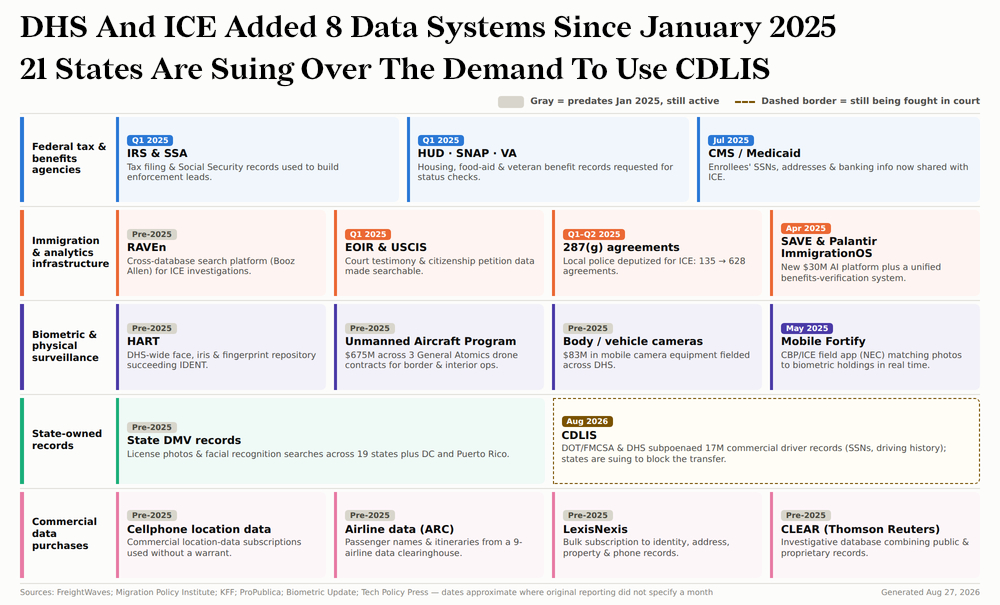
The Trump administration wants states to allow access to their drivers’ license databases. This would permit the federal government to see the personal information of 17 million commercial drivers nationwide. The databases include names, birth dates, and Social Security numbers of holders of commercial driver’s licenses. A multistate coalition of 21 state attorneys general (including New York and New Jersey) has filed a lawsuit to prevent access. If states do not comply, the federal government threatens to withhold funding for the databases. The legal issue is privacy and control over huge amounts of personal information.

The federal government has not stated what it plans to do with the information. Still, the lawyers believe the Federal Motor Carrier Safety Administration, part of the Department of Transportation, plans to share the information with DHS for use in immigration enforcement, whether or not the information is accurate.

How the CDLIS data grab fits into the data sets Homeland Security has already grabbed.


In a statement, DHS said the administration is targeting dangerous “illegal aliens” whom it says don’t know traffic laws or English and criticized politicians who allow dangerous drivers on the road. The order demanding information was issued in February 2026 by Transportation Secretary Sean Duffy. It cites seventeen crashes involving non-domiciled drivers (less than 0.5% of all fatal crashes). This followed Duffy’s September 2025 order removing nearly 3000 commercial driver training centers from approved provider lists.

In fact, requirements for commercial drivers’ licenses are very detailed and include criminal background checks, drug use tests, written tests, and behind-the-wheel (BTW) tests. There are different requirements for passenger vehicles, taxis, school buses, trucks of different types, construction equipment, and hazardous materials driving. All tests are in English.

In addition, New York used to have a “non-domiciled” program, which allowed drivers who do not reside in the state, including immigrants legally in the United States, to obtain commercial licenses. However, after pressure from the government, the program was halted. Now this statement appears on the DMV website: “DMV offices are temporarily unable to accept an application for a Commercial Learner Permit (CLP) or CDL document if you are not a U.S. citizen or lawful permanent resident (i.e., temporary visitors).” 

How will the government’s access to the database affect New Yorkers? New York officials and labor leaders say thousands of immigrant drivers, including MTA bus drivers and school bus drivers could lose their jobs. Some foreign drivers have already been unable to renew their commercial licenses.

Paul Quinn Mori, president of the New York School Bus Contractors Association, said about 5% of the state’s yellow bus drivers are licensed through the “non-domiciled” program. There is already a shortage of school bus drivers.

The lawsuit states, “The chilling effect of the transfer of data is particularly acute for some individuals who are concerned in general about disclosing their personal information to the federal government, such as noncitizens who are legally present in the United States and lawfully qualified to obtain a CDL, or individuals who are part of mixed-status immigration families.”

Attorney General Letitia James has said, “The Trump administration is attempting to seize confidential state records without any lawful justification. New Yorkers provide their personal information to the state with the expectation that it will be protected, not handed over to anyone who demands it.”

On August 20, U.S. District Judge Anthony J. Trenga granted the states’ request for a temporary restraining order. That prevents the federal government from obtaining the states’ records from the Commercial Driver’s License Information System, or CDLIS, while the court considers whether to issue a preliminary injunction.

What Can We Do?

2. Democrats Divided over Demand to Abolish ICE

“In the final week of July, we saw an amazing effort on their [ICE] part to rip away community members from this community, specifically here in Corona, where over half of reported detentions and kidnappings happened in this neighborhood.”New York Immigration Coalition President and CEO Murad Awawdeh

Shanel Thomas-Henry, born and raised in Corona and East Elmhurst, represents City Council 21, which includes Corona, East Elmhurst, Lefrak, and Jackson Heights. Since her district is the heart of ICE actions in NYC, she might seem to be a natural voice of opposition to ICE’s very existence. Yet she faces the same challenge that Democrats are struggling with nationally: a lack of consensus about what the future of ICE should be.

This month, she joined a rally at Corona Plaza organized by Larinda Hooks, whose Assembly District 35 covers much of the same areas of Queens as Thomas-Henry. The August 10 rally was a protest against the notable increase of ICE removing people from their streets. Last June there were just two people taken. In the two weeks prior to the rally there were 14. One every day. It was stressed that none of the people ICE took had criminal records. Jessica González-Rojas spoke at the rally and said, “Every single day, we get text messages from ICE watchers saying that ICE is in our communities. It doesn’t matter if you’re a small business owner. Doesn’t matter if you’re a five-year-old child. They are coming after all of us.”

Recent neighborhood sightings reported by ICE watching groups:

  • 8/21@9:25am: Two ICE SUVs circling 85th Street and 31st Ave.
  • 8/22@6:05pm: 4 ICE agents in a Jeep stop car on 77th St. and 30th Ave
  • 8/24@: spotted ICE pickup used in a July 30 kidnapping.
  • 8/25@9:25am: ICE vehicle at 99th st. btw. 34th and Northern. Community responder peppersprayed by ICE at 9:50am. 7 vehicles circling North Corona up to noon.
  • 8/26@8:03am: 3 confirmed ICE vehicles at 100 St between 34th and 35th Aves. Also 101 St. btw. 37th and 34th Aves. All cars left the block after community members showed up and began whistling & making noise!
  • 8/26@9.50am: ICE circling around 85-06 Roosevelt Ave
  • 8/26@1:37pm: Active Kidnapping on Northern Blvd. btw. 96th and 97th Sts.
  • 8/28@11:00am: 6 ICE agents in 4 cars seen in Corona
  • 8/28@4:29pm: 5 ICE agents tackled someone to the ground. Northern Blvd. at 108th St.

Neither Hooks, nor Thomas-Henry had signed a July letter calling on Democratic leadership to abolish ICE in order to restore public safety. They continue to believe the issue is not the Department of Homeland Security itself but the tactics of enforcement. Hooks’ Not-In-My-Backyard thinking suggests that introducing laws to restrict local police collaborating with ICE agents means ICE will look for people elsewhere. Her approach will not address the issue of a massively funded agency acting with impunity for pepper spraying a 72 year-old filming their activities or targeting out-of-state cars for search as a pretence to find immigrants to deport—vehicle stops are happening more frequently in College Point and also have made national news when the legally present father of an active-duty sailor on the USS Lincoln was taken into custody by ICE after a traffic stop in Florida.

Thomas-Henry claims that ICE existed for a reason before Trump and, before the rally, said it was important to “look at changing the laws that allow them to deport individuals on minor traffic offenses.” She ran as a progressive to win her seat against Francisco Moya, but she describes her approach to ICE as looking at the many layers. Her stance is similar to that of the Senate and House Minority Leaders Chuck Schumer and Hakeem Jeffries. They talk of adding guardrails instead of a total overhaul to a department that was born out of fear and suspicion of identity within US borders.

Some Democrats are pointing out how the expansion of ICE actions is spilling into the policing of more aspects of social life, including the increasing likelihood of ICE deploying to polling places during midterm elections or leveraging private Medicaid data. Only the Democratic Socialist movement and progressive candidates are taking the strong abolition stance against ICE, including NY Representative Alexandria Ocasio-Cortez: Centrist democrats worry that such candidates will hurt the Democratic Party. Last month, a bill was submitted by three progressives, all immigrants themselves, who described ICE as “too corrupt to reform“. Yet the Democrat leaders continue to express their skepticism about abolishing ICE.

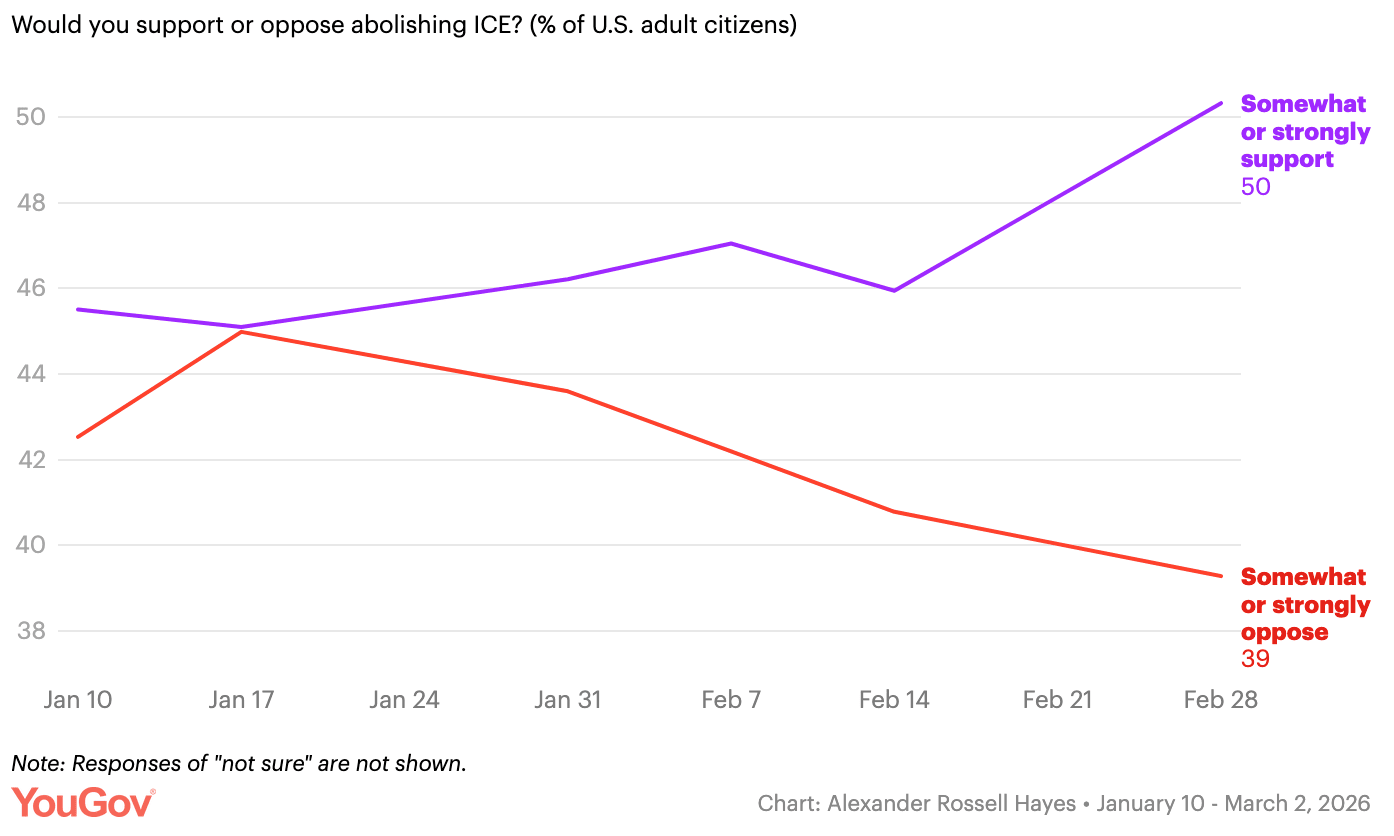
Polls showed that back in February 2026 support for abolishing ICE had grown, for the first time, to 50%—with only 39% opposing abolition. Even 23% of Republicans supported its abolition.

In July, an additional YouGov poll showed that Democrat support for abolition had actually dropped 4 points to 73%. For Independents, it grew 4 points to 52%, and, even for Republicans, support for abolition grew 1 point to 24%. Overall, due only to the Democrat responses, support for abolition support had dropped to 48%. 

DNC Chairman Ken Martin noted that “Clearly, the one thing that unites Democrats, regardless of their position on reform versus abolish or whatever other ways to change what’s happening, is people believe that what ICE is doing right now — and CBP and the federal government — should stop.” This year State Futures published a report showing 242 bills were introduced to prevent federal encroachment by regulating federal immigration: about a fifth of them passed. While the report indicates that all the bills submitted in New York were passed, it also notes that they were only part of the NY For All and the MELT bills: so they are not reflective of all the legislation NY can implement. 

What Can We Do?
  • Join an ICE Watch group and learn to use the SALUTE reporting tool to craft a text to share ICE on the street actions with the ICE Hotline: (229) 304-8720
  • Follow @nycicewwatch on instagram and share SALUTE messages with them too.


In solidarity and with collective care,

Jackson Heights Immigrant Solidarity Network (JHISN)


Follow @JHSolidarity on Facebook and Twitter and share this newsletter with friends, families, neighbors, networks, and colleagues so they can subscribe and receive news from JHISN. 

JHISN Newsletter 07/25/2026

Dear friends,

We often struggle to decide what stories to write for the newsletter: how to choose from the cascade of immigration news; what will promote solidarity without softening the brutal reality of what is happening in the US. For this newsletter, it was easy to decide that we had to report on a recent violent ICE arrest here in Jackson Heights. And then focus on the ugly consequences for New York’s health care system because of the cancellation of Temporary Protected Status (TPS) for Haitians.  

For a deeper and wider dive into news about, for, and by immigrants, please keep the NYC-based online news outlet Documented on your ‘must read’ list. They do an extraordinary job keeping us informed and promoting an immigrant-centered and social justice lens.

Finally, to supplement our story about Haitians losing TPS status, see this report on how one senior living center in California is already being affected by the forced exodus of Haitian health care workers.

Newsletter highlights:
  1. ICE unleashed in Jackson Heights
  2. Threats to Haitians and the NY health care system


1. How ICE Is Coming To Our StreetsAgain.  

“We are horrified by federal immigration enforcement operations that deliberately infringe upon First Amendment rights to assemble and dissent. The use of intimidation, surveillance, and deadly force against lawful protestors is not public safety—it is repression.” Statement from the League of Women Voters on Federal Immigration Enforcement and the Erosion of Constitutional Rights, January 2026

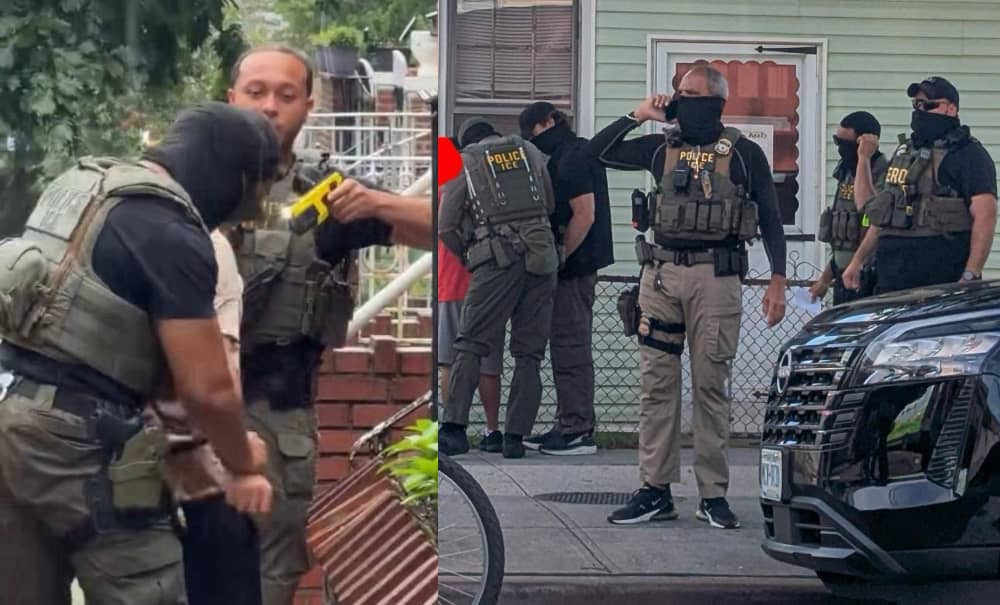
Five blocks away from the Jackson Heights Shopping Center on 31st Avenue, a woman walked. Protected from the rain by an umbrella. She noticed two ICE agents grabbing the arms of a man on the street about 20 feet in front of her. She crossed the road to avoid walking directly past them. The agents had tactical vests with POLICE ICE patches velcroed on the front and back. They carried holstered guns. Handcuffs dangled from their belts. One was illegally masked with a neck gaiter covering his mouth and secured over his ears by his own black baseball cap: its brim was angled low, allowing only the strip of his face with his eyes to be seen. The other agent was unmasked. The man was not struggling. The masked agent forcefully grabbed the man’s wrists; the man’s body twisted in reaction, and he struggled to maintain balance. There was no threat in his struggle. The agents’ lives were not in peril. Yet the unmasked agent chose to raise his left arm nonchalantly, without any urgency or need to defend himself, and aimed a taser inches from the man’s chest: violating recommended considerations for taser deployment by law enforcement. His verbal direction while pointing the taser was minimal and vague: “Cut the shit.” The two agents walked the man to a Black Hyundai Palisade SUV, LZW 7506. Nothing more is seen of them. This was July 9th in Jackson Heights.

Using the SALUTE reporting method, this 90-second encounter would be reported as:

S: 2
A: Arrested a man
L: 81st Street and 31st Avenue
U: ICE
T: 5:14 pm
E: Tan ICE vests, masked, taser

The only reason we even have this information is because a Rapid Response (RR) group member was walking the streets, paying attention to and legally documenting the actions of ICE agents. After the man was taken away, an RR team located a family connection for the man. Because of that volunteer work, the family would now know what happened to him. (The same RR team is currently searching to locate a family contact for someone else recently taken from 108th Street at 45th Avenue.) Since the federal government is not informing people when they move ICE detainees, how else would this information be discovered? 

The critical work for any RR action is to establish communication with the person being targeted. Let them know you’re there to help them, ask them for a phone number of a family member or contact that you can call to tell what has happened to them, or any information to help know more about them. The faster an ID can be made, the faster legal support can be gathered. 

The June 2026 budget reconciliation bill that ended the US government shutdown and funded Homeland Security for three more years “did not include basic guardrails like required oversight for detention, transparency measures requiring ICE to provide basic detention data to the public, and some basic civil rights protections in immigration enforcement.” It also gave $350 million for ICE to carry out enforcement actions in cities or states DHS decides are “non-cooperating” with Trump’s mass deportation agenda. It allows people to be taken by ICE if they were arrested for minor offenses, and ICE can also take someone if they were ever charged with the federal offense of unauthorized entry, even if charges were later dropped.

When Markwayne Mullin replaced Kristy Noem as DHS secretary, he said his key goal was to not be the lead story every single day. Yet, his team continues to murder people publicly and blame the victims with impunity. Mullin’s public response when asked how his agents would be held accountable was to say DHS will “turn up the heat on the streets”. The FBI has recently announced it will no longer take the lead on “assault on a federal officer” cases involving ICE and other Department of Homeland Security agents. Instead, Homeland Security Investigations will be responsible. Since the start of the second Trump presidency, no officers have been charged in any of the 9 killings by agents, and the federal government has suggested state prosecutors don’t have jurisdiction to investigate federal officers.

In summary: we can expect more on-the-street ICE activities and will see no change in tactics regarding overtly harsh enforcement techniques of non-criminal immigrants. We can anticipate more murders of anyone in proximity to ICE activities, and no independent agency will hold accountable the agents who kill. We will continue to see an increase in protesters being charged falsely with the once-obscure 18 U.S.C. 111 statute, which makes it a federal crime to assault or forcibly impede a government officer. We therefore need more people mobilized in Rapid Response groups to stand up for the disappeared as well as for our constitutional rights.

WHAT CAN WE DO?
  • Participate in neighborhood walks for a Rapid Response group in these key areas:
    • 1-2 block radius of any 7 train stop in the area (Jackson Heights, Elmhurst, Corona)
    • Most of Corona south of Northern Blvd. to just south of Corona Ave.
    • All along 111th, 108th streets
    • 1-2 block radius of the Ideal Supermarket by Corona Ave at 102nd street
    • Along 45th Ave., the LIRR underpass
    • Eastern side of Jackson Heights closer to Corona 
    • North of Northern Blvd. along 31st/32nd Aves.
    • Staging sites: FMCP parking lots, QCM parking lots, parking lots along Northern Blvd./Queens Blvd. 
  • Do what you can to help the Legal Defense Fund achieve their “6 Steps to End ICE and Other Federal Law Enforcement Abuses in Our Streets” 
  • Support efforts to enforce gambling laws against prediction markets which profit from their speculations on ICE arrests.

2. Loss of TPS for Haitians Endangers New York’s Healthcare System

“During COVID, we knew we were exposed. We knew we could be the next one, but guess what? We showed up every day. Some of us lived in the hospital for months. And this is how we are being repaid.” Dr. Marie Paul, founder of Haitian Nurses Network

In November 2025, then Secretary of Homeland Security Kristi Noem declared that Temporary Protective Status (TPS) for Haitians would end on February 3, 2026, but on February 2, a US District Court for the District of Columbia put a stay on that decision. On June 25, the Supreme Court removed the stay, permitting the administration to remove TPS for Haitians and Syrians. The decision put 350,000 Haitians and 6,100 Syrians in danger of deportation. The decision disregarded the continuing chaos in Haiti. It also invites turbulence in New York State’s health care system where thousands of Haitians currently work. 

The court decision was not effective immediately. A 32-day delay is required before actions can take place, so on July 10, US Citizenship and Immigration Services (USCIS) announced that the current work permit expiration date for Haitians with TPS is July 24, 2026. The state has about 56,000 Haitian residents; the city has around 5,400. The most obvious consequences of the court’s decision are the total disruption of Haitian families’ lives and well-being as well as their inability to send money to relatives in their country of origin. Another serious consequence is economic damage. Nationwide, Haitian TPS holders contribute $5.9 billion to the US economy, including $1.1 billion to New York state and $281 million in federal, state and local taxes.

Additionally, the health care industry will be severely disrupted. Thousands of Haitians provide essential care as nurses and nursing assistants across New York’s hospitals, as home health aides to the elderly, and as caregivers in long-term care facilities. All their patients and clients will be severely affected if Haitians are unable to continue working.

According to an amicus brief filed in April by Letitia James and 18 other state attorneys general, there are tens of thousands of Haitian TPS holders nationwide who work in critical services including health care. The American Immigration Council states that 112,000 Haitians work nationwide in health care, including 58,000 home health aides.

The policy group FWD.us estimates there are 25,000 Haitian TPS holders working in New York state, including 5,000 caregivers and 2,000 nursing assistants who, along with other workers, contribute $141 million annually in state and local taxes.

It is well-known that there is a nursing shortage in New York City, and the loss of these TPS holders will only increase the problem.

“Even with the current numbers that they have, including TPS workers, there is still a nursing shortage. Removing even a small percentage of these people will further impact our ability to provide quality care. There is no replacement pipeline. That’s why I’m losing sleep. My concern is, what happens to patients?” Dr. Cherlie Magny-Normilus, a family nurse practitioner and assistant professor of nursing at New York University

There are efforts in Congress to alter these consequences. In April, the House passed a bill with bipartisan support to extend TPS protection for Haitians for three years. After the Supreme Court ruling, Senators Sheldon Whitehouse and Jack Reed presented Senate bill S.4814 to extend TPS for Haitians, and on July 6 Representative Mike Lawler (NY-17), a strong advocate for Haitians in his district, urged the Senate to take up the bill.

In the meantime, some families threatened with deportation may stop going to work, avoid school or public spaces, or withdraw from daily life because of ICE fears. For TPS holders, the main option now is to check for any other form of immigration relief and to start concrete planning in case TPS ends.

WHAT CAN WE DO?

In solidarity and with collective care,

Jackson Heights Immigrant Solidarity Network (JHISN)


Follow @JHSolidarity on Facebook and Twitter and share this newsletter with friends, families, neighbors, networks, and colleagues so they can subscribe and receive news from JHISN. 


JHISN Newsletter 01/24/2026

Dear friends,

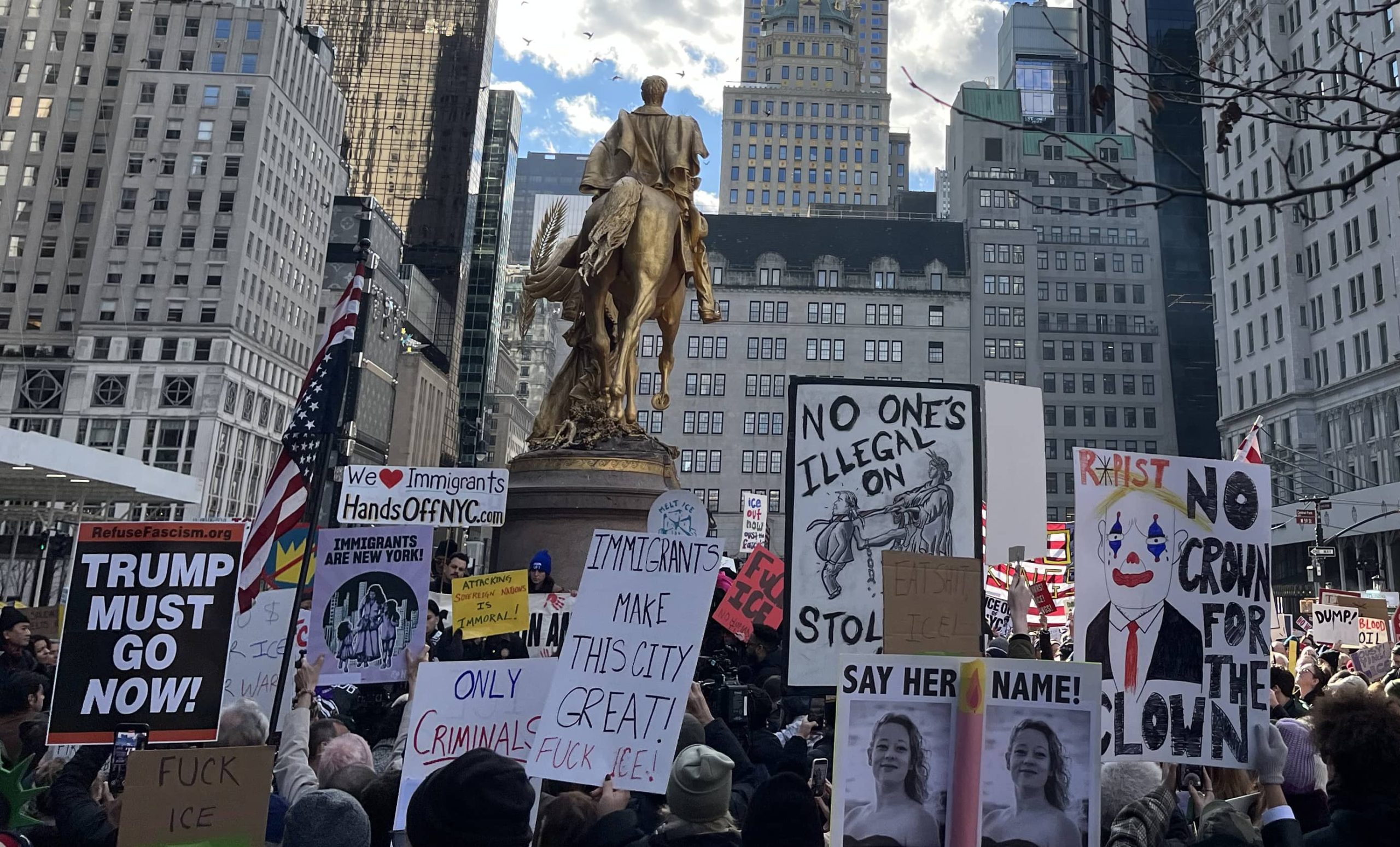
Yesterday, New York City joined protests around the country, standing with striking Minnesotans who have risen in the cold as a powerful anti-ICE voice. They represent a people’s resistance against the always escalating, harmful, militarized tactics of Homeland Security. The entire nation watched a federal agent shoot and kill Renee Gooda poet, mother, and citizen who refused to ignore the inhumane federal deportation operations in her Minneapolis neighborhood.  The president, and others in the administration and blamestream media, peddled the lie that Good was a domestic terrorist who was the cause of her own death. The person who clearly killed Renee Good was not a newly hired agent who lacked training: Jonathan Ross served more than 10 years in ICE’s elite Special Response Team.

While many agree that ICE (established less than 25 years ago) should be abolished, most Democrat leaders appear to be following the guidance of a “Don’t Say Abolish ICE” memo. Written by a former Customs and Border Protection official who is now a corporate consultant for the defense and surveillance sector, the memo advises reforming and retraining ICE. Fortunately, our new Mayor, Zohran Mamdani, remains strong in his stance. He stated on ABC’s, The View, “I am in support of abolishing ICE…We’re seeing a government agency that is supposed to be enforcing some kind of immigration law, but instead what it’s doing is terrorizing people”. 

Today’s newsletter reports on NYC’s now ex-mayor’s veto, just as he left office, of City Council legislation promoting immigrant and economic justice. We then offer an update on battles over Temporary Protective Status (TPS), including the good news of a recent court decision that reverses the Trump regime’s cancellation of protections for Nepali TPS holders. 

Newsletter highlights:
  1. Eric Adams vetoes immigrant justice in cruel exit act
  2. Temporary Protective Status (TPS) under attack: Update


1. Eric Adams’ Last Betrayal

“It is unsurprising that this mayor is ending his term by demonstrating, once again, that protecting and supporting working-class New Yorkers is not his priority. His vetoes put special interests above greater affordability and opportunity for hardworking New Yorkers, and public safety.” — Outgoing City Council Speaker Adrienne Adams

On his last day in office, Eric Adams—a mayor we have long criticized for scapegoating immigrants—vetoed three key pro-immigrant legislative packages that had been passed by large majorities in the City Council. The bills were among a total of 19 measures Adams vetoed, as a final New Year’s Eve “drop dead” to the lawmakers and the people of New York.

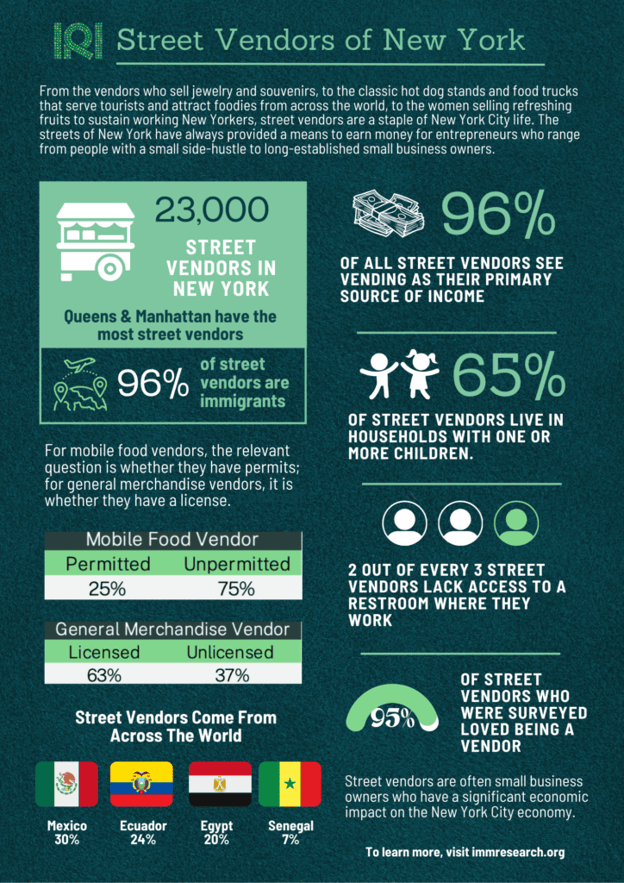
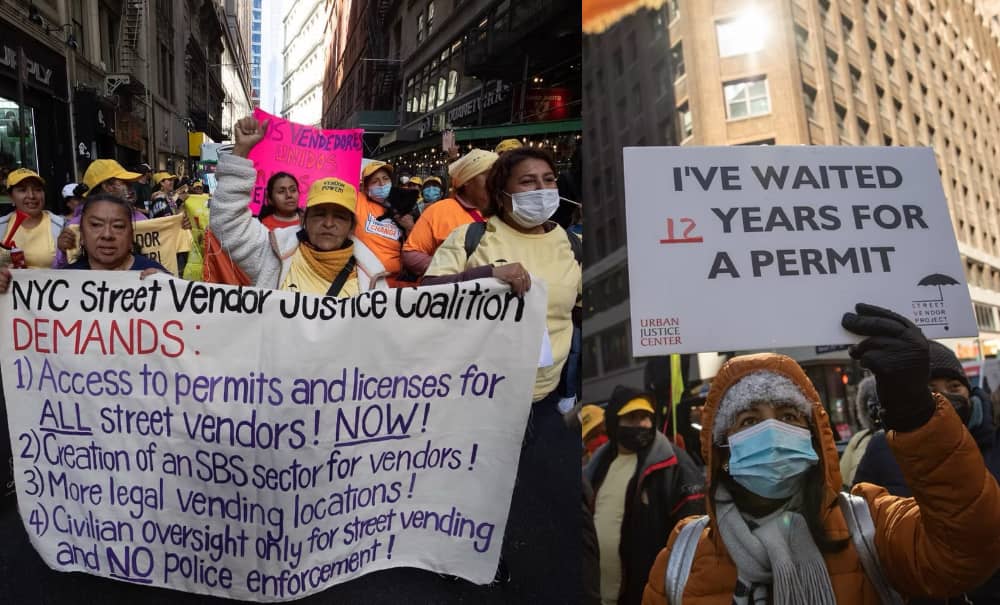
One of the vetoed packages aims to regulate and reform street vending. Among its provisions is the long-delayed raising of the cap on the number of vending licenses. Local Councilmember Shekar Krishnan had praised passage of the package as “a historic day for workers.” The legislation became urgent after Mayor Adams, who had promised to raise the cap and dial down punitive enforcement against vendors, made a quick 180-degree turn, joining with right-wing forces in a campaign to uproot and intimidate vendors in Corona Plaza, Roosevelt Avenue, and other parts of the city.

Another veto casualty was Tiffany Cabán’s Safer Sanctuary Act. This would outlaw the establishment of ICE offices on Rikers Island, something that has been contentious throughout Adams’ tenure. That act would also close a loophole in the city’s sanctuary laws, making it clear that the restrictions they place on cooperation with federal authorities would apply to all immigration enforcement agencies, not just ICE.

Adams’ third anti-immigrant veto gave a thumbs down to badly-needed legislation defending deliveristas from a wave of arbitrary “deactivations”—firings—initiated by delivery app companies. The Council measure requires that delivery workers be given a reason for deactivation, the right to appeal, and a 120-day notice before permanent deactivation.

According to city law, once the vetoes were formally registered, which happened on January 7, the Council has 30 days to override them, a process which requires a 2/3rds majority vote. The clock is ticking, with many other priorities competing for legislators’ attention in the new year.

New Council Speaker Julie Menin can strongly influence the fate of the vetoed bills, since she largely controls legislative scheduling and agendas. In practice, she seems unlikely to run out the clock on these three measures, which were all passed with “veto-proof “ majorities. For instance, the measure lifting the vendor license cap was passed by a margin of 39-9, as was the Safer Sanctuary Act. The bill defending deliveristas passed 40-8. Menin is a supporter of sanctuary laws, and was actually a co-sponsor of the street vendor bill.

However, Menin has refused to commit to overriding all of Mayor Adams’ vetoes, saying only that “the Council will consider next steps on these bills.”

NYC lawmakers have been given further impetus to act by ICE’s arrest of one of their own staffers, Venezuelan immigrant Andres Rubio Bohorquez, at a routine asylum interview. Menin and many other Council members have expressed concern and anger at ICE over the data analyst’s detention. This attack on one of their own employees is likely to concentrate the Council’s attention, bringing home how much is at stake for immigrants in their deliberations.

WHAT CAN WE DO?


2. The Ongoing Weaponization Of TPS

“The harm already caused by the administration’s cruel, lawless actions cannot be undone, but we are hopeful that, with this ruling, the new year will bring a measure of justice and peace to the TPS holder community.” Jessica Bansal, attorney at the National Day Laborer Organizing Network (NDLON)

The new year started positively for Adhikaar, the Queens-based group that serves and supports the Nepali-speaking community in NYC. They shared welcome news that a Northern California District Court judge ruled that the Trump administration had illegally ended TPS for Honduras, Nepal, and Nicaragua. Adhikaar applauded the work of the National Day Laborer Organizing Network (NDLON) and other members of the National TPS Alliance who argued the legal case, which affects around 60,000 people nationwide, including thousands of Queens residents.

Ama Frimpong, the Legal Director of CASA, stated that the ruling clearly showed TPS cannot be terminated based on racialized political narratives. Frimpong continued, “This decision is not only a victory for TPS holders from Honduras, Nicaragua, and Nepal, but an encouraging signal for TPS holders from Venezuela, Cameroon, Afghanistan, and beyond who are fighting to protect their families and their futures.” 

Two days later, after US forces captured and removed the president of Venezuela, Homeland Security Secretary Kristy Noem announced that Venezuelans in the US under TPS had the opportunity to apply for refugee status. There was no hint as to how more than 600,000 people could do that when the US government has limited the total number of refugees per year to just 7,500. A few hours after her announcement, the Homeland Security eX-twitter account denied that Noem had ever said that, and instead reaffirmed that she had ended TPS for more than 500,000 people. The post suggested that, “now they can go home to a country that they love.” Even those Venezuelans who are happy about Maduro’s removal say returning is an extreme risk.

Minnesota has the largest Somali population in the US. Just days after a weekend of national protest in the wake of the ICE murder of Renee Nicole Good in Minneapolis, and Homeland Security’s brutal tactics in the Twin Cities, Trump announced the termination of TPS for Somalis. Ignoring the economic destabilization it will bring, he declared legal protections for Somali nationals enrolled in the TPS program will be ended in two months, on March 17. He claimed that country conditions had improved, an opinion easily contradicted by the work of Freedom House, which has monitored the state of global freedom for 85 years: currently, they give Somalia a Global Freedom Score of 8 out of 100; the US score is 84

The day after Trump’s Somalia announcement, the US Ninth Circuit Court of Appeals heard oral arguments for the second of the National TPS Alliance lawsuits, defending Haitians and Venezuelans. A Federal Judge has indicated she will not rule on the Haitian TPS case until February 6, which is just one day before that protection is set to expire. Just as the year began, and our article started with hope from NDLON, so these recent fraught weeks have ended with Ahilan Arulanantham, the Co-Director of UCLA’s Center for Immigration Law & Policy (CILP) stating, “We hope the court will insist the administration comply with the law as Congress intended it to by engaging in an objective assessment of the country conditions in Venezuela.” 

We wonder, is “hope” really enough?

WHAT CAN WE DO?

In solidarity and with collective care,

Jackson Heights Immigrant Solidarity Network (JHISN)


Follow @JHSolidarity on Facebook and Twitter and share this newsletter with friends, families, neighbors, networks, and colleagues so they can subscribe and receive news from JHISN.