Dear friends,
When good immigration news is hard to find, we look harder. The notorious Alligator Alcatraz detention camp in Florida is fully shut down as of this week, less than a year after it opened with sadistic fanfare from Trump’s minions. We hope, with many of you, that the expansion of Mayor Mamdani’s political power with this week’s primary victories will strengthen a pro-immigrant, anti-authoritarian agenda. And a Trump lawsuit targeting four NJ cities for allegedly “unconstitutional” sanctuary policies was just tossed out by a federal judge.
But the bad news is really terrible. Thursday’s Supreme Court ruling that allows the federal government to continue stripping Temporary Protective Status (TPS) from hundreds of thousands of US residents is a nightmare. Most immediately, 350,000 Haitians and 6,000 Syrians are now facing the reality of losing their TPS legal status by July 1—a loss that will affect everyone who is their neighbor, co-worker, healthcare patient, or friend.
Our newsletter covers some of the mixed good/ bad immigration news out of this year’s NYS legislative session, which ended in early June. We then update you on the ongoing legal campaigns—and harassment—of two high-profile international students from Columbia University targeted for deportation.
Newsletter highlights:
- NY State Legislature gestures toward immigrant protections
- Deportation threats to Mohsen Mahdawi and Mahmoud Khalil
1. Latest NY State Legislation Falls Short On Immigrant Protection
On May 21, NYS Assembly Speaker Carl Heastie noted that the 2026-27 state fiscal budget includes legislative provisions, signed by the governor, that protect our neighbors throughout New York from aggressive federal immigration enforcement. He suggested that local governments will be prohibited from collaborating with federal immigration enforcement officers and private detention facilities. He highlighted provisions that “will protect children in their schools and establish sensitive locations within our communities.” The official press release received endorsements from various elected officials, including Queens Assembly Member Catalina Cruz.
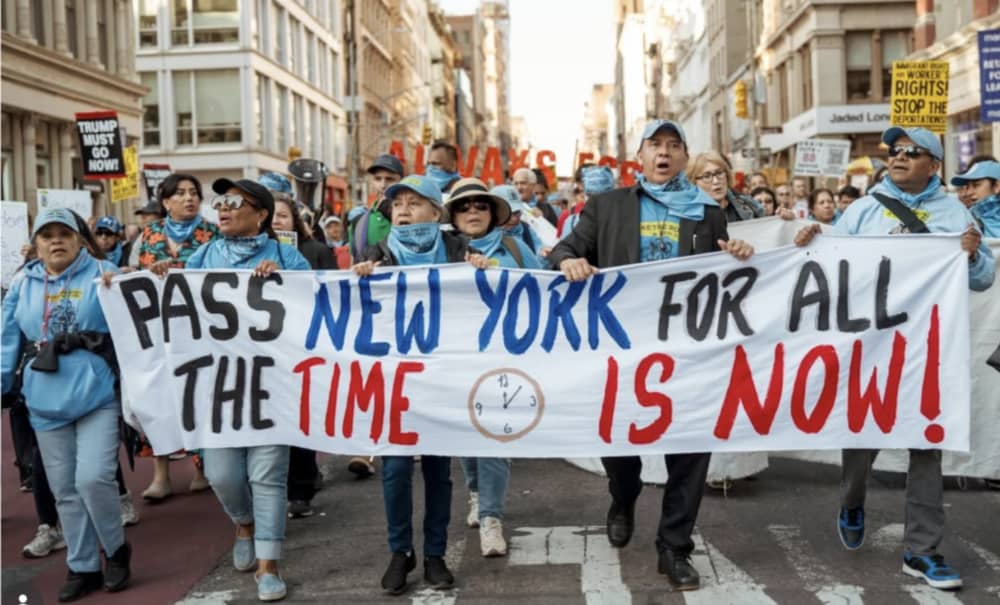
The perspective of immigrant justice supporters of the New York For All Act—proposed legislation which was never brought to a vote in the state legislature—was markedly different. The multi-organization coalition advocating for New York For All said, “The lack of political courage and moral leadership in Albany – and the failure to take a bold stand in the face of rising xenophobia – means that New York’s immigrant communities will continue to live with the threat that any encounter with government agencies can result in separation from their families.”
The New York Civil Liberties Union (NYCLU) outlined some of the Enacted Budget’s key elements, explaining which protections were included or fell short:
- State and local employees may not gather information about immigration status, and cannot share personal data of NY residents with ICE…but the police are excluded from this restriction.
- “Sensitive locations,” including hospitals, churches, and private homes, can deny entry to ICE agents.
- The right to free public education for children, regardless of the family’s immigration status, was established.
- State and local agencies may not rent space to ICE for immigration detention nor financially support immigration detention facilities.
- New Yorkers can sue local, state, and federal officials in state court when their constitutional rights are violated using the newly established Office of Immigrant Trust.
Republicans claim that these new protections mean that “New York is now a sanctuary state on steroids.” But there are, in fact, at least three significant elements missing from the new budget that progressive forces had fought for. First, although the formal 287(g) agreements that allow local governments to work with ICE (previously signed by twelve New York law enforcement agencies) were banned in New York, informal collusion between local police and immigration enforcement was not prohibited—that was called for in the New York For All Act. Murad Awawdeh, Executive Director of the New York Immigration Coalition, noted, “The legislative package falls short of offering comprehensive protections by continuing to permit informal law enforcement collusion with ICE and Border Patrol.”
Second, state-funded counsel for immigrants facing deportation, part of the Access to Representation and the BUILD Act, was not included in the budget package. Although some money was secured for immigrant legal services, it was less than half of the $175 million called for by immigrant advocates.
Finally, the new measures banning face coverings for state, local, and federal officers in New York still allow for “tactical equipment” that covers faces. Even with this legal loophole permitting ICE to deploy with tactical face masks, the federal government initiated a lawsuit against New York four days before the face mask ban was scheduled to go into effect. The Department of Justice has also initiated legal action against New Jersey, California, and Virginia, which sought similar mask restrictions.
The New York Bar has explained why many of the items demanded and signed into law do not violate federal laws about police power and preemption. None of those explanations will stop the threats from Homeland Security to conduct an ICE surge in NYC. Passing the entire New York For All Act would help strengthen legal action against the overreach and violations of basic rights by ICE and border patrol federal agents.
WHAT CAN WE DO?
- Consider working with the Immigrant Defense Network’s New York ICE Collusion Watch program to report and stop ICE/policing entanglement.
2. Deportation Threat Ongoing for Palestinian Student-Activists at Columbia University
“[T]he administration is abusing immigration law to silence me for speaking the truth about Palestinian suffering and genocide. When a government weaponizes immigration to punish speech, millions of immigrants and citizens feel that blow.” —Mohsen Mahdawi (June 10, 2026)
In Spring of 2025, Mohsen Mahdawi and Mahmoud Khalil, both Columbia University students, became two of the most prominent faces of international student-activists targeted for their Palestine solidarity work. The newly-installed Trump regime quickly weaponized immigration law and accusations of antisemitism to incarcerate both young men in its broader campaign to silence and punish university-based mobilizations against the US-backed Israeli genocide in Gaza.
Both men are Palestinian. Khalil was born in a refugee camp in Syria; Mahdawi in a refugee camp in the occupied West Bank. Khalil is a graduate of Columbia’s prestigious School of International and Public Affairs (SIPA); Mahdawi is currently enrolled in the MA program at SIPA. Both are green card holders and legal US residents. Both were accused of nothing beyond the “memos” from Secretary of State Marco Rubio stating that their presence in the country might undermine US foreign policy goals. Both were eventually released from detention after public outcry and legal challenges.
And … both are still threatened with deportation through legal proceedings pursued by the federal government, even as their names have faded from most headlines.
Their ongoing legal battles differ. An immigration judge in February 2026 ruled that the deportation case against Mohsen Mahdawi be dismissed. Trump’s DOJ fired that immigration judge (unlike other judges, immigration judges serve at the will of the federal government) and appealed the decision. The US Board of Immigration Appeals (BIA) ruled that the deportation case could go forward, and Mohsen’s case went to a second immigration judge who this month issued an order of removal that would send Mohsen to Jordan. Nevertheless Mohsen remains in the US while his legal team challenges the deportation order in the First Circuit Court on constitutional grounds. Mohsen declared:
“… I’m going to cut to the core of this issue, which is an issue that is related to the First Amendment. Do I have, as a green card holder, as a lawful permanent resident for 12 years, never committed a crime — do I have the rights that actually the citizenship questionnaire that I get tested on states that I do … do I have the right to free speech, freedom of assembly and freedom of expression?” —on Democracy Now! (June 12, 2026)
Mahmoud Khalil’s case is on a different track, though he also is protected for now from a deportation removal order that has been set in motion. His legal team made a second appeal in May 2026 to the US Board of Immigration Appeals (BIA) to dismiss the deportation case against him, after new revelations of government misconduct. The Trump regime is accused of “secretly engineering” the outcome of his case. The allegations of misconduct are corroborated by statements from former immigration judges, former BIA workers, and accumulating evidence that top government officials pressured judges to “decide” cases with predetermined outcomes in spotlight cases like Khalil’s, and to expedite deportation orders. One legal decision against Khalil was handed down by the BIA in a mysteriously speedy nine days.
Meanwhile, a legal challenge in the Third Circuit Court of Appeals was decided in late May against Khalil, and a new challenge was immediately filed by his team in the Fifth Circuit Court of Appeals, which also separately requested a Supreme Court review of the Third Circuit decision. “We hope the Supreme Court will recognize how dangerous the Third Circuit’s decision was, not just for Mahmoud but for other non-citizens the administration has its vengeful sights upon,” said Baher Azmy, legal director at the Center for Constitutional Rights.
Regardless of the outcome of their cases, Mohsen and Mahmoud remain targets of merciless legal harassment through a federal government campaign to deport them—and to silence, repress, and frighten others who would speak out.
Columbia University has to date made no public statements in support of Mohsen, a current student, or Mahmoud, a recent graduate. The University has been operating since July 2025 under an unprecedented “settlement”’ with the Trump regime, in which the University paid the government $221 million, and agreed to a set of institutional changes demanded by the federal government. One of those demands was that the University start asking all international applicants “questions designed to elicit their reasons for wishing to study in the United States.” Or, in the words of Marco Rubio, “we are not going to be importing activists into the United States.”
WHAT CAN WE DO?
- Join the weekly vigil every Monday at 12pm near Columbia’s campus to protest DHS and ICE targeting of students, organized by CUIMC Stands Up.
In solidarity and with collective care,
Jackson Heights Immigrant Solidarity Network (JHISN)
Follow @JHSolidarity on Facebook and Twitter and share this newsletter with friends, families, neighbors, networks, and colleagues so they can subscribe and receive news from JHISN.