Dear friends,
Remain vigilant? Breathe a temporary sigh of relief? The mass targeting of immigrants for deportation in central Queens has not yet materialized. We share recent wisdom from Queens Neighborhoods United: “[W]e can’t always live in fear that ICE is around, and we can’t pretend that ICE is never around. Finding a balance and arming ourselves with information to inform our day-to-day lives is important.” Find a balance; stay informed; build and hold our collective strength.
Yet, every day, police violence against immigrants continues, and our first article highlights the pursuit of justice for two Queens families shattered by NYPD shootings in their homes.
Our second article dives into the mess of government propaganda, misinformation, missing data, and realistic “best estimates” of the number of immigrants in the US who have been recently detained and/or deported. Who really counts in US society? All those whose lives have been upended by a revved-up mass detention and deportation machine deserve to be counted.
Newsletter highlights:
- Where is justice for two Queens families shattered by NYPD violence?
- Checking the numbers on US detentions and deportations
1. Justice for Win Rozario and Jabez Chakraborty!
On March 27, 2024, struggling with a mental health crisis in his Ozone Park home, 19-year-old Bangladeshi immigrant Win Rozario called 911 for help. What showed up was two aggressive cops, who provoked, tased, and gunned him down without mercy in front of his family.
“After shooting Win, the NYPD forced Win’s mom and brother to go to the precinct immediately, refusing to let them accompany Win to the hospital. Win’s mother and brother were separated and interrogated without lawyers and before being notified that Win had died. The NYPD then refused to let the Rozario family back into their apartment for over 48 hours, refusing to let them retrieve critical medications or even feed their cat. It took the advocacy of the Public Advocate to get the Rozario family back into their home – which the police had neglected to clean up after murdering Win.” —The Justice Committee
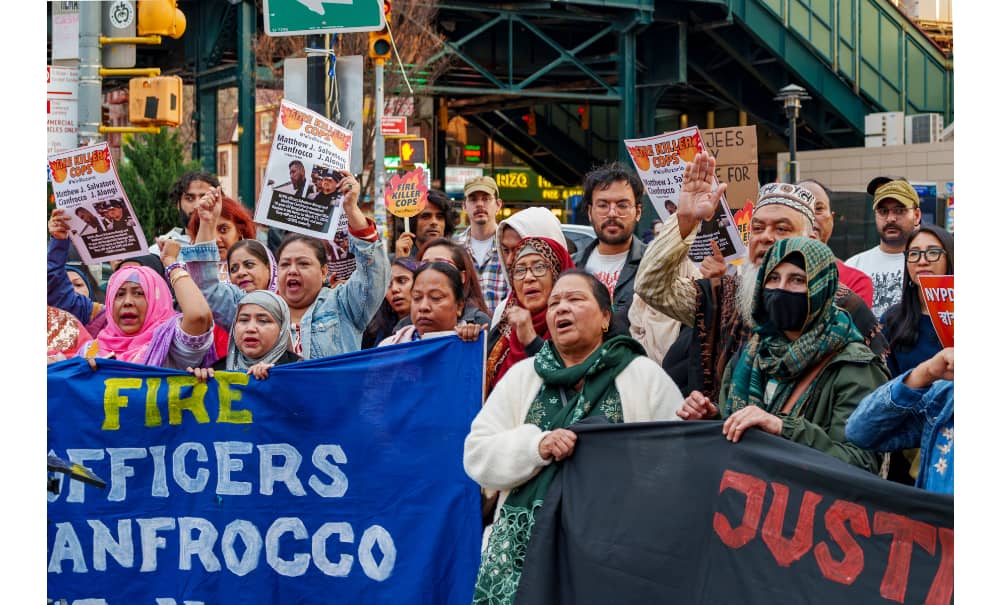
In September 2025, NYC’s Civilian Complaint Review Board (CCRB) found that Officers Matthew Cianfrocco and Salvatore Alongi used excessive force and abused their authority. But so far, they have not faced any consequences. State Attorney General Letitia James refused to prosecute the cops, a decision the family called “cowardly.” Potential disciplinary action is now at the discretion of New York Police Commissioner Tisch, who is considered likely to order the loss of some vacation days—or no punishment at all. Only Mayor Mamdani can overrule whatever she decides.
This April 1, the Rozario family and local immigrant justice group Desis Rising Up and Moving (DRUM) led a demonstration at Diversity Plaza, solemnly marking the second anniversary of Win’s murder and calling on the city to fire Cianfrocco and Alongi:
“Win’s mother shared her experiences and demands: ‘I can’t believe two years have passed and still the police have not been punished… I want to say that police should not be sent to respond to situations involving illness or mental health crises. Otherwise, more families like mine will be forced to live with this emptiness and grief.’” —@DRUMNYC
The Diversity Plaza protest also mobilized support for another Queens immigrant family brutalized in a similar way by the NYPD. Jabez Chakraborty, 22, who lives with schizophrenia, was shot by cops in a January 2026 confrontation that his family insists was completely unnecessary.
“We are shocked and outraged by the NYPD’s treatment of our son and brother, Jabez Chakraborty, and our family. We called for help. We called 911 for an ambulance to provide medical attention for our son, who was in emotional distress. We did not call the police. Instead of medical responders, the NYPD arrived and shot our son multiple times right in front of us.” —Chakraborty family, 1/30/26
Although he was severely wounded, Jabez Chakraborty survived. But District Attorney Melinda Katz rushed to arraign him on assault and weapons charges as he lay chained to his hospital bed—ignoring objections from Mayor Mamdani.
“What purpose does it serve to punish someone who needed medical and mental health care, and got bullets instead? This shooting was not an isolated incident: it’s a devastating example of how our systems repeatedly fail the most vulnerable New Yorkers.” —Fahd Ahmed, Executive Director of DRUM
WHAT CAN WE DO?
- Call on Mayor Mamdani and Police Commissioner Tisch to immediately fire Cianfrocco and Alongi.
- Stand with the Rozarios in the upcoming @ccrb_nyc hearing to be scheduled this year.
- Support the Chakraborty family by calling on @queensdakatz to #DropTheCharges against Jabez.
- Show up for the Chakraborty family at their next court date on May 15.
- Tell the @nycmayor to finally stop using cops for mental health responses!
2. The Reality Behind Detention & Deportation Propaganda Numbers
“We know of no reliable count of the total number of deportations during the first year of the Trump administration.” — Deportation Data Project (January 2026)
Those managing the anti-immigrant agenda of Trump and his hatemongering Homeland Security advisor, Stephen Miller, regularly obfuscate their arrest, detention, or deportation numbers. Such transparency problems are not new. Before Trump took office in 2024, the American Immigration Council (AIC) published Transparency Recommendations identifying numerous legally mandated reporting requirements that ICE failed to fulfill. The AIC reported that ICE, under Biden, was “severely undercounting the number of people it has in immigration detention.” In July of last year, Robert Garcia, a representative on the House Committee on Homeland Security, stated, “I actually just don’t trust numbers the administration is putting out, and I don’t think the American public should.” Thankfully, the diligent work of non-profits and university researchers does serve as a lighthouse in the fog.
The number of people processed through the deportation machine is obscured by the administration’s hyperbolic statements. Only through the independent work of organizations, reporters, and pro bono lawyers, who process Freedom of Information Act (FOIA) lawsuits to delve into Homeland Security data, can we get a sense of how many people are actually being processed through the deportation machine.
In March of last year, TRAC Reports won a major FOIA case against ICE and CPB when a court rejected all the government’s arguments for withholding records. In November 2025, TRAC released a report about detention and removals after the massive deployments of military and civil immigration enforcers: “The data show surprisingly little has been accomplished given the huge expenditure of resources devoted to this effort.” The increase in ICE removals under Trump in 2025 was reportedly only 7% higher than the 2024-25 numbers under Biden.
Before Trump’s second inauguration, data on border arrests, deportations, and other immigration metrics were published twice a month (as mandated by the DHS funding bill). An April 2026 visit to the DHS website finds that the immigration websites have not been updated since 2024. ICE Detention and Repatriation data has also not been updated since 2024. The 2025 numbers reported by Homeland Security on its detention management site are severely limited. Even a high school student’s online ICE Tracker project is making a better attempt than Homeland Security to share this data publicly.
While TRAC Reports highlighted the many data errors in ICE data releases, the Vera Institute of Justice reported that the “failure [of ICE] to regularly release accurate, complete, and accessible data is part of what enables it to operate this multi-billion-dollar network with little oversight or accountability.” With the support of the Deportation Data Project, the Vera Institute published its December 2025 report on ICE Detention Trends in 1,464 facilities. If the ICE reports from August of last year are accurate, then the 61,226 people detained by ICE is the highest ever level of detention.
“First, ICE arrests quadrupled, including both street arrests and transfers from criminal custody to ICE immigration custody. ICE street arrests (i.e. arrests not at jails) went up by over a factor of eleven. Street arrests at this order of magnitude are a new phenomenon. For both types of arrests, ICE was much less likely to target people with criminal convictions. These changes led to over a sevenfold increase in arrests of people without criminal convictions.”—Deportation Data Project
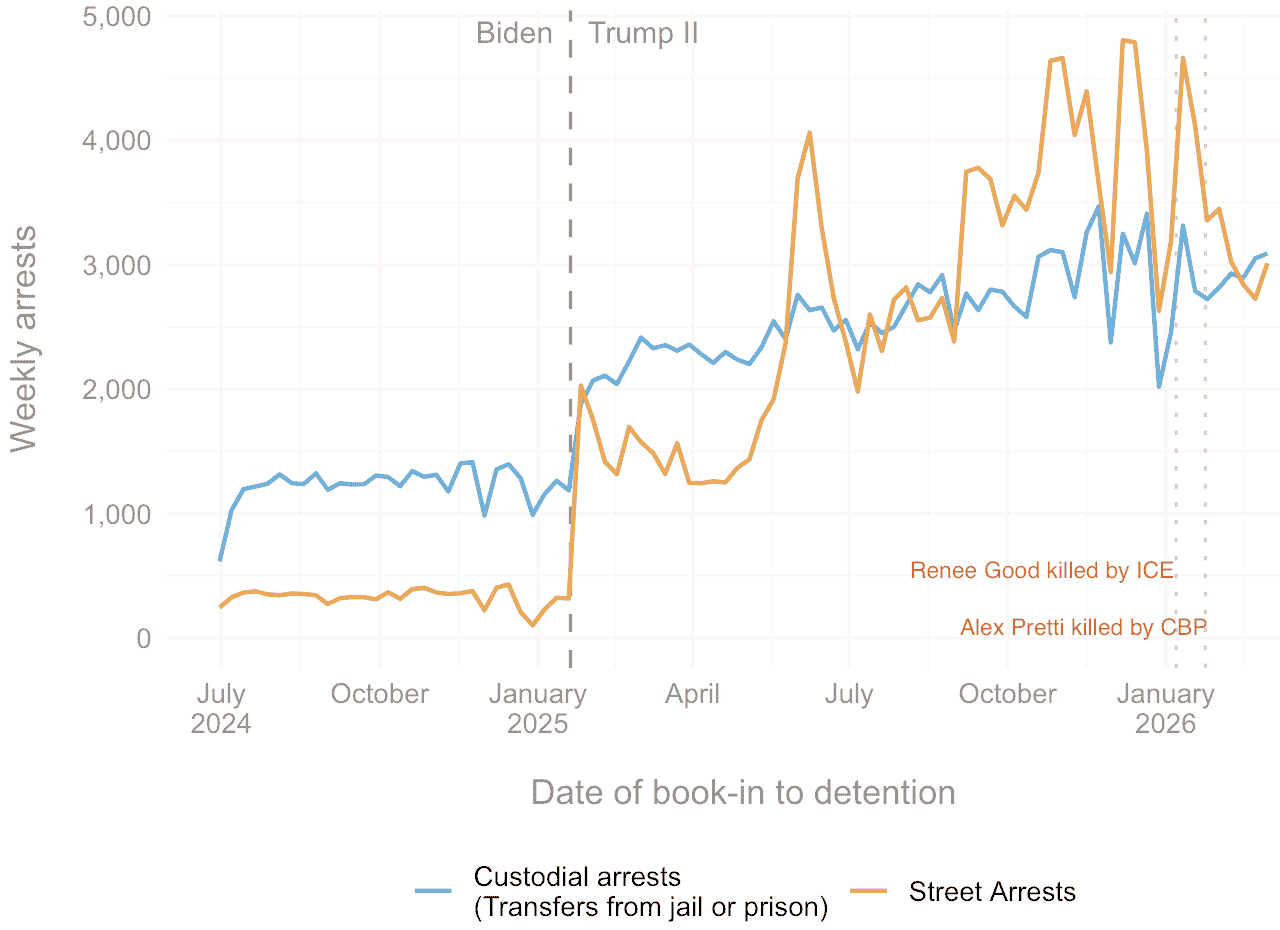
Transfers from Jails and Prisons Doubled and Street Arrests Increased by 11x—Deportation Data Project
The self-deportation component of the Miller-Trump strategy, despite a significant increase in numbers, failed spectacularly to deliver its promise as a cost-effective way to remove immigrants rapidly. Last September, DHS posted self-aggrandizing statements, and Kristi Noem talked about self-deportation numbers, which came from an estimate by the anti-immigrant think tank CIS that did not even use DHS data.
Homeland Security spent $200M on ads (created by agencies with direct ties to DHS staff) to urge self-deportation through the incongruously named Project Homecoming. The “voluntary” project claims to offer applicants a free plane ticket and a stipend of $1,000, recently increased to $2,600. Data review confirmed around 25,000 people registered for self-deportation on the CBP mobile app. Only half of those actually returned home with DHS support. The others face delays in paperwork processing, have not received payments, and still await their flights home. Immigration attorneys indicate their lack of trust in the program. In reality, only a minority of immigrants are eligible for those incentives to leave: those who do not meet the requirements are simply handing over their information and risking detention.
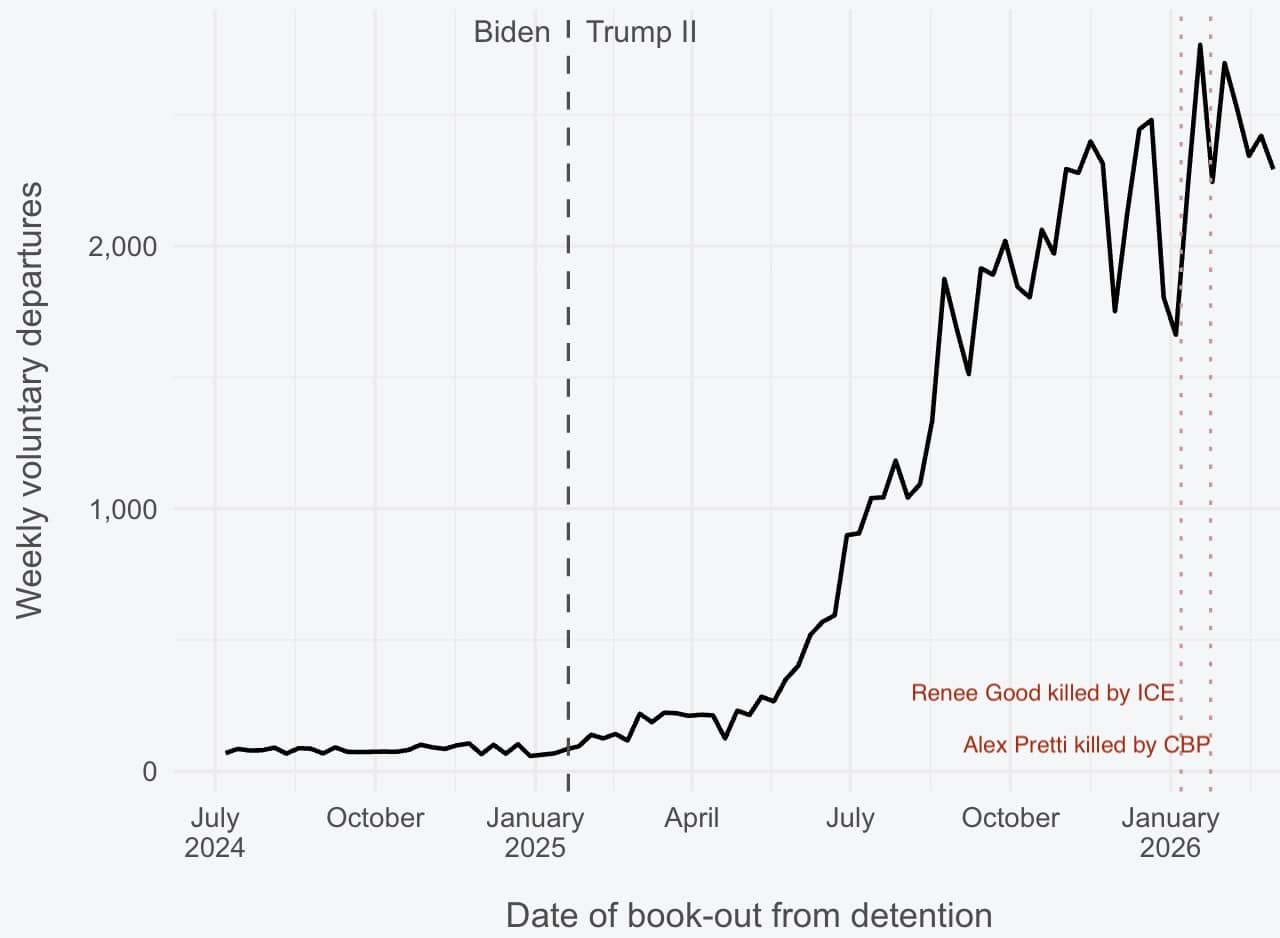
Voluntary Departures Increased by 28x—Deportation Data Project
Although the government’s Project Homecoming data is questionable, reliable data shows that the number of court cases ending in “voluntary departure” increased to 35,000—over three times those during the previous year. Looking at New York specifically, under Biden, less than 1% of people arrested by ICE opted for voluntary departure—today it is 22%. People are also deciding to self-deport without government intervention—but even at the point where they are boarding flights to return home, they are still being detained and handed over to ICE agents.
The end goal of this administration is really not just about deportation. It is about enabling white nationalism and authoritarianism through racial profiling, eroding constitutional rights, scapegoating and subjugating immigrants, and weaponizing a massive private, for-profit prison system.
WHAT CAN WE DO?
- Attend Sunday’s Know Your Rights / ICE Preparedness Training program from 1 pm to 4 pm.
- Read and share your awareness of the Deportation Detention Project’s extensive comparison of the last 6 months of the Biden administration through the first year of Trump’s second term.
- Add your voice to the petition demanding the shutdown of the Family Detention Center in Dilley, Texas.
- Financially support the work of UCLA’s Deportation Data Project, if you are able.
In solidarity and with collective care,
Jackson Heights Immigrant Solidarity Network (JHISN)
Follow @JHSolidarity on Facebook and Twitter and share this newsletter with friends, families, neighbors, networks, and colleagues so they can subscribe and receive news from JHISN.