
Tag: Hands Off NYC

JHISN Newsletter 11/21/2026

Dear friends,

No one knows for sure what political difference the dramatic outcome of the November elections will ultimately make. But for many of us, it certainly felt like a moment to celebrate, to cautiously hope, and to look around and start envisioning what might now be possible. 

And yet, our newsletter remains focused on the ongoing emergency so many immigrants still endure. Our first article gives an early post-election assessment of what the Democratic Party at the national level is signalling re: immigration policy. The news is not good. We remind ourselves that local, community-based, grassroots politics are necessary to keep pushing Congressional Democrats beyond cowardice and complicity. We then offer another update on the Trump regime’s systematic efforts to dismantle the decades-old Temporary Protected Status (TPS) program, and the pushback to try to regain legal status for hundreds of thousands of Haitian and Nepali residents—including our neighbors here in Queens.  

Newsletter highlights:
  1. Post-election Democratic majorities: what will they do for immigrants?
  2. Latest on TPS status for Nepalis and Haitians


1. Will the “Blue Wave” Help Immigrants? 

In the wake of a “blue wave” mid-term election, it seems as if the country is holding its breath, waiting to see if anything is actually going to change. For immigrants living in a state of emergency, the answer will be particularly consequential.

It is now clear that voters, especially Latinos, turned against the cruelty and chaos of the Trump regime’s mass deportation campaign. A Forbes report on exit polls indicates that 60% of all voters disapproved of how ICE is doing its job. 69% of Latino voters disapproved, and 87% percent of those disapproving voted Democratic. 

Trump’s response to this clear shift in popular sentiment was to elevate Stephen Miller—the main architect of the regime’s mass deportation campaign—to the key position of White House Chief of Staff. Trump insists that his policies on immigration will remain unchanged. After all, ICE has locked in more than $113 billion in Congressional funding over the last two years. 

Nevertheless, Democrats have won solid, if not veto-proof, majorities in both the Senate and the House. What will their response to the immigration emergency be?

Early signs are far from reassuring. At a well-publicized event outside Washington, D.C., on November 11, progressive and moderate Congressional Democrats united around a mild, “bipartisan” approach to immigration. Representative Henry Cuellar (D-Texas), who expects to chair the House appropriations homeland security subcommittee next year, said he “has a list of guardrails to revert ICE…to its role prior to Trump’s second term.” 

Much of the discussion centered on reviving a moribund “reform” bill that has garnered limited Republican support. The 2023 Dignity Act would allow those in the country “illegally” before 2021 to register for temporary legal status, as long as they meet various stringent requirements. Those accepted would have no path to citizenship and no eligibility for welfare programs. The Act also beefs up border enforcement and raises penalties for immigration offenses.

It’s striking that victorious Democrats somehow imagine this to be a moment to promote legislation that asks millions of undocumented immigrants to register with the Trump regime, and to provide extensive biometric and personal information, for a chance at temporary, limited legal status.

On the other hand, a post-election coalition of over 150 immigrants rights groups is publicly calling on Democrats:

”… to cut funding for federal immigration enforcement agencies and create a pathway for citizenship when the party takes control of the next Congress. In a letter sent Monday [November 9]… the groups urged Democrats to use their new congressional majorities to ‘prioritize a bold agenda’ on immigration and to hold the Trump administration accountable for the chaos fueled by its immigration crackdown.” —The Hill, 11/09/26

Notably, the letter insists on a pathway to citizenship for immigrants “without unnecessary and harmful compromises.” It advises Congress to freeze funding for ICE and Border Patrol until “transformative” reforms are made, and urges them to claw back immigration enforcement funding that Republicans had passed using the parliamentary maneuver of “reconciliation.” Signatories include the New York Immigration Coalition and the Worker Justice Center of New York.

Local and state Democrats often seem to respond more fluidly and directly to the human emergency posed by ICE’s mass detention and deportation campaign than their national counterparts. NYC Mayor Zohran Mamdani, whose election in 2025 could be considered the leading edge of the current blue wave, is an outspoken opponent of mass deportation. He recently demanded that ICE stop using city parks and parking lots as staging areas for immigration raids. “ICE has no right to use our property as a base for tearing families apart,” Mamdani said. “That goes for every park and every lot this City owns….If they keep coming back, we will see them in court.” This prohibition is supported by Governor Hochul.

It’s important to recognize that activist, street-level resistance to ICE contributed significantly to the “blue wave” by transforming public opinion about ICE throughout the country: 

“Left-leaning groups in Los Angeles, Chicago, and mostly notably Minneapolis organized aggressive opposition to Trump’s immigration raids in their communities, even as Democratic Party officials largely [accepted] that any discussion of immigration benefits Trump…. It was critical to have a strong activist community loudly casting the administration as authoritarian, essentially forcing the media and Democratic officials to stop ignoring the obvious.” —TNR, 10/10/26

Our own neighborhoods of Jackson Heights, East Elmhurst and Corona are part of this community resistance powering the “blue wave”—and requiring accountability from national Democrats. 

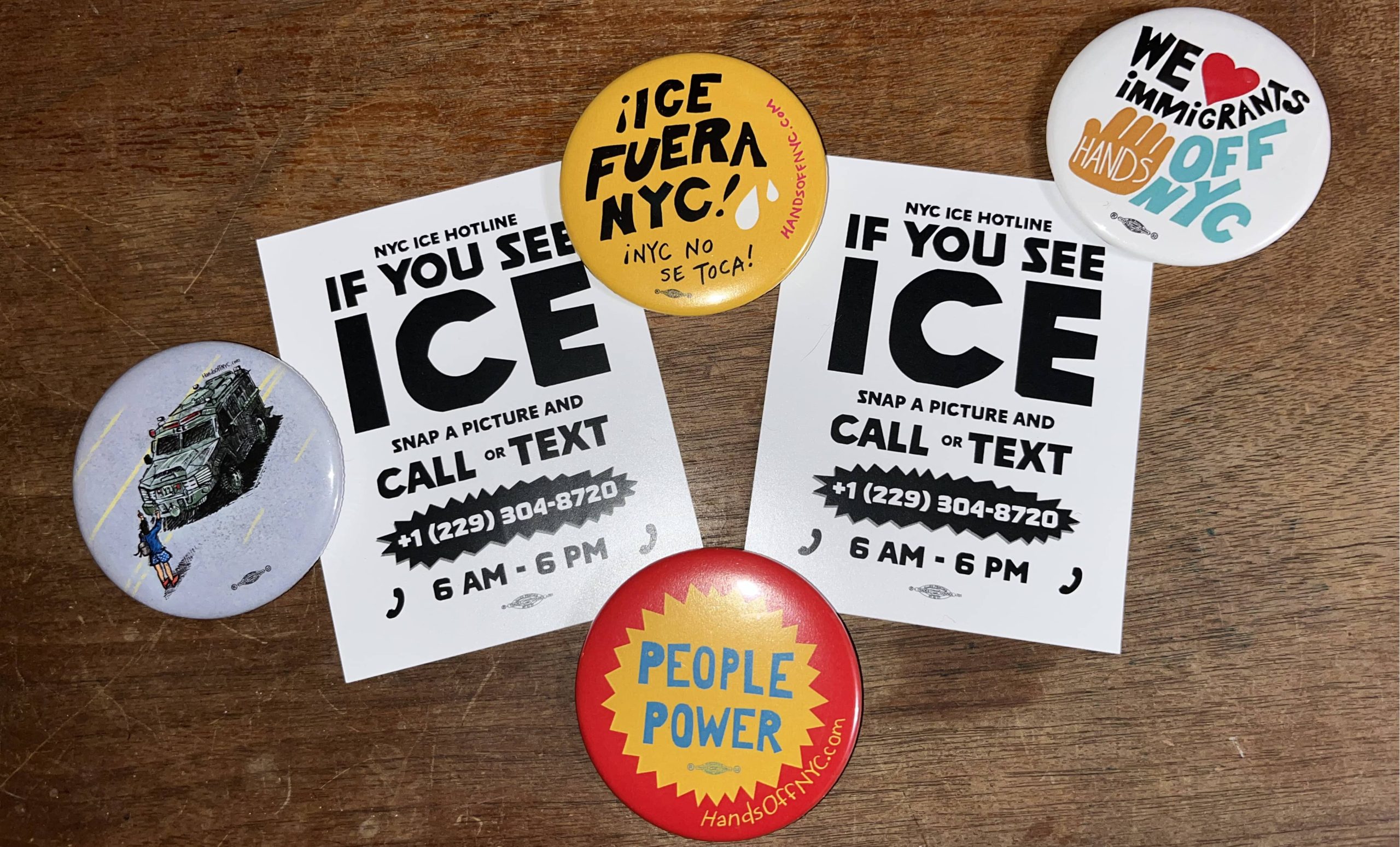
For instance, the ramped-up ICE presence on our streets starting this summer has been challenged by Queens Neighborhoods United, Hands Off NYC, ICE Watch, Indivisible and other grassroots local activists—providing warnings, documenting arrests, identifying staging areas, exposing illegal actions, and creating friction wherever agents of mass arrest and deportation appeared. 

And on Sunday, October 8, young people from local immigrant justice group Desis Rising Up and Moving (DRUM) initiated a state-level campaign against ICE’s horrible “shock gloves” that deliver a disabling electric shock to those they touch. DRUM Youth are gathering petition signatures demanding that Governor Kathy Hochul do more to prevent the use of the gloves in New York. 

Even after “blue wave” elections, it seems likely that local struggles will still be the center of gravity for anti-ICE activism. Congressional Democrats as a group must continue to feel pressure from below, as justice groups and outraged state and local residents demand immediate attention to immediate needs: the restoration of TPS, the end of warrantless arrests, the shutdown of ICE detention centers, and the thwarting of militarized ICE thuggery. In the midst of the blue wave, we can still see how resistance originates not at the ballot box but in our neighborhoods, our schools, our workplaces, and on our streets.

WHAT CAN WE DO?
  • Sign DRUM’s petition to Governor Hochul against ICE shock gloves.
  • Monitor NYC ICE Watch and respond to their local alerts.

2. Update on TPS Status for Nepalis and Haitians

As one brutal tactic in its anti-immigrant campaign, the Trump regime has been trying to eliminate Temporary Protected Status (TPS) for hundreds of thousands of immigrants, disregarding the dangerous conditions in various countries that meet the criteria for TPS. TPS permits eligible individuals from countries with unsafe conditions to live and work in the US temporarily. Unsafe conditions include natural disasters as well as armed conflict or other conditions that make living unsafe. TPS is renewable but not guaranteed and does not enable people to apply for citizenship. As follow-up to our previous reports on the weaponization of TPS, we look at current efforts to reinstate legal status for Nepalis and Haitians stripped of their protections. 

Nepali TPS

After various court decisions, on February 9, Nepal’s TPS designation and work authorization was finally terminated. This is dire news for 12,700 Nepali nationals living in the US.

Between January and April, there were large charter flights carrying 298 deported Nepali nationals back to Nepal. Charter flights paused when the Iran war began, but between July and October 22, 29 more Nepalis were deported on commercial flights.

On August 26, Nepal experienced catastrophic flooding affecting over 84,000 people, with additional floods and landslides in September. Because of these disasters, 57 members of Congress sent a bipartisan letter to President Trump and DHS Secretary Mullin expressing the need for renewed TPS for Nepal. They have not responded. In October, local immigrant justice group Adhikaar, together with the Non-Resident Nepali Association plus 50 other Nepali and allied organizations, urged the government of Nepal to request a new TPS designation.

Haitian TPS

The order to terminate TPS for Haitians came on July 27, and a previous stay of that order was lifted on August 5, 2026. This affects more than 350,000 Haitians living in the USA.

Haiti is a dangerous place with gangs controlling most of the capital; armed groups continue to perpetrate killings, kidnappings, and attacks against civilians, and nearly 1.5 million people are internally displaced. The US government has issued a travel advisory. Nevertheless, more than 470 Haitians were deported between August 30 and September 17, and 140 more in October.

Guerline Jozef, Founder and Executive Director of Haitian Bridge Alliance, stated:

“The Trump administration knows Haiti is not safe, yet it continues to deport people into a humanitarian catastrophe. Stripping hundreds of thousands of Haitians of Temporary Protected Status while sending families into conditions of violence and instability is a profound assault on human dignity.”

About 15,000 Haitians live in Springfield, Ohio. Many had TPS, some are citizens or have other legal status. Since August, many have lost their jobs, others have left the country, and those remaining live in fear. Resident Haitians in Springfield have been called to ICE offices to receive ankle monitors and turn in their passports. Five Springfield residents were deported in October.

Members of Congress have tried to get TPS extended for Haitians. In April, the House had enough bipartisan support to pass H.R. 1689  to extend TPS for Haitians until April 2029. In June, Senators Edward Markey and Lisa Blunt Rochester introduced the companion Senate bill 4814, which awaits approval. The bill currently has 46 cosponsors. The Haitian Bridge Alliance is urging people to ask their Senators to support the bill.

WHAT CAN WE DO?


In solidarity and with collective care,

Jackson Heights Immigrant Solidarity Network (JHISN)


Follow @JHSolidarity on Facebook and Twitter and share this newsletter with friends, families, neighbors, networks, and colleagues so they can subscribe and receive news from JHISN. 
JHISN Newsletter 12/20/2025

Dear friends,

Warmest greetings to our readers as the winter solstice arrives, giving us the dark gift of the longest night of the year. Together with many non-Western and indigenous cultures, we remember that the dark is a place of rest and dream, of healing and the first life of buried seed. May you be well, this winter season.

December confronts us with the growing presence of ICE in our neighborhoods. Our newsletter this month is devoted to citywide and community-based organizing to defend against the federal government’s paramilitary deportation operations. And we report on the first, though likely not the last, breach of masked federal agents with assault weapons on our streets in Jackson Heights on December 4. “We keep us safe,” says Black Lives Matter. May we keep safe together.  

Newsletter Highlights:
  1. Reportback on Hands Off NYC trainings
  2. ICE and federal agents’ operations in Jackson Heights


1. Hands Off NYC Bolsters Neighborhood ICE Watch

“Protests are great, but they are not enough. We need sustained neighborhood responses.”—Hands Off NYC trainer

On a recent Saturday afternoon, around 500 people rode an escalator past a wall inscribed with these incomplete words of MLK Jr., “FREEDOM IS NEVER VOLUNTARILY GIVEN BY THE OPPRESSOR”. The sentence continued, in his 1963 Letter from a Birmingham Jail, “it must be demanded by the oppressed.” Four hours later, the crowd left energized and educated by the articulate women-led activism trainers of Hands Off NYC, a coordinated initiative supported by over 100 community groups, union and worker organizations, and immigrant, human rights groups, and faith-based groups. They shared tactics and guidance for everyone to take action in their New York City neighborhoods to oppose the injustices that grow more egregious every day, including collective defense against the mass deportation campaign led by ICE. They talked about the Authoritarian Playbook of 2025, described “The People’s Response” as a culture of defiance, and concluded with a Know Your Rights (KYR) overview described as a way for us all to embody democracy. The day ended in smaller breakout groups for people who live in shared neighborhoods to meet together and plan next steps.

The training was geared particularly at people new to activism and immigrant justice struggles, and did not highlight the local organizing going on for decades by immigrant-led groups. Attendees were disproportionately retirees, women, and predominantly white. In one breakout room, just one man sat among 25 women; all of them willing to take to the streets to support the freedoms supposedly guaranteed to immigrant neighbors being snatched from local courthouses, streets, and homes, and now from interstate flights by the TSA, or threatened in hospitals, schools, and churches by masked and militarized government enforcers working for, or with, ICE. 

As the training began, the presenter noted an ICE raid was reportedly underway. The key to successfully opposing these federal incursions, she said, is to preempt, to prepare, and to stand up. Local action cannot come from the large groups like Hands Off NYC. Instead, local people must build within our own neighborhood communities for mass action and rapid response. We must create spaces where we protect one another. For this, effective communication will be vital. A retired woman in the crowd shared that she holds vigil with a silent protest outside her local subway stop—she stands holding posters of people ICE has kidnapped. The people walking by have been taking notice—slowing down and looking. A crucial first step is getting people to pay attention.

Another presenter stressed that a pillar of organizing is to do the work in places where you have influence. That is your power. That is how you reach people and make change. Yes, it was invigorating to see that the Hands Off NYC protests grew from 75,000 attendees to 125,000, and then to 300,000. The crowds reveal growing opposition to MAGA oppression; however, it is you, not that massive crowd, who can teach the people close to you about what we can do to prepare before ICE escalations occur. She suggests you take signs for businesses to hang up that clearly state which spaces are designated as private; that sign quickly shows federal enforcers where they cannot go without a warrant. You can choose the people you can influence. Talking to neighbors builds a Culture of Defiance, as shown when a group recently challenged the callous actions of ICE agents in Staten Island. 

One critical concept is the importance of bogging ICE down. Non-cooperation means you make things harder for the enforcers who rely on people abdicating their rights when faced with domineering actions. This also works for corporate accountability protests, such as the ice scraper slowdown at an LA Home Depot and, this past weekend, in NYC. 

Use your whistles to attract a crowd at the scene to reveal the problem. If it is between 6 am and 6 pm, then call the dispatch hotline 1-229-304-8720 to report the ICE activity. When others gather around, use chants like “Shame, Shame, Shame” or “Let Them Go! Let Them Go!”, shouted at the abductors. That has been a powerful way to reduce the aggression of the federal agents. It breaks their expectation that people will be docile out of fear. As a result, ICE has sometimes given up and left.

The trainers advised us, while documenting a raid, to film what is going on, focus on the facts, not emotions. Record, narrate, and describe the agents (not the abductee), including their clothing, their vehicles, their weapons. Use the SALUTE method to report what you have seen to local ICEWatch groups that you have found and joined. If the agents confront you with any questions, it is helpful to model the KYR response that you do not need to answer their questions. Importantly, they say, do not call the police: adding more armed enforcers to a group of armed enforcers is an escalation, not a slowdown. 

It is important to note that Federal agents are not immune from state prosecution. When appropriate, activists can upload videos and photos of the abductions, along with a SALUTE summary, to the NY State Attorney General’s Federal Action Reporting Form. You do not need to provide your own contact information.

Last weekend, in Queens, another well-attended borough-based training was held. The turnout allowed people to start discussing actions they can take in their designated neighborhood groups: Astoria; Woodside with Jackson Heights; Long Island City with Sunnyside; Forest Hills with Rego Park; Corona, Elmhurst, and East Elmhurst with Oakland Gardens; and another group for those from over 20 more Queens neighborhoods. On the following day in Jackson Heights, for two hours, ten people came together for the first time to create whistle packages for distribution to businesses and individuals. Local action is growing.

Serious challenges, of course, remain. It is immigrants themselves who must lead NYC’s battle with ICE. As the Hands Off NYC coalition itself insists, it is up to local communities to build networks and organize the fightback. A decisive role in our area will likely be played by the deeply rooted local immigrant justice organizations, who may have their own analyses of the situation, and their own tactics.

Yet Hands Off NYC has, in a way, “broken the ice,”  unleashing the energy of, and offering resources to, thousands of New Yorkers who are eager to oppose ICE. They have also given activists in various neighborhoods a framework for meeting and figuring out the way forward together.

To close, we offer a humble extension to the MLK Jr. quote that opened this article:

Freedom is never voluntarily given by the oppressor; It must be demanded by the oppressed; who must be defended by the people.

WHAT CAN WE DO?

2. Neighborhood ICE Raids: Update

“This is the first time we’ve seen something like this in Jackson Heights, on this level.” –neighbor, quoted in Queens Daily Eagle (12/4/25)

The news travelled fast and many of our readers may have heard: In the early morning of Thursday, December 4, dozens of federal agents armed with assault weapons arrived in unmarked vehicles and a helicopter to conduct a raid on a residential building near 34th Ave and 88th St. Many of the agents wore black masks and HSI uniforms (Homeland Security Investigations, an investigative arm of ICE). A video of the raid, circulated by State Senator Jessica Ramos, shows a militarized swarm of agents with rifles in our streets. Two residents of the building were taken away in handcuffs, while neighbors also swarmed the pre-dawn scene to verbally confront the armed agents.

The names of the people taken, where they are now, the target and rationale for the militarized spectacle of arrest remain unknown. But we do know this: one Jackson Heights resident reported “incredible pride at how many people showed up at six in the morning and just yelled in the faces of ICE agents on the street.”

In the hour before the December 4 raid, the masked federal agents blocked local traffic and set up a checkpoint for cars at a residential intersection. “Taken together, these raids and roadblocks build a steady drumbeat of fear and spectacle, even when there are no cameras around,” notes Epicenter news. The Jackson Heights operation, they explain, fits a broader pattern where we see ICE increasingly conduct “semi-covert” and quick “surgical actions” across the NYC boroughs, rather than the more publicized, dramatic raids we have seen documented on social media nationwide. “The effect is the same, if not greater—an atmosphere of constant fear and uncertainty for immigrants who live, work, congregate and raise families on these blocks.” 

As JHISN reports in our article above, people are getting angry and getting organized as a stunningly reckless, sadistic, and lawless mass deportation campaign ramps up and gets all too real. But we also join with longstanding immigrant justice groups, embedded in local immigrant communities, to caution against a singular focus on the threat and terror of visible ICE raids. We are reminded that solidarity includes honoring the existing immigrant networks of collective defense and community knowledge—invisible to those of us outside the networks—that have been doing the work behind the scenes to educate, communicate, defend, and support. We are asked to consider extending our commitments beyond whistles and rushing to the latest ICE sighting, to also include:  

  • Fundraising and donations: Organize aware friends and family into a rotating monthly donation pool. Fundraise in your pool for immigrant-led local groups who are doing direct mutual aid and support with impacted families around legal fees, rent, or lost income due to detentions.
  • Legal support: Attend legal webinars and monitor the constantly changing legal landscape for people who are detained. By supporting families or individuals through ongoing legal cases, we can learn hands-on what is needed and what is possible. 
  • Relations with activists living near detention centers: Reach out to and support the work of activists and allies who are geographically close to immigrant detention centers in New York and New Jersey or elsewhere. What actions can facilitate support for people being released from detention, or families trying to visit loved ones who are detained?  

As one respected Queens-based immigrant justice group notes: “The deportation machine is big and has many parts, we must match it with our skillsets and numbers.”

In just this past week, there have been reports of ICE using the vacant Rite Aid parking lot on Northern Blvd for a staging ground, and multiple ICE sightings in East Jackson Heights and Corona, with one arrest near the corner of Junction and Roosevelt. As responding to local threats becomes more urgent, let’s keep sharing what works. Let’s reflect on what we are best positioned to do. Let’s remember that all of this is also emotion work that needs to be grounded and sustained. And let’s collectively attend to how power is distributed within our cultures of defiance and our communities of care. 

WHAT CAN WE DO?


In solidarity and with collective care,

Jackson Heights Immigrant Solidarity Network (JHISN)


Follow @JHSolidarity on Facebook and Twitter and share this newsletter with friends, families, neighbors, networks, and colleagues so they can subscribe and receive news from JHISN.