Tag: Documented

JHISN Newsletter 05/24/2026

Dear friends,

Like the volatile Spring weather, the battle for NYC immigrants’ future runs hot and cold. We were glad last Monday when a federal judge ruled that ICE arrests at Manhattan immigration courts must be significantly curtailed. But that feeling of relief was soon tempered by learning that ICE detained a man at immigration court the very next day—and by awareness that ICE might respond to the ruling by increasing its presence on our streets. 

Today’s newsletter begins on a positive note by describing how NICE (New Immigrant Community Empowerment) has expanded its programs and physical presence in the neighborhood. Our second article dives into the little-known story of Omni Airlines, a billionaire-funded company noted for its particularly cruel ICE deportations. We share a revealing map that quickly shows the story of ICE activity in Corona, and conclude with information about an upcoming volunteer event—one where we hope you will join us.

Newsletter highlights:
  1. Going “beyond one-time assistance” for immigrants at NICE
  2. The airline you’ve never heard of that transports ICE deportees
  3. Mapping ICE activity in NYC


1. NICE: “From Surviving to Thriving”

Migration and displacement are overwhelming experiences. Community members must navigate complex U.S. systems—healthcare, employment, housing, and financial services—that are often unfamiliar and difficult to access. —NICE Fact Sheet

Since 1999, New Immigrant Community Empowerment (NICE) has been a crucial first point of contact in our neighborhood for thousands of recent Spanish-speaking immigrants seeking access to social services, legal advice, community, and basic survival assistance. NICE has long been known for its support for day laborers, its OSHA and ESL classes, and for political action in support of immigrant rights.

In recent years, NICE has expanded both its role and its facilities. Their current strategy gives priority to “holistic, culturally competent support that goes beyond one-time assistance.” A key feature of this strategy is the Pre-Apprenticeship Program for Life and Work (Pre-APLW). This apprenticeship program offers English-language, legal, and job-related training. But it also helps immigrants build other practical skills useful in navigating life in the US, including:

  • accessing health and mental health services
  • learning more about transportation systems
  • strengthening financial literacy
  • dealing with New York’s rental and real estate markets

Pre-APLW is organized around intensive workshops. These typically include 25 to 30 participants, who devote 30 to 40 hours a week for four weeks. NICE has contacts and partnerships with potential employers, allowing Pre-APLW Apprentices to obtain hands-on experience and job opportunities. Like all NICE programs, Pre-APLW aims to promote social and political leadership and build community among immigrants.

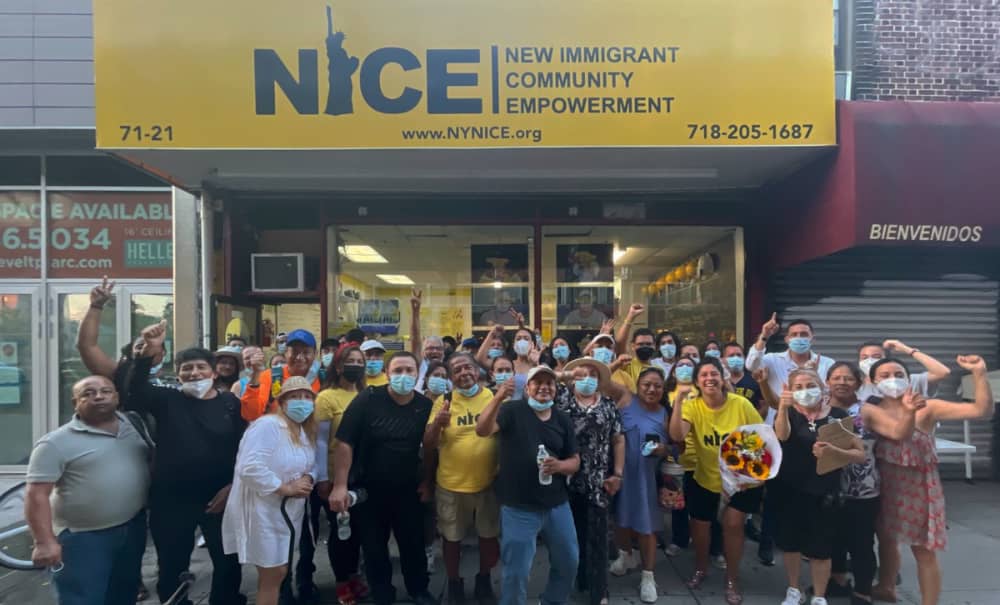
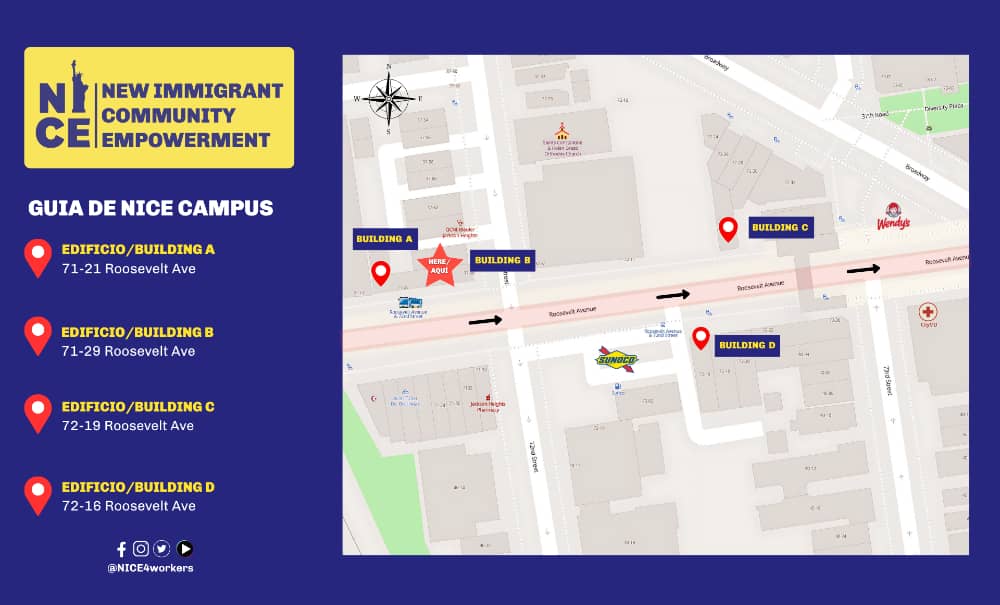
NICE has recently acquired and renovated additional spaces around Roosevelt and 72nd Street, becoming a small campus. This includes a community center, event and meeting areas, classrooms, and offices. The organization hopes to keep expanding to further meet the needs of their members and all recent immigrants. 
Funding for NICE’s work comes from a combination of government grants, philanthropic or corporate donors, and private contributions. Volunteers are encouraged to assist at the organization’s community events, such as their winter toy giveaway and their Thanksgiving distribution. NICE is currently campaigning to build community support by sponsoring runners in this year’s New York Marathon.

WHAT CAN WE DO?

2. Omni: ICE’s “Special” Airline

“To leave human beings warehoused on a tarmac for hours reveals a system that does not see them as people. This is not simply a logistical error; it is a feature of ICE’s inhumane mission.”Jo Jordon of No ICE NH

Michael Dorrell, an immigrant from Australia, made billions as a financial investor in logistics companies like the Air Transport Services Group, ATSG, which owns Omni Airlines, a passenger airline that, through the broker Classic Air Charter, contracts with ICE to provide airline deportations. Omni is reportedly the sole provider of “special high-risk charter” (SHRC) deportation flights. Since other airlines refuse to provide that service, Omni charges ICE twice the standard rate for similar flight services, over $33,000 per hour. Comparing the ICE deportation machine to Amazon for people is more than a metaphor: between 2016 and 2024, Amazon acquired over 13 million shares in ATSG, and ATSG expanded the number of cargo planes leased to Amazon in an operating agreement that is good to 2029.

The Torture Abolition and Survivors Support Coalition demanded, in 2022, that Omni suspend cooperation with ICE due to the many human rights violations created by their deportation work. Omni did not stop. In fact, that year, the US government gave Omni $67 million in COVID bailout funds and awarded them a $78 million contract. The airline’s treatment of immigrants actually got worse: flights have become longer and crueler. In 2024, Omni had just six trips that took more than 24 hours to complete, using multi-destination hops. By the end of 2025, 31 flights took between 24 and 50 hours—some have taken 70 to 80 hours. Deportees are held in shackles for the entire duration–an ICE requirement–and deportees have sometimes gone 10 hours without food or water. 

ICE talked publicly last year about possibly purchasing its own fleet, but for now, it works with between 8 and 14 aircraft from about 10 contractors to oversee about 15,000 deportations every month. To reach Trump’s goal of 1 million annual deportations would require 83,300 removals every month, which would require more than 50 planes.

Thomas Cartwright offers a stark contrast with Dorrell.  He is a retired financial investor who, when working with Witness at the Border in 2019, learned about the dehumanizing deportation flights leaving small border airports. He used his skills to track deportation planes using flight-tracking apps. It was his work that revealed the details about the notorious CECOT flights last year. He trained others in his process and has transferred the bulk of the work to Human Rights First, which now publishes monthly reports. April’s report holds 32 pages of revealing details, including:

  • The number of flights for both internal transfers and removals.
  • The use of coast guard flights in the deportation machine.
  • The number of planes provided by each airline carrier.
  • The path of a 51-hour flight carrying deportees to 6 countries.
  • How many times each airport is used: Alexandria, in Louisiana, had the most usage at 2,439 flights.

The contrast of the work these two people have done reveals the difference in mindset between a person who is seeking to make money regardless of how people’s lives are horrifically impacted, and a person who is looking to help his community do well by other people instead of blaming and abusing them.

WHAT CAN WE DO?

3. Locally Mapping ICE 

There are data analysts, such as Danielle Harlow, who examine ICE records nationally to produce public data visualizations showing deportation flights and the locations from which people were taken.  NYC activists are also gathering data to tell the stories of local people kidnapped by ICE enforcers. Corona-based Queens Neighborhoods United (QNU) has been tracking neighborhood ICE raids and verifying the locations where they have kidnapped people. 
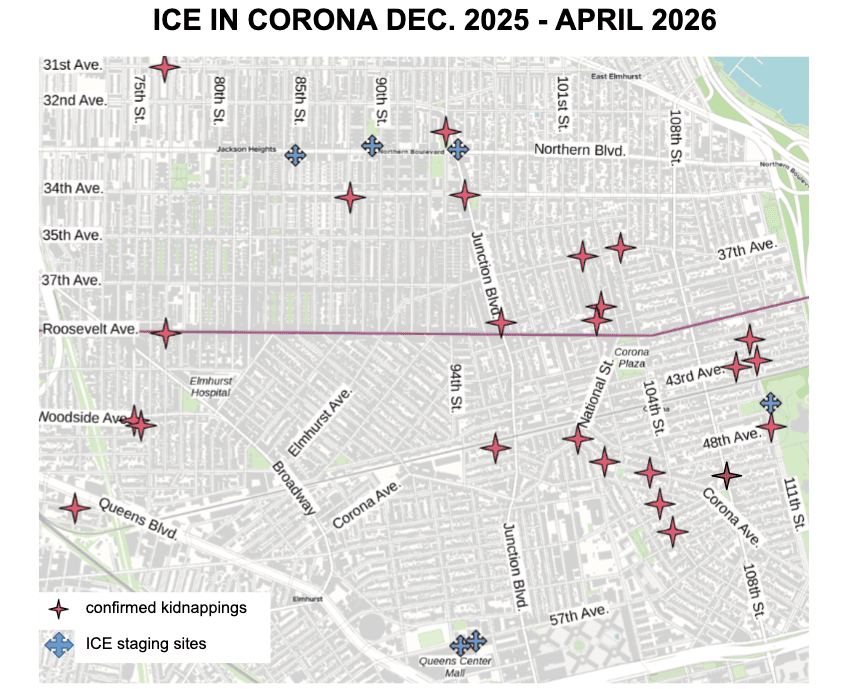
 

NYC Icebreaker has been tracking ICE actions throughout the city: their work has revealed that raids are most likely to take place between 7-8 am and 3-5 pm. Monday seems to be the most popular day of the week for ICE to stage their raids in Corona, Tuesday in Bushwick, and Thursday in Sunset Park.

Maps like these are helpful, but incomplete. At last weekend’s anti-casino town hall meeting, it was noted that hundreds of people per month are taken from NYC streets to endure the excruciating flights and inhumane detention centers. Neither maps nor figures can show the full extent or cruelty of the process. 

Like so much immigrant justice work, tracking and mapping ICE is the work of small, local, volunteer-led groups who need support from neighbors and progressive journalists to continue raising awareness and speaking out against the injustices of the deportation machinery.

WHAT CAN WE DO?
  • Join JHISN, Brave of Us, and others at the Community Volunteer Morning organized by Documented, the multilingual, immigrant-driven news outlet we have covered in this newsletter (and often use as a source):

    “Saturday, June 6, from 10:00 AM to 12:00 PM: Distribute newspapers and guides to community spaces (houses of worship, small businesses, community centers, and busy public areas). Engage with residents about their information needs and build community in real time, together— and over food and drink.” INFORMATION AND RSVP


In solidarity and with collective care,

Jackson Heights Immigrant Solidarity Network (JHISN)

Follow @JHSolidarity on Facebook and Twitter and share this newsletter with friends, families, neighbors, networks, and colleagues so they can subscribe and receive news from JHISN. 


JHISN Newsletter 08/23/2025

Dear friends,

When this week a six-year-old child attending P.S. 89 in Queens is deported to Ecuador; when this week a US Court of Appeals upholds the cancellation of Temporary Protective Status (TPS) for many of our Nepali neighbors; when this week a reported 40% of the arrests so far in the Trump regime’s hostile takeover of Washington, DC, are undocumented immigrants—it can feel like immigrant justice is an impossible dream. 

But. This week, we bring you stories of the organized resistance of everyday people in Los Angeles to ICE raids and federal government terrorizing of immigrants, with an eye towards the near future of resistance we might organize here in Queens. We also take a deeper dive into Documented, an ambitious, vibrant NYC digital media organization bringing community journalism (in multiple languages) to immigrant issues and audiences. 

Newsletter highlights:
  1. Resisting ICE violence from LA to JH
  2. Documented: New York’s immigrant-focused digital news hub


1. Los Angeles, Manhattan…and Queens?

The Trump regime is following through on its promise to unleash ICE thugs on sanctuary cities and “the core of the Democrat Power Center.” But mass deportation is taking different forms in NYC and LA—and so is the resistance by immigrants and their supporters.

In NYC, ICE has concentrated its efforts on kidnapping immigrants—more than 2,600 people so far—when they show up for scheduled immigration hearings at the courthouses in Federal Plaza in Manhattan. Recent reports indicate that ICE no longer even bothers to check asylum-seekers’ legal status: people are being detained, separated from their families and held under horrifying conditions even when a judge has continued their case and assigned it a future hearing.

Immigrant justice activists in our city are pushing back on several fronts. Lawyers are filing for remote appearances (by video) instead of in person. Citizen residents are going to Federal Plaza to bear witness and to accompany immigrants. A recent legal victory by the ACLU, Make the Road NY, and other groups has succeeded in slowing down the arrests, at least temporarily. There are daily demonstrations in Federal Plaza, some of which include civil disobedience. Yet many immigrants are deciding not to show up for their scheduled hearings, even though that means they will definitely be subject to a deportation order.

3,000 miles away in Southern California, ICE has focused its attacks on immigrants at workplaces, and especially at day labor pickup sites. They’ve unleashed swarms of militarized agents without warrants who don’t even pretend to search for specific individuals. Instead they chase down and detain whole groups of workers who “look Latino”—racial profiling in its boldest form. These ugly raid spectacles have more public visibility than the indoor arrests at NYC’s Federal Plaza. Partly for that reason, they have caused widespread mass revulsion and political backlash in Southern California. Most state and local politicians have spoken out strongly against the raids; LA Mayor Karen Bass has called for ICE to end its “reign of terror” in the city. A lawsuit to stop warrantless arrests of Latinos in Los Angeles has had early success.

At street level, key leadership of the resistance in Southern California has come from the National Day Laborer Organizing Network (NDLON), a 24-year-old worker center with extensive community and national presence. (New Immigrant Community Empowerment in Jackson Heights is a member of their national network.) In the LA area, NDLON often draws on Mexican cultural and political traditions to rally its members and supporters. It sponsors a band, Los Jornaleros del Norte, who play highly danceable protest songs denouncing ICE and promoting the dignity of Latino immigrant labor. In the wake of an ICE raid, NDLON’s large flatbed truck, with Los Jornaleros del Norte performing on board, may drive slowly down the street. Dozens or hundreds of residents come out of their houses and follow—marching, dancing, waving protest signs and Mexican flags—to demand an end to ICE brutality towards workers and the community.

Along with other groups such as Unión del Barrio, NDLON tracks ICE activities and shows up to try to disrupt ICE attacks. The group also participates in anti-ICE lawsuits, and raises money from the wider community to assist families of arrested immigrants as well as street vendors unable to work because of the threat of deportation. NDLON sponsors lively demonstrations, block parties and street festivals with anti-ICE themes, and organizes supporters to “adopt a day labor corner.” They regularly take to Instagram and other social media to uphold day laborers as pillars of the community and to denounce ICE’s racism, violence, and disrespect for all residents. NDLON seems to be growing in influence in Southern California, as they provide focus for the anger and resistance of ever wider parts of the population.

NDLON is central to a national campaign and series of boycotts against Home Depot, the giant chain of construction supply stores where many day laborers assemble to find work, and where many large-scale raids have taken place. Anti-Home Depot actions have been endorsed by some 50 progressive organizations, and are happening in multiple locations including New Jersey and Westchester. Demonstrators demand that the corporation keep ICE out of their parking lots unless they can show a judicial warrant, and they call on Home Depot to give financial restitution to workers who are detained in mass raids. 

The example of NDLON and other energetic resistance forces in Southern California provokes the question of how mass community street support can be mobilized here in Queens, which includes so many immigrants and their family members, friends and supporters. Circumstances are clearly different here. ICE’s current NYC arrests have a lower public profile, and have mostly been carried out in Manhattan, even when targeting Queens residents. There are many different immigrant nationalities in our neighborhood, each with specific urgent issues to address, speaking a variety of languages. We have no local umbrella organization of immigrants and supporters, nor, obviously, is there a single musical group that can help galvanize street protest.

But we’re pretty sure that it’s only a matter of time until ICE expands its attacks on our local streets. And we believe that there are thousands of local residents, including many of our readers, who oppose their fascist agenda. Is there a way for the diverse grassroots immigrant-led organizations here to unite, to support each other for mutual benefit, and to begin to rally the whole community behind them on the streets? Will we come out of our homes together to protest and confront ICE? Answers to those questions will prove crucial over the next months and years.

WHAT CAN WE DO?
  • Follow National Day Laborer Organizing Network (NDLON) on social media to learn about the tactics, activities, media and arguments they employ in Southern California and nationally.
  • Donate to or volunteer with NICE, our local affiliate of the NDLON.

2. Documented’s Digital Media: NYC Community Journalism With, And For, Immigrants  

“I have long dreamed that New York immigrants should have such media. Finally, you young media people with talent, conscience, and sense of responsibility have done it.”  —message posted to Documented’s WeChat community (translated from Chinese)

We are excited to encourage readers to explore Documented, an award-winning, independent NYC-based digital media non-profit that generates immigration news daily. With a long-term vision of producing more and better coverage of immigrant issues, they have transformed how that news is produced. This summer, Documented joined with four other immigrant news organizations nationwide to found the Immigrant News Coalition, dedicated to news that reflects immigrants’ experiences and responds to their needs. Since 2020, over 150 ethnic media newsrooms have closed down, so the Coalition’s commitment to sustainable, skilled, well-funded “immigrant-centric” news media is especially critical. 

Community journalism is at the heart of Documented’s commitment to respond to, as well as report on, immigrant concerns. Documented’s community correspondents are part of their communities of coverage. They conduct audience/reader research and design new digital media products that engage with community members (online and in-person), using that engagement to generate investigative stories and news insights. In 2022-23, community correspondents at Documented conducted audience research with NYC’s Chinese and Caribbean immigrant communities, then innovated two new digital platforms to serve those communities in their own languages. With a $2 million grant from the Knight Foundation, Documented is building curricula and training for other news media to develop “community-driven reporting” and expand audiences nationwide.

This week in Jackson Heights, Documented and New Immigrant Community Empowerment (NICE) co-organized an Education Resource Fair on 35th Ave. School supply giveaways, medical screenings, and activities for kids targeted both parents and students, aiming to support a successful start to the new school year. Live events like the Fair are an integral part of Documented’s community engagement; in 2024, they hosted in-person events involving 600 New Yorkers across three boroughs, building “trust with the people behind the news.”

Launched in 2018, Documented has altered the landscape and ecosystem of immigration news in New York City, offering a robust range of news stories and resources over multiple digital platforms, and in multiple languages (Spanish, English, French, Chinese, and Haitian Creole):

  • WhatsApp Documented Semanal—Their Spanish-language WhatsApp channel, started in 2019, serves weekly news to thousands of NYC immigrants, many undocumented. The channel is a two-way bridge as immigrant audiences can inform Documented’s journalism by asking questions, posting insights, and sharing information. Documented Semanal also hosts Q&A sessions where subscribers can text questions to ‘experts’ including immigration lawyers, diplomats, and professors.
  • WeChat community—Their Chinese-language WeChat community (named ‘New York Immigrant Chronicle’), started in 2023, serves NYC’s Chinese immigrants, most of whom receive their news via the WeChat platform.
  • Nextdoor newspage—Research indicated that over 30% of Caribbean residents actively use Nextdoor as their communication platform. So Documented created a Nextdoor presence to bring community-driven news to them. “[W]e are bringing onto this platform—where people usually talk about their lost cat…—serious news content sparking a new kind of conversation,” writes Documented’s Caribbean communities correspondent.
  • Documented.Info—Created in partnership with the International Rescue Committee (IRC), this web-based project offers trusted and regularly updated information about a rich range of “actionable resources” re: immigrant housing, education, legal support, deportation and ICE, jobs, health, and more. An extensive Service Map marks locations and gives descriptions of hundreds of NYC sites/resources.  

These innovative digital media projects are in addition to the in-depth reporting that regularly flows from Documented’s ambitious newsroom. In this month alone, they published stories on how Chinese-American voters in South Brooklyn view Zohran Mamdani’s mayoral campaign; Mayor Adams’ veto of a City Council bill that would decriminalize street vending and protect vendors from deportation based on a “criminal” record for selling without a permit; a federal judge’s Temporary Restraining Order in response to the ACLU’s class action lawsuit against inhumane conditions at 26 Federal Plaza where ICE is detaining immigrants; and rallies and resistance in Queens to the cancellation of Temporary Protective Status (TPS) for hundreds of thousands of US residents. Such a vital, vibrant news organization has earned our support, and the best support you can offer is to read and share Documented’s ongoing experiments in community journalism. 

WHAT CAN WE DO?


In solidarity and with collective care,

Jackson Heights Immigrant Solidarity Network (JHISN)


Follow @JHSolidarity on Facebook and Twitter and share this newsletter with friends, families, neighbors, networks, and colleagues so they can subscribe and receive news from JHISN. 
 

JHISN Newsletter 07/26/2025

Dear friends,

Like many of you, we find ourselves at risk of being overwhelmed every week, sometimes daily, by immigration news. Much of it bad and some of it almost unbelievable. We continue to publish our monthly newsletter with a local focus whenever we can—looking at both the forces aligning against immigrant lives, and those allied with solidarity, resistance, and community-based care. None of it makes any sense without you, our readers, taking this news and acting when and where you can, for immigrant justice and power. Thank you for continuing to read the newsletter—and for using it as a tool in our common struggle.

Today’s issue takes on systematic wage theft—disproportionately experienced by immigrant workers—while highlighting how common it is in our own neighborhood. The newsletter also returns to the urgent issue of the Trump regime’s attempts to cancel Temporary Protective Status (TPS) for hundreds of thousands of legal immigrant US residents, including many in the Nepali community here in Queens.  

Newsletter highlights:
  1. Wage theft is all around us
  2. Temporary Protective Status (TPS) under assault: an update


1. Wage Theft is All Around Us

Wage theft is rampant in industries that employ large numbers of immigrant workers. These include agriculture, building maintenance, garment assembly, hotel, restaurant and food service, construction, nursing homes, nail salons, warehouses and car washes. Inequality.org states the obvious: “Undocumented workers are particularly vulnerable to wage theft as they are often the least likely to report violations due to fear of retaliation, job loss, or exposure of their immigration status.” This has become an even more pressing consideration as the terror of the Trump regime’s mass deportation accelerates.

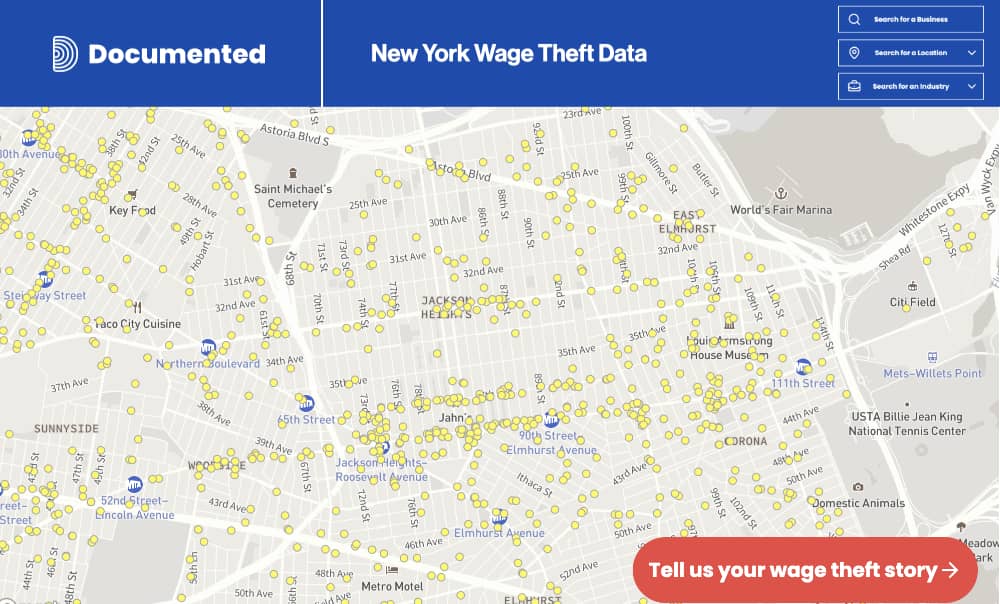
The Center for Popular Democracy reports that “An estimated 2.1 million New Yorkers are victims of wage theft annually, cheated out of a cumulative $3.2 billion in wages and benefits.” Wage theft among New York City’s 300,000 low-wage workers is reported to be roughly $18.4 million per week. The widespread nature of wage theft in the state and city can be visualized by clicking on Documented’s Wage Theft Monitor. The Monitor is based on state and federal data acquired through Freedom of Information requests. It records thousands of final wage theft settlements—large and small, in every neighborhood—including hundreds of findings against businesses in our area. 

Examples of wage theft in Queens alone seem endless:

  • In 2020, Desis Rising Up and Moving (DRUM) organized a large protest outside Sona Chaandi, one of the largest jewelry stores on 74th Street. Demonstrators accused the owners of sexual harassment, as well as wage theft. Nargis, an immigrant DRUM member and former employee, told the rally that she was harassed, paid $50 to $75 for 10 hour days, and forced to take care of the owner’s elderly parent without pay. The Documented Wage Theft Monitor shows that Sona Chaandi was eventually ordered to pay $65,000 to two unnamed workers.
  • Some local eating and drinking establishments with immigrant work forces have faced large wage theft settlements. El Picosito Bar on Roosevelt was ordered to pay $237,621 to 10 workers a few years back. La Boina Roja Steakhouse was recently ordered by the state to pay $221,130 to 11 workers, according to the Wage Theft Monitor. National chain restaurants are also implicated. For instance, Chipotle on Northern Boulevard was ordered to reimburse 85 workers in a wage theft case filed in 2023.
  • In 2022, Attorney General Letitia James announced a settlement of more than $90,000 in favor of several Astoria laundry workers. The Laundry Workers Center, which primarily represents immigrant women of color, did the initial investigation on the case and pushed it to the AG’s office.
  • That same year, James also won a $130,000 settlement for two building superintendents in Flushing who were paid no wages at all—the owners had decided that a rent-free apartment would serve as their only compensation.
  • Last year, Make the Road New York was instrumental in publicizing and filing a disturbing wage theft complaint by Ecuadorian migrants at a tobacco packaging factory in Queens. Workers assert that they were paid about $4 an hour, working in sweatshop conditions 10-13 hours a day, seven days a week.
  • This summer, Assemblymember Shekar Krishnan took the lead in trying to terminate lucrative city contracts handed out to Griffin’s Landscaping, a firm accused of repeated wage theft and other illegal behavior.

Unfortunately, many ripped-off immigrant workers never get a legal settlement, or any kind of justice. Even those bold enough to file complaints with state or federal authorities face an uphill struggle. They may win their cases, which often take years, and yet the employer stalls, refuses to pay the judgement, hides, or declares bankruptcy.

“Hildalyn Colón Hernández, deputy director of New Immigrant Community Empowerment, a New York-based worker advocacy organization, said, ‘Employers are operating with no consequences’….Colón Hernández added that her organization now trains its employees on how to investigate wage theft because it would take too long if they had to rely on federal or state investigators to recover back wages.”  —ProPublica, 8/22/23

WHAT CAN WE DO?

2. The Impact of TPS Changes for NY

“The law is very clear that once the TPS extension has been granted, it cannot be taken away en masse. This is the first time in the 35-year history of the TPS statute that anyone’s ever tried to do that.” Ahilan Arulanantham, co-director, Center for Immigration Law and Policy, UCLA School of Law

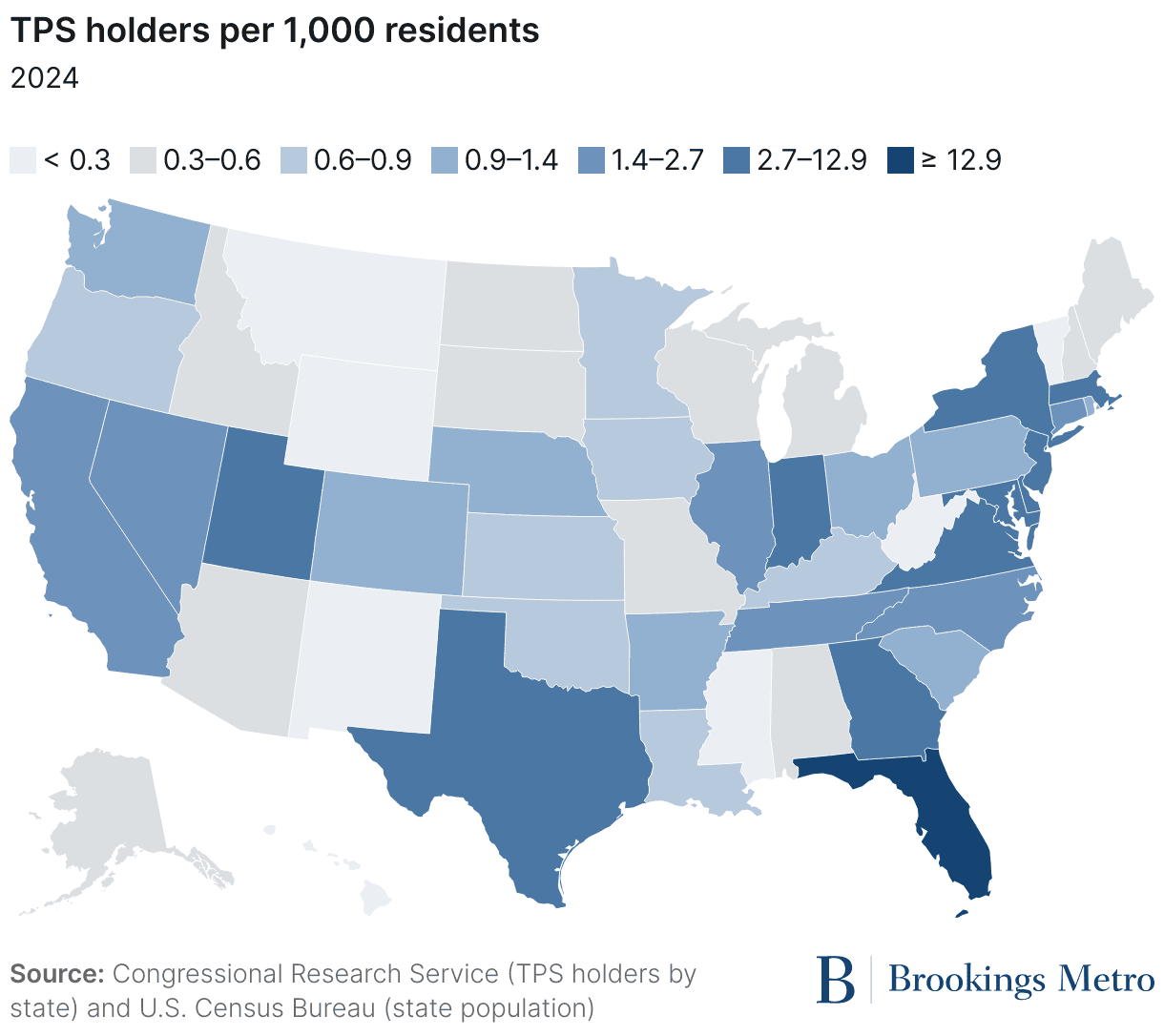
The Brookings Institute warned that Trump’s campaign promises targeting immigrants “would have disproportionate impacts on U.S. cities and urban areas, given that most foreign-born individuals live and work in these places.” Among US counties with undocumented populations, Queens is ranked the sixth-largest and has over three TPS holders per 1,000 people. (With a population of about 2,250,000, that amounts to over 6,750 TPS holders.) The Trump regime, led by Stephen Miller’s hard-line propaganda, aims to abruptly end TPS status for hundreds of thousands of US residents, which disproportionately threatens people living here in Queens and NYC.  

About 40% of the migrants who arrived in NY in 2022-23 came from Venezuela under TPS protections. New York City has the second-largest TPS-eligible Haitian population in the nation, which comprises about 3% of the city’s population. Among other TPS recipients, New York City also has the largest Honduran population and, residing in both Woodside and Jackson Heights is the second-largest Nepali migrant population in the country. Around Flushing and Kew Gardens, there is a large population of Afghan immigrants in Queens. 

These groups combined comprise 87,000 TPS holders in New York state who are specifically under threat from the questionable legal actions spearheaded by the Trump administration to strip their legal authorization to remain and work in the US, making them all detainable and deportable. The inappropriately named One Big Beautiful Bill, which barely received enough votes to become law, supplements these attacks by requiring higher fees for individuals to submit forms necessary to file in court to fight against potential deportation. The Showcase of Nepalis in New York (NepYork) published the full details of these cost increases. NepYork also reported on a recent NJ event organized to discuss increased deportation threats and the imminent termination of TPS for Nepalese immigrants. 

“TPS is ending on August 5 [for Nepal], and thousands of lives are hanging by a thread. We organized this not just because the law is changing, but because our families are suffering silently. Many don’t know their rights. Many are scared. We have organized this event to help them find a way and let them know they are not alone.” Dr. Bishnu Maya Pariyar, Program Director at Hudson S.P.E.A.K.S.

Pushback against TPS terminations includes Maryland Senator Chris Van Hollen’s SECURE Act, introduced last month along with 30 other senators. The bill would secure a pathway to permanent residency and is supported by numerous unions, CASA, the National TPS Alliance, and the National Network for Arab American Communities. Additionally, in February, the Dream and Promise Act was resubmitted—a bipartisan bill supported by nearly 200 representatives that would protect DACA recipients as well as TPS holders.  

On Monday, July 28, Queens Borough President Donovan Richards will hold a rally at 6:00 PM at Queens Borough Hall to support community members who are deeply affected by the terminations of Temporary Protected Status. Haitian-American City Councilmember Farah Louis has also spoken out against the efforts to end TPS. She notes that people fled their dangerous home countries, came here for a better life, they work for local businesses, and invest in the economy here—and now all that is about to be snatched away. Brad Lander, the NYC Comptroller, has published Protecting Our Neighbors, describing the humanitarian costs of cancelling TPS. His report also highlights the defunding by the Trump and Adams administrations of vital legal services used to protect over 1,800 children whose lives will be disrupted by this change.

Hundreds of thousands of TPS recipients, along with family members and supporters, await the outcome of the numerous challenges made in court by the National TPS Alliance, CASA, Haitian Americans United Inc., and the Haitian Evangelical Clergy Association as the clock ticks down towards deadlines that threaten to end their legal status. 

Country Designation Date Most Recent Action Expiration Date # Individuals
Afghanistan* May 20, 2022 Termination (5/13/25) July 14, 2025 11,700
Cameroon* June 7, 2022 Termination (6/4/25) August 4, 2025 5,200
Haiti* Jan. 21, 2010 Termination (7/1/25) Sept. 2, 2025 348,187
Honduras* Jan. 5, 1999 Termination (7/8/25) Sept. 8, 2025 72,000
Nicaragua* Jan. 5, 1999 Termination (7/8/25) Sept. 8, 2025 4,000
Nepal* June 24, 2015 Termination (6/6/25) August 5, 2025 12,700
Venezuela* Oct. 3, 2023 (re-designation) Termination (2/5/25) Not applicable 348,202

Table compiled by bhfs 7/22/2025
* Asterisks denote ongoing litigation 

WHAT CAN WE DO?
  • Local group DRUM has been organizing for 25 years and supports the Nepali population under threat from TPS terminations. Join their 25×25 campaign and have 25 of your own contacts donate $25 to support their work.
  • The National TPS alliance includes, among others, the National Day Laborer Organizing Network (NDLON), Adhikaar and the Haitian Bridge Alliance. If you are able, consider donating to any or all of these organizations.
  • Attend the rally this Monday, July 28, at 6pm at Queens Borough Hall to demand continued TPS protections for immigrant neighbors. 


In solidarity and with collective care,

Jackson Heights Immigrant Solidarity Network (JHISN)


Follow @JHSolidarity on Facebook and Twitter and share this newsletter with friends, families, neighbors, networks, and colleagues so they can subscribe and receive news from JHISN.