Tag: Jessica Gonzalez-Rojas

JHISN Newsletter 08/29/2026

Dear friends,

As promised, ICE has ramped up its activities in New York, and significantly in Queens. Organizations like the Deportation Project are keeping us all informed through Freedom of Information Act lawsuits, which force the federal government to share its enforcement data. Locally, ICE watch groups are also on the lookout, and rapid responders (still mostly women) are hitting the streets when ICE sightings are reported. In July, a new high of 804 arrests were made in NYC. 80% of nationwide detentions were of people with no criminal history. Jackson Heights, East Elmhurst, and Corona are all in the top 5 of NY neighborhoods with the highest arrest reports.

Our newsletter delves into the overreach of Homeland Security as ICE grabs at yet more data in its attempt to locate people to deport: this time it is the details stored in commercial drivers license databases maintained by states. But the states are fighting back with lawsuits to prevent them. Following a “Know Your Rights Week” in Queens we also look at the reticence by Democrats, locally and nationally, to call for the full abolition of ICE, even though no one is happy with their hateful and hurtful and harmful tactics.  

Newsletter highlights:

  1. NY in the fight to keep commercial drivers license data private
  2. The call to abolish ICE has been losing steam


1. Feds Demand Access to State Commercial Drivers’ License Databases

The Trump administration wants states to allow access to their drivers’ license databases. This would permit the federal government to see the personal information of 17 million commercial drivers nationwide. The databases include names, birth dates, and Social Security numbers of holders of commercial driver’s licenses. A multistate coalition of 21 state attorneys general (including New York and New Jersey) has filed a lawsuit to prevent access. If states do not comply, the federal government threatens to withhold funding for the databases. The legal issue is privacy and control over huge amounts of personal information.

The federal government has not stated what it plans to do with the information. Still, the lawyers believe the Federal Motor Carrier Safety Administration, part of the Department of Transportation, plans to share the information with DHS for use in immigration enforcement, whether or not the information is accurate.
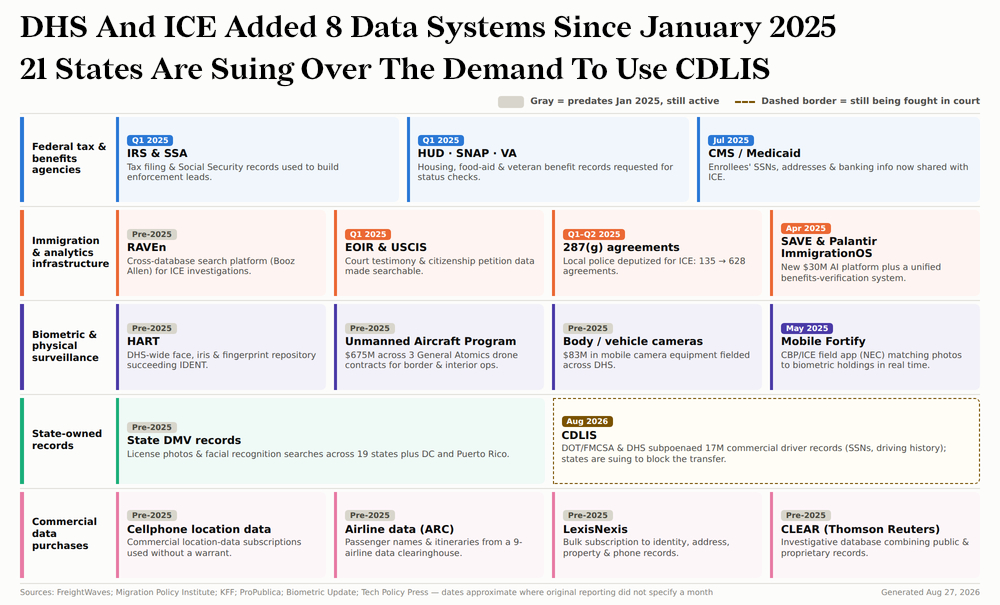
How the CDLIS data grab fits into the data sets Homeland Security has already grabbed.


In a statement, DHS said the administration is targeting dangerous “illegal aliens” whom it says don’t know traffic laws or English and criticized politicians who allow dangerous drivers on the road. The order demanding information was issued in February 2026 by Transportation Secretary Sean Duffy. It cites seventeen crashes involving non-domiciled drivers (less than 0.5% of all fatal crashes). This followed Duffy’s September 2025 order removing nearly 3000 commercial driver training centers from approved provider lists.

In fact, requirements for commercial drivers’ licenses are very detailed and include criminal background checks, drug use tests, written tests, and behind-the-wheel (BTW) tests. There are different requirements for passenger vehicles, taxis, school buses, trucks of different types, construction equipment, and hazardous materials driving. All tests are in English.

In addition, New York used to have a “non-domiciled” program, which allowed drivers who do not reside in the state, including immigrants legally in the United States, to obtain commercial licenses. However, after pressure from the government, the program was halted. Now this statement appears on the DMV website: “DMV offices are temporarily unable to accept an application for a Commercial Learner Permit (CLP) or CDL document if you are not a U.S. citizen or lawful permanent resident (i.e., temporary visitors).” 

How will the government’s access to the database affect New Yorkers? New York officials and labor leaders say thousands of immigrant drivers, including MTA bus drivers and school bus drivers could lose their jobs. Some foreign drivers have already been unable to renew their commercial licenses.

Paul Quinn Mori, president of the New York School Bus Contractors Association, said about 5% of the state’s yellow bus drivers are licensed through the “non-domiciled” program. There is already a shortage of school bus drivers.

The lawsuit states, “The chilling effect of the transfer of data is particularly acute for some individuals who are concerned in general about disclosing their personal information to the federal government, such as noncitizens who are legally present in the United States and lawfully qualified to obtain a CDL, or individuals who are part of mixed-status immigration families.”

Attorney General Letitia James has said, “The Trump administration is attempting to seize confidential state records without any lawful justification. New Yorkers provide their personal information to the state with the expectation that it will be protected, not handed over to anyone who demands it.”

On August 20, U.S. District Judge Anthony J. Trenga granted the states’ request for a temporary restraining order. That prevents the federal government from obtaining the states’ records from the Commercial Driver’s License Information System, or CDLIS, while the court considers whether to issue a preliminary injunction.

What Can We Do?

2. Democrats Divided over Demand to Abolish ICE

“In the final week of July, we saw an amazing effort on their [ICE] part to rip away community members from this community, specifically here in Corona, where over half of reported detentions and kidnappings happened in this neighborhood.”New York Immigration Coalition President and CEO Murad Awawdeh

Shanel Thomas-Henry, born and raised in Corona and East Elmhurst, represents City Council 21, which includes Corona, East Elmhurst, Lefrak, and Jackson Heights. Since her district is the heart of ICE actions in NYC, she might seem to be a natural voice of opposition to ICE’s very existence. Yet she faces the same challenge that Democrats are struggling with nationally: a lack of consensus about what the future of ICE should be.

This month, she joined a rally at Corona Plaza organized by Larinda Hooks, whose Assembly District 35 covers much of the same areas of Queens as Thomas-Henry. The August 10 rally was a protest against the notable increase of ICE removing people from their streets. Last June there were just two people taken. In the two weeks prior to the rally there were 14. One every day. It was stressed that none of the people ICE took had criminal records. Jessica González-Rojas spoke at the rally and said, “Every single day, we get text messages from ICE watchers saying that ICE is in our communities. It doesn’t matter if you’re a small business owner. Doesn’t matter if you’re a five-year-old child. They are coming after all of us.”

Recent neighborhood sightings reported by ICE watching groups:

  • 8/21@9:25am: Two ICE SUVs circling 85th Street and 31st Ave.
  • 8/22@6:05pm: 4 ICE agents in a Jeep stop car on 77th St. and 30th Ave
  • 8/24@: spotted ICE pickup used in a July 30 kidnapping.
  • 8/25@9:25am: ICE vehicle at 99th st. btw. 34th and Northern. Community responder peppersprayed by ICE at 9:50am. 7 vehicles circling North Corona up to noon.
  • 8/26@8:03am: 3 confirmed ICE vehicles at 100 St between 34th and 35th Aves. Also 101 St. btw. 37th and 34th Aves. All cars left the block after community members showed up and began whistling & making noise!
  • 8/26@9.50am: ICE circling around 85-06 Roosevelt Ave
  • 8/26@1:37pm: Active Kidnapping on Northern Blvd. btw. 96th and 97th Sts.
  • 8/28@11:00am: 6 ICE agents in 4 cars seen in Corona
  • 8/28@4:29pm: 5 ICE agents tackled someone to the ground. Northern Blvd. at 108th St.

Neither Hooks, nor Thomas-Henry had signed a July letter calling on Democratic leadership to abolish ICE in order to restore public safety. They continue to believe the issue is not the Department of Homeland Security itself but the tactics of enforcement. Hooks’ Not-In-My-Backyard thinking suggests that introducing laws to restrict local police collaborating with ICE agents means ICE will look for people elsewhere. Her approach will not address the issue of a massively funded agency acting with impunity for pepper spraying a 72 year-old filming their activities or targeting out-of-state cars for search as a pretence to find immigrants to deport—vehicle stops are happening more frequently in College Point and also have made national news when the legally present father of an active-duty sailor on the USS Lincoln was taken into custody by ICE after a traffic stop in Florida.

Thomas-Henry claims that ICE existed for a reason before Trump and, before the rally, said it was important to “look at changing the laws that allow them to deport individuals on minor traffic offenses.” She ran as a progressive to win her seat against Francisco Moya, but she describes her approach to ICE as looking at the many layers. Her stance is similar to that of the Senate and House Minority Leaders Chuck Schumer and Hakeem Jeffries. They talk of adding guardrails instead of a total overhaul to a department that was born out of fear and suspicion of identity within US borders.

Some Democrats are pointing out how the expansion of ICE actions is spilling into the policing of more aspects of social life, including the increasing likelihood of ICE deploying to polling places during midterm elections or leveraging private Medicaid data. Only the Democratic Socialist movement and progressive candidates are taking the strong abolition stance against ICE, including NY Representative Alexandria Ocasio-Cortez: Centrist democrats worry that such candidates will hurt the Democratic Party. Last month, a bill was submitted by three progressives, all immigrants themselves, who described ICE as “too corrupt to reform“. Yet the Democrat leaders continue to express their skepticism about abolishing ICE.

Polls showed that back in February 2026 support for abolishing ICE had grown, for the first time, to 50%—with only 39% opposing abolition. Even 23% of Republicans supported its abolition.
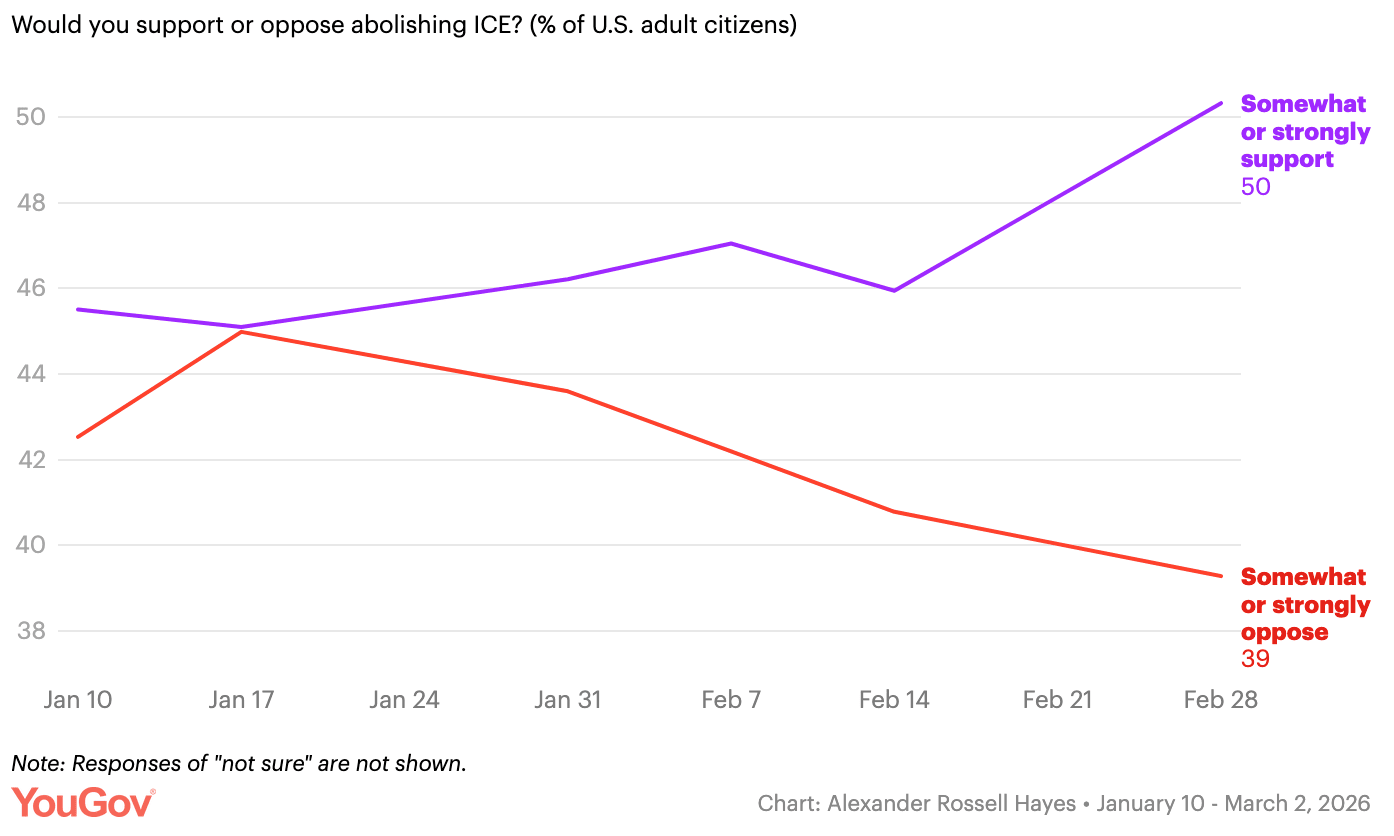
In July, an additional YouGov poll showed that Democrat support for abolition had actually dropped 4 points to 73%. For Independents, it grew 4 points to 52%, and, even for Republicans, support for abolition grew 1 point to 24%. Overall, due only to the Democrat responses, support for abolition support had dropped to 48%. 

DNC Chairman Ken Martin noted that “Clearly, the one thing that unites Democrats, regardless of their position on reform versus abolish or whatever other ways to change what’s happening, is people believe that what ICE is doing right now — and CBP and the federal government — should stop.” This year State Futures published a report showing 242 bills were introduced to prevent federal encroachment by regulating federal immigration: about a fifth of them passed. While the report indicates that all the bills submitted in New York were passed, it also notes that they were only part of the NY For All and the MELT bills: so they are not reflective of all the legislation NY can implement. 

What Can We Do?
  • Join an ICE Watch group and learn to use the SALUTE reporting tool to craft a text to share ICE on the street actions with the ICE Hotline: (229) 304-8720
  • Follow @nycicewwatch on instagram and share SALUTE messages with them too.


In solidarity and with collective care,

Jackson Heights Immigrant Solidarity Network (JHISN)


Follow @JHSolidarity on Facebook and Twitter and share this newsletter with friends, families, neighbors, networks, and colleagues so they can subscribe and receive news from JHISN. 
JHISN Newsletter 12/14/2024

Dear friends,

 As New York City sits on the precipice of the largest mass deportation in US history as threatened by Trump, the city’s Mayor—indicted under federal charges of corruption and abuse of power—sat down this week with incoming “border czar” Tom Homan. Discussion topic: Adams’ cooperation with the feds’ deportation plans. Already on record saying, “I’m not going to be warring with this administration, I’m going to be working with this administration,” Mayor Adams declared after the meeting that he will consider using executive power to change the city’s sanctuary laws to expedite deportations. Homan declared that the meeting “went great.” 

Immigrant justice activists, including Make the Road NY and Adhikaar, rallied outside City Hall during the Adams-Homan meeting to oppose our city’s collaboration with Trump’s promised spectacle of punishment, caging, and exile.

JHISN will continue to highlight, and fight for, immigrant justice struggles as the enemies of justice gather power and popular support. This week’s newsletter reports again on the draconian Operation Restore Roosevelt and its militarized presence in our neighborhood. We then look at how national immigrant advocacy organizations are stepping up in the face of the incoming administration’s anti-immigrant violence and scapegoating.  

Newsletter highlights:
  1. Roosevelt Avenue: new home for NYPD and NY state troopers
  2. Immigrant advocates gear up for the struggle

1. Political Fault Line on Roosevelt Ave.

Roosevelt  Avenue, along with its plazas, has long been known for its vibrant street life. It’s a microcosm of working-class New York: a human tapestry of immigrant vendors from all over the world, creating an ever-changing, 24-hour open-air market and food destination in the shadow of the elevated 7 train. Today, the Avenue is mostly blank concrete and asphalt. And cops, hundreds of cops. Cops hassling street vendors and sex workers. Cops supervising the bulk seizure of unregistered e-bikes and mopeds. Cops just standing around, in pairs and groups, owning the street.

Answer Triangle, Roosevelt Avenue, May 2024


Answer Triangle, December 2024

This new, dreary, police state version of Roosevelt Avenue comes to us courtesy of Operation Restore Roosevelt, a 90-day enforcement crackdown previously described by JHISN (10/26/24). The crackdown is the brainchild of an energetic conservative initiative called the Let’s Improve Roosevelt Coalition, led by disgraced right-wing politician Hiram Monserrate, local church groups, embattled Mayor Adams, and City Councilmember Francisco Moya.

Operation Restore Roosevelt represents another advance for a spreading right-wing politics of respectability and scapegoating of recent immigrants. The current cop takeover of Roosevelt Avenue builds on an earlier conservative victory: largely destroying the internationally famous and much-loved vendor marketplace at Corona Plaza. Operation Restore Roosevelt is an even bigger spectacle of morality policing and criminalization, again directed at the poorest and most vulnerable immigrants in our community.

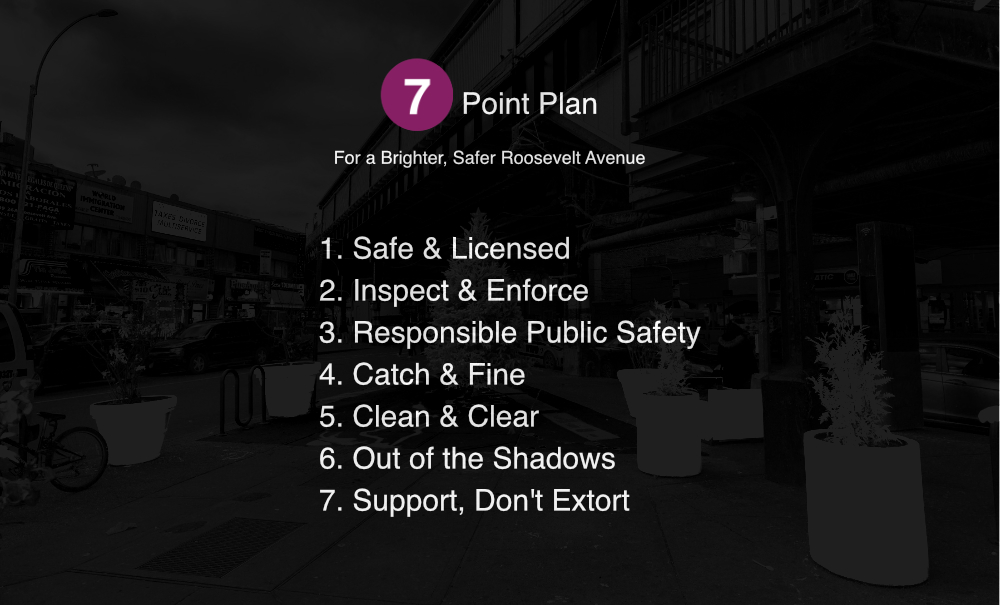
Acknowledging that there are long-standing problems with crowding and trash on Roosevelt, progressive politicians have attempted to get ahead of the conservative groundswell by promoting their own improvement plans for the Avenue. After Operation Restore Roosevelt was announced in mid-October, State Assembly member Jessica González-Rojas held a roundtable discussion on how to prevent sex trafficking in the community without police action. City Councilmember Shekar Krishnan and Assemblymembers Steven Raga and Catalina Cruz quickly announced a “7 Point Plan,” emphasizing social services, licensing, inspections and infrastructure improvements rather than massive police presence. Cruz told the Queens Eagle:

“I think historically, there has been a relationship of fear, and that’s the reality of the members of the community with the police. It cannot be the only measure or solution…because if the only approach is enforcement, we’re going to have the exact same result that we’ve had for the last 10 years.”

Conservative organizers told news outlet QNS that they “repudiated any efforts by ‘radical fringe groups’ to oppose the policing plan and ‘return control’ of Roosevelt Avenue to cartels and street gangs.Nevertheless, the 7 Point Plan has had recent mainstream successes. It was endorsed by Leslie Ramos of the 82nd St. Business Improvement District. Also, Governor Hochul just agreed to provide a million dollars to support four local grassroots organizations in implementing the Plan. The organizations include New Immigrant Community Empowerment, AIDS Center of Queens County, Korean American Family Service Center, and Commonpoint. 

It should be noted that Leslie Ramos and Hochul each originally supported Operation Restore Roosevelt––Hochul even supplied state troopers to beef it up. But they also are both aware that the police crackdown on the Avenue is due to end in January, while the 7 Point Plan aims for long-lasting solutions.

Looming in the background of the struggle over Roosevelt Avenue is the issue of big money real estate development. As JHISN previously reported, there has been major controversy over the proposed Metropolitan Park casino project, a giant development which would be adjacent to Roosevelt Avenue. The plan is slowly advancing, despite resistance by many progressives including State Senator Jessica Ramos. Part of the Senator’s concern about the plan, which a majority of her constituents oppose, is that it would bring the wrong kind of development and visitors to Roosevelt Avenue. “Why are casinos our prime economic development idea in New York City?”, she asks. Meanwhile, Mayor Adams’ new “City of Yes” housing plan, which was just passed by the City Council, eases zoning requirements and promotes larger scale real estate development along transit lines, such as the 7 train.

Battle lines on Roosevelt Avenue are being drawn according to where to assign blame for economic problems and quality of life issues. One group of activists has chosen to “punch down” at their most vulnerable immigrant neighbors, resorting to criminalization and demonization. While another group of activists is promoting social solidarity, demanding that all levels of government, community and business live up to their responsibility to provide work opportunity and social services in an environment free from repression and fear.

WHAT CAN WE DO?
  • Consider volunteering with New Immigrant Community Empowerment (NICE) here in Jackson Heights.
  • Subscribe to the Street Vendor Project’s newsletter.

2. Strategies for Future Immigrant Advocacy

“As the new Trump administration takes office, Adhikaar stands resolute in our commitment to grassroots organizing and providing essential, direct services to our community.” Adhikaar Newsletter (11/15/24)

Last weekend the US president-elect stated clearly his intent to circumvent the 14th amendment in his pursuit to end birthright citizenship. This came after he proposed placing anti-immigrant hardliner and family separator, Tom Homan “in charge of our Nation’s Borders”. They plan to create the largest deportation force in US history, violating the rule of law, by using the US military on home soil despite knowing there are serious financial, legal, and logistical obstacles. Trump’s heartless strategy to avoid separating families that have a mix of undocumented members and citizens is to deport the entire family.

Also last weekend, in counterpoint, the National Immigration Inclusion Conference was held in Texas. The three-day gathering showcased immigrant groups’ intersectional approach to stand against the current and future administration. Building justice coalitions with unions and anti-racist, gender, housing, and youth groups, was a significant daily focus. Also on the agenda were sessions about turning arts and storytelling into impact strategies, examining how funders can support immigrant rights, and discussing various legal and mobilization strategies that the 1,500 people from 450 groups in attendance can implement.

Another organization that brings together immigrant advocacy support is Grantmakers Concerned with Immigrants and Refugees. At their two-day 2024 Convening, just a week before the election, they examined:

  • the state of the immigrant justice movement 
  • power-building strategies
  • how to intersect immigrant justice with racial justice
  • strategies for amplifying groups historically excluded from philanthropic investment. They called on funders “to act boldly, moving beyond financial investments to leverage their privilege and power to tackle the challenges that deny individuals the freedom to stay, move, work, transform, and thrive.”

Immigration Equality is an intersectional advocacy group that focuses on immigration rights for LGBTQ and HIV-positive people in the US. They recently published their Strategic Plan for 2024-2026 which includes demands for equity, secure paths to safety for LGBTQ refugees, robust resources for legal and self-help, and training enforcement officers and judges. They also demand the release of all LGBTQ and HIV-positive people from immigration detention centers.

Simply put—immigrant advocacy organizations are not silenced by Trump’s election victory and vicious rhetoric. They continue to work and provide the support their communities need.

According to Naomi Braine, a longtime activist and sociologist at CUNY, any thought of “resignation and retreat” is largely confined to people “who have never been engaged with sustained forms of action and resistance”. The election, she says, hasn’t affected the immigrant rights movement as a whole. The President of the New York Immigration Coalition (NYIC), Murad Awawdeh, stated after the election, “We’re going to fight it…we’re as prepared, if not more prepared than the first time around.” He identified a three-prong approach: protests, local legislation, and lawsuits. Soon after that statement, NYIC published its 10-year Blueprint for Immigrant Progress and Justice. In November, Manuel Castro of NYC’s Mayor’s Office of Immigrant Affairs said they are working with all community groups and agencies to ensure everyone understands the sanctuary laws of our city. 

New York Congressman, Adriano Espaillat, is running unopposed to lead the Congressional Hispanic Caucus in the next Congress. He has said he will oppose any efforts to pursue the additional threat of denaturalizations as promoted by American Firster Stephen Miller. “I think it’s a radical approach, one that is unprecedented in America, and I think that the vast majority of American people will oppose it as well.” The ACLU is also looking at various ways to oppose deportations. Their National Prison Project is looking to shine a light on the shadowy operations of the deportation machine. Using Freedom of Information litigation, the ACLU is preparing lawsuits against mass detention and deportation actions. One of the organization’s recent public record lawsuits demands more details about ICE Air, the government’s method for carrying out deportation flights.

To immigrant advocates, legal support, and immigrant rights groups, the threat of deportation and anti-immigrant rhetoric and legislation is simply not new. Advocates have been providing groups with Know Your Rights materials and are now adding to their presentations family safety planning. They also anticipate a marked escalation of what was seen during the first Trump administration. They anticipate drastic changes without any prior announcements from the administration and will rely on word of mouth as a way for people to learn about what is happening. As Adhikaar concluded in their newsletter:

“The election outcome is a reminder of the entrenched systems that seek to undermine the rights and dignity of marginalized communities…We refuse to let our communities be silenced or pushed into the shadows. Together, we will continue to build power, advocate for justice, and demand a future where all can thrive with dignity and self-determination.”

WHAT CAN WE DO?


In solidarity and with collective care,

Jackson Heights Immigrant Solidarity Newsletter (JHISN)


Follow @JHSolidarity on Facebook and Twitter and share this newsletter with friends, families, neighbors, networks, and colleagues so they can subscribe and receive news from JHISN. 

 

JHISN Newsletter 12/31/2022

Dear friends,

As the year 2022 comes to a close, we invite our readers to look back on some of the recent activism of local immigrant groups, and look ahead to the ongoing struggle to dismantle the US detention and deportation system. We feature the recent activities of three vibrant organizations—NICE, DRUM, and Make the Road NY—that each have a base here in central Queens. And we report on what a ‘true’ alternative to detention might be while remembering that, as the new year approaches, over 23,000 immigrants are currently in detention, and over 377,000 people are being monitored under ICE’s ‘Alternative to Detention’ (ATD) programs.

As we usher in 2023, we wish you joy, and community, and collective imaginings of a more just world for all.

Newsletter highlights:
  1. Year-end activities of local immigrant-led groups
  2. Implementing real alternatives to detention

1. Local Immigrant Justice Groups@End of Year 2022

As the calendar year turns, we take a look at three immigrant-led groups based here in Central Queens, and report back on some of their recent activism and advocacy. 

NICE (New Immigrant Community Empowerment) held a demonstration with City Council member Shekar Krishnan in front of City Hall on November 22, advocating for more resources to fight against wage theft. Undocumented workers are especially vulnerable to not being fully paid for their work, or not being paid at all. 

NICE’s commitment to protecting workers includes their support for Carlos’ Law. Named for Carlos Moncayo, a 22-year-old undocumented Ecuadorian construction worker killed on the job in 2015, the bill was proposed in 2018 and passed the NY State Legislature in August. It would raise the maximum fine for criminal liability for worker injury or death from $10,000 to no less than $500,000, or, in the case of a misdemeanor, no less than $300,000. The bill has been sitting unsigned on the desk of Governor Kathy Hochul, even though three more workers were killed this November, for a total of at least 24 construction worker deaths this year. Over 80% of construction workers who die in New York are employed at non-union work sites, and immigrant construction workers are disproportionately vulnerable to dying on the job. 

On December 13, members of NICE together with CUFFH (Churches United for Fair Housing), CASA, Make the Road NY and Center for Popular Democracy rallied in Washington, DC, to demand climate, health, economic and immigration justice. NICE met with six different congressional offices: Senator Bernie Sanders and Representatives Rashida Tlaib, Ilhan Omar, Alexandria Ocasio-Cortez, Grace Meng, and Nadya Velazquez.

The Omnibus federal budget bill recently approved by Congress allots $500,000 to NICE.

DRUM (Desis Rising Up and Moving) joined more than 100 organizations on November 15 calling on Department of Homeland Security Secretary Alejandro Mayorkas to designate Temporary Protective Status (TPS) and Special Student Status (SSR) for Pakistani nationals working and studying in the US. The devastating floods of 2022 have created ongoing health and economic crises in Pakistan, with at least 33 million people (1 in 7 Pakistanis) directly affected by the disaster. No safe return of Pakistani immigrants to their country of origin is currently possible. Support TPS and SSR for Pakistani by signing this petition

DRUM’s director of organizing, Kazi Fouzia Kabir, joined Grassroots Global Justice Alliance’s delegation in November at the United Nation’s COP27 meetings in Egypt. Kabir works to connect with civil and government representatives from countries that DRUM’s members come from, in order to coordinate their demands for climate justice.

On November 22 and again on December 7, DRUM participated in a Care Not Cuts rally at City Hall demanding that Mayor Adams protect city services for working-class New Yorkers—threatened by Adams’ proposed budget cuts in fiscal 2023—and roll back the Mayor’s dangerous plan to forcibly detain New Yorkers deemed by the NYPD to have a mental illness. The proposed budget cuts and hiring freeze will affect vital city services, including a proposed cut to the extension of the universal 3-K Child Care Program. DRUM is fighting for housing, childcare, education, and care, instead of cuts and criminalization.  

DRUM is also working with ICE Out! NYC, Make the Road NY, African Communities Together (ACT), and other immigrant justice organizations to advocate for three crucial bills being considered by the City Council. The proposed legislation would further restrict the city from funneling people into ICE custody and detention by: ensuring accountability and compliance with existing detainer laws; limiting the Department of Corrections from communicating with ICE about a person’s release; and limiting the NYPD’s ability to hold a person for ICE.

Make the Road NY’s (MTRNY) Trans Immigrant Project (TrIP) held a vigil on November 19 in Corona Plaza to honor the lives of trans and gender-diverse siblings lost in 2022 and previous years. They renewed their commitment to protecting those who are still with us, and the generations that come after us.

MTRNY also held a series of Town Halls for members to meet with Queens legislators ahead of the 2023 legislative session. The November 16 Town Hall included State Senator Jessica Ramos, and Assembly members Catalina Cruz, Jessica Gonzalez-Rojas, Juan Ardila, and Steven Raga. Two more events were held on November 17 in Brooklyn and November 29 in Westchester.

On November 16, MTRNY launched its 2023-24 Respect and Dignity for All state policy platform to address the persistent inequities across NY State and improve the lives of immigrant, Black, and brown families. Proposals include:

  • Permanent inclusion in the unemployment system for all. Excluded No More.
  • Ensure immigrant healthcare access. Coverage for All.
  • Pass Good Cause Eviction legislation to bring renter’s rights to tenants in smaller buildings.
  • Pass the Solutions Not Suspensions Act for youth.
  • Pass the Stop Violence in the Sex Trades Act

The just-passed federal budget allots $400,000 to MTRNY which will help them implement their policies.

WHAT CAN WE DO?
  • Sign the petition supporting TPS for Pakistani immigrants.
  • If you are able, make a donation to any of the local immigrant activist and advocacy groups mentioned here–check their website for donation information!

2. The Real Alternative to Detention is No Detention

“The point is not to provide an alternative to electronic monitoring, an alternative to probation …  and so on—but to look instead at the actual problems we face, and to take lessons from projects around the country that are addressing these problems in effective ways.”Prison by Any Other Name, by Maya Schenwar and Victoria Law (p.241)

Immigrant advocates including Mijente, Detention Watch Network (DWN), the National Immigrant Justice Center, and the U.S. Conference of Catholic Bishops with the Center for Migration Studies have each issued reports opposing ISAP (Intensive Supervision Appearance Program), an Alternative to Detention (ATD) program run by ICE agents. They highlight the many problems of ISAP, and the value of community-based support programs as true alternatives to detention. ISAP, launched in 2004, is run by prison corporations and has been renewed four times despite sustained criticism by immigrants and activists. 

The government has piloted a few community-based ATD programs. In 2000, the Vera Institute for Justice worked with the INS (Immigration and Naturalization Services) to run one such ATD called the Appearance Assistance Program (AAP). The AAP was a break from the carceral approach to immigration policy which ramped up after Cuban and Haitian refugees arrived on Florida’s shores in the late 1980s, prompting Congress to amend the Immigration and Naturalization Act to require mandatory detention for immigrants with specific criminal convictions. The association of immigration with criminality was expanded by the 1996 Illegal Immigrant Reform and Immigrant Responsibility Act (IIRIRA) which increased the scope of mandatory detention and captured legal permanent residents as well. 

Despite the AAP’s non-carceral success, with 90% of participants attending their court hearings, the aftermath of September 11, 2001, reconfigured immigration policy as a national security issue. The creation of the Department of Homeland Security (DHS) in 2002 prioritized immigrant surveillance, deportation, and the escalation of detention. ISAP became the primary ATD program supported by DHS, which leverages smartphone and facial recognition software, ankle monitors, and telephone check-ins with ICE agents with a focus on discipline and supervision, not community support.

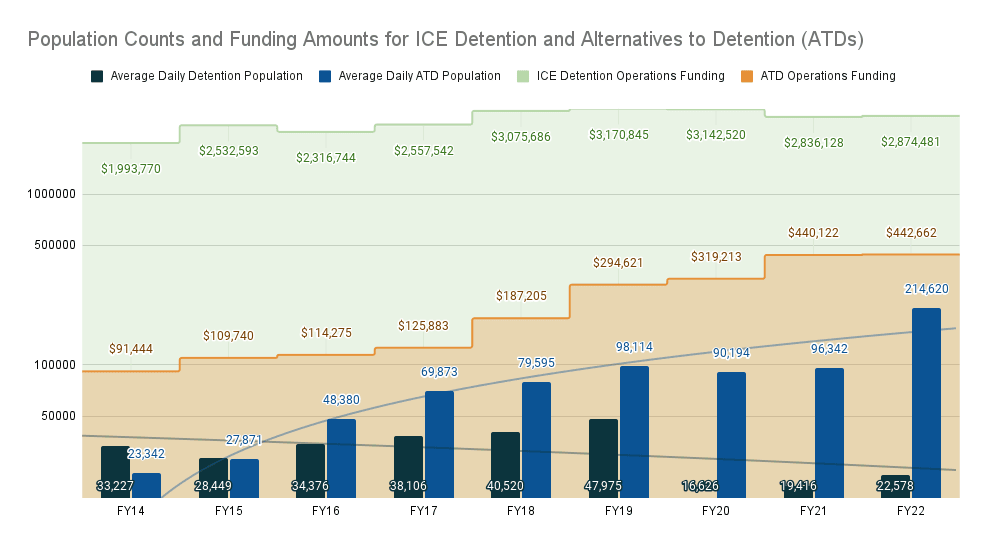
The chart below shows the increase over time of funding allocations to ATD programs, including ISAP, as daily enrollment in those programs grew, spiking at almost 225% under President Biden in one year. The chart clearly shows government spending is not reduced with ATDs because they continue to spend on detention. The data reveal that ATDs like ISAP are not a real alternative, but an addition to detention. The chart also illustrates how bed quotas in private detention facilities keep detention costs consistently high even though the actual detention population recently dropped due to the unjustified use of Title 42 as an immigration enforcement tool during the COVID-19 pandemic.

Some claim that the ISAP program is better than detention as a more humane way to approach the problem of immigration management. Participants in the program have agreed that given a choice between detention or not, then ISAP is preferred. But the report Tracked and Trapped: Experiences from ICE’s Digital Prisons shows the direct human impact that ISAP has on people (not by comparison with detention): 

  • When there are problems with the technology, ICE case officers will not blame the technology, instead punishment will fall on the participant. Because the ISAP program is run by a prison subsidiary company, the threat of detention is immediate for non-compliance.
  • Smartphone monitoring data constantly tracks people with no restrictions on how that data will be used. In fact, ISAP data was used in 2019 to assist in a Mississippi ICE raid to arrest 680 immigrant workers in meat processing plants, 300 of whom were later released. 
  • Ankle monitors have notably caused irritation, bleeding, or even electro-shocked the wearer—possibly because they are being worn for over 10 times longer than the intended length of time. 
  • 97% of people surveyed reported feeling social stigma or isolation, and two-thirds reported job-related issues. 
  • Black immigrants are given the ankle shackle twice as often as others. 

Detention Watch Network criticizes these ATD approaches as Alternatives to Freedom, but there are programs that can be community-based true alternatives, and ISAP is not the sole approach that ICE takes with ATDs. Parole allows people to live freely while they navigate their immigration cases—95% of Ukrainians were granted this option to escape the war with Russia, but only 11% of non-Ukranians were given this option during the same timeframe. In January 2016, ICE set up the Family Case Management Program (FCMP), an ATD without punitive and restrictive measures which did not use ankle monitors. The program successfully maximized court hearing attendance and ICE appointments. It was also significantly cheaper than the detention costs at just $38 each day per family unit instead of $320 per detainee per day. President Trump chose to eliminate this successful program after just one year. He also adjusted the Risk Classification Assessment (RCA) algorithm used to advise if someone can be released from detention and placed into an ATD—as a result, the continued detention of low-risk individuals rose from around 50% to 97%. When later seen by a human case officer, about 40% of people were released on bond. In 2020 the Bronx Defenders and the ACLU brought a lawsuit against ICE for adjusting RCA as a violation of due process and federal immigration law that calls for “individualized determinations” about a person’s release. 

Much immigrant justice work has tried to ensure that legal representation is provided to protect due process. However, as with the criminal justice system, the guarantee of due process does not always lead to a better outcome, which would be no detention and no deportation. But there are community programs working independently of the government that offer prime examples of successful ATDs: the New York Immigrant Family Unity Project, NYIFUP, is a coalition of groups with a process that strives for a different outcome from all the rest. It resulted in a 48% non-deportation outcome–a different measure than ensuring participation in court appearances and ICE meetings. That is a real alternative with a valuable outcome for immigrants.

WHAT CAN WE DO?


In solidarity and with collective care,

Jackson Heights Immigrant Solidarity Network (JHISN)


Follow @JHSolidarity on Facebook and Twitter and share this newsletter with friends, families, neighbors, networks, and colleagues so they can subscribe and receive news from JHISN.