
Tag: Freedom of Information Act

JHISN Newsletter 08/29/2026

Dear friends,

As promised, ICE has ramped up its activities in New York, and significantly in Queens. Organizations like the Deportation Project are keeping us all informed through Freedom of Information Act lawsuits, which force the federal government to share its enforcement data. Locally, ICE watch groups are also on the lookout, and rapid responders (still mostly women) are hitting the streets when ICE sightings are reported. In July, a new high of 804 arrests were made in NYC. 80% of nationwide detentions were of people with no criminal history. Jackson Heights, East Elmhurst, and Corona are all in the top 5 of NY neighborhoods with the highest arrest reports.

Our newsletter delves into the overreach of Homeland Security as ICE grabs at yet more data in its attempt to locate people to deport: this time it is the details stored in commercial drivers license databases maintained by states. But the states are fighting back with lawsuits to prevent them. Following a “Know Your Rights Week” in Queens we also look at the reticence by Democrats, locally and nationally, to call for the full abolition of ICE, even though no one is happy with their hateful and hurtful and harmful tactics.  

Newsletter highlights:

  1. NY in the fight to keep commercial drivers license data private
  2. The call to abolish ICE has been losing steam


1. Feds Demand Access to State Commercial Drivers’ License Databases

The Trump administration wants states to allow access to their drivers’ license databases. This would permit the federal government to see the personal information of 17 million commercial drivers nationwide. The databases include names, birth dates, and Social Security numbers of holders of commercial driver’s licenses. A multistate coalition of 21 state attorneys general (including New York and New Jersey) has filed a lawsuit to prevent access. If states do not comply, the federal government threatens to withhold funding for the databases. The legal issue is privacy and control over huge amounts of personal information.

The federal government has not stated what it plans to do with the information. Still, the lawyers believe the Federal Motor Carrier Safety Administration, part of the Department of Transportation, plans to share the information with DHS for use in immigration enforcement, whether or not the information is accurate.
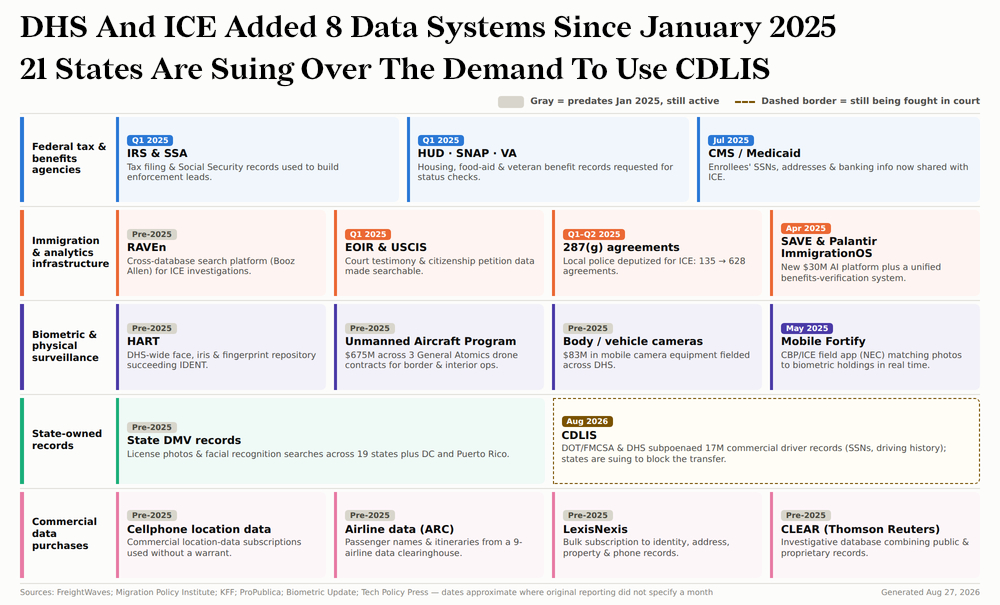
How the CDLIS data grab fits into the data sets Homeland Security has already grabbed.


In a statement, DHS said the administration is targeting dangerous “illegal aliens” whom it says don’t know traffic laws or English and criticized politicians who allow dangerous drivers on the road. The order demanding information was issued in February 2026 by Transportation Secretary Sean Duffy. It cites seventeen crashes involving non-domiciled drivers (less than 0.5% of all fatal crashes). This followed Duffy’s September 2025 order removing nearly 3000 commercial driver training centers from approved provider lists.

In fact, requirements for commercial drivers’ licenses are very detailed and include criminal background checks, drug use tests, written tests, and behind-the-wheel (BTW) tests. There are different requirements for passenger vehicles, taxis, school buses, trucks of different types, construction equipment, and hazardous materials driving. All tests are in English.

In addition, New York used to have a “non-domiciled” program, which allowed drivers who do not reside in the state, including immigrants legally in the United States, to obtain commercial licenses. However, after pressure from the government, the program was halted. Now this statement appears on the DMV website: “DMV offices are temporarily unable to accept an application for a Commercial Learner Permit (CLP) or CDL document if you are not a U.S. citizen or lawful permanent resident (i.e., temporary visitors).” 

How will the government’s access to the database affect New Yorkers? New York officials and labor leaders say thousands of immigrant drivers, including MTA bus drivers and school bus drivers could lose their jobs. Some foreign drivers have already been unable to renew their commercial licenses.

Paul Quinn Mori, president of the New York School Bus Contractors Association, said about 5% of the state’s yellow bus drivers are licensed through the “non-domiciled” program. There is already a shortage of school bus drivers.

The lawsuit states, “The chilling effect of the transfer of data is particularly acute for some individuals who are concerned in general about disclosing their personal information to the federal government, such as noncitizens who are legally present in the United States and lawfully qualified to obtain a CDL, or individuals who are part of mixed-status immigration families.”

Attorney General Letitia James has said, “The Trump administration is attempting to seize confidential state records without any lawful justification. New Yorkers provide their personal information to the state with the expectation that it will be protected, not handed over to anyone who demands it.”

On August 20, U.S. District Judge Anthony J. Trenga granted the states’ request for a temporary restraining order. That prevents the federal government from obtaining the states’ records from the Commercial Driver’s License Information System, or CDLIS, while the court considers whether to issue a preliminary injunction.

What Can We Do?

2. Democrats Divided over Demand to Abolish ICE

“In the final week of July, we saw an amazing effort on their [ICE] part to rip away community members from this community, specifically here in Corona, where over half of reported detentions and kidnappings happened in this neighborhood.”New York Immigration Coalition President and CEO Murad Awawdeh

Shanel Thomas-Henry, born and raised in Corona and East Elmhurst, represents City Council 21, which includes Corona, East Elmhurst, Lefrak, and Jackson Heights. Since her district is the heart of ICE actions in NYC, she might seem to be a natural voice of opposition to ICE’s very existence. Yet she faces the same challenge that Democrats are struggling with nationally: a lack of consensus about what the future of ICE should be.

This month, she joined a rally at Corona Plaza organized by Larinda Hooks, whose Assembly District 35 covers much of the same areas of Queens as Thomas-Henry. The August 10 rally was a protest against the notable increase of ICE removing people from their streets. Last June there were just two people taken. In the two weeks prior to the rally there were 14. One every day. It was stressed that none of the people ICE took had criminal records. Jessica González-Rojas spoke at the rally and said, “Every single day, we get text messages from ICE watchers saying that ICE is in our communities. It doesn’t matter if you’re a small business owner. Doesn’t matter if you’re a five-year-old child. They are coming after all of us.”

Recent neighborhood sightings reported by ICE watching groups:

  • 8/21@9:25am: Two ICE SUVs circling 85th Street and 31st Ave.
  • 8/22@6:05pm: 4 ICE agents in a Jeep stop car on 77th St. and 30th Ave
  • 8/24@: spotted ICE pickup used in a July 30 kidnapping.
  • 8/25@9:25am: ICE vehicle at 99th st. btw. 34th and Northern. Community responder peppersprayed by ICE at 9:50am. 7 vehicles circling North Corona up to noon.
  • 8/26@8:03am: 3 confirmed ICE vehicles at 100 St between 34th and 35th Aves. Also 101 St. btw. 37th and 34th Aves. All cars left the block after community members showed up and began whistling & making noise!
  • 8/26@9.50am: ICE circling around 85-06 Roosevelt Ave
  • 8/26@1:37pm: Active Kidnapping on Northern Blvd. btw. 96th and 97th Sts.
  • 8/28@11:00am: 6 ICE agents in 4 cars seen in Corona
  • 8/28@4:29pm: 5 ICE agents tackled someone to the ground. Northern Blvd. at 108th St.

Neither Hooks, nor Thomas-Henry had signed a July letter calling on Democratic leadership to abolish ICE in order to restore public safety. They continue to believe the issue is not the Department of Homeland Security itself but the tactics of enforcement. Hooks’ Not-In-My-Backyard thinking suggests that introducing laws to restrict local police collaborating with ICE agents means ICE will look for people elsewhere. Her approach will not address the issue of a massively funded agency acting with impunity for pepper spraying a 72 year-old filming their activities or targeting out-of-state cars for search as a pretence to find immigrants to deport—vehicle stops are happening more frequently in College Point and also have made national news when the legally present father of an active-duty sailor on the USS Lincoln was taken into custody by ICE after a traffic stop in Florida.

Thomas-Henry claims that ICE existed for a reason before Trump and, before the rally, said it was important to “look at changing the laws that allow them to deport individuals on minor traffic offenses.” She ran as a progressive to win her seat against Francisco Moya, but she describes her approach to ICE as looking at the many layers. Her stance is similar to that of the Senate and House Minority Leaders Chuck Schumer and Hakeem Jeffries. They talk of adding guardrails instead of a total overhaul to a department that was born out of fear and suspicion of identity within US borders.

Some Democrats are pointing out how the expansion of ICE actions is spilling into the policing of more aspects of social life, including the increasing likelihood of ICE deploying to polling places during midterm elections or leveraging private Medicaid data. Only the Democratic Socialist movement and progressive candidates are taking the strong abolition stance against ICE, including NY Representative Alexandria Ocasio-Cortez: Centrist democrats worry that such candidates will hurt the Democratic Party. Last month, a bill was submitted by three progressives, all immigrants themselves, who described ICE as “too corrupt to reform“. Yet the Democrat leaders continue to express their skepticism about abolishing ICE.

Polls showed that back in February 2026 support for abolishing ICE had grown, for the first time, to 50%—with only 39% opposing abolition. Even 23% of Republicans supported its abolition.
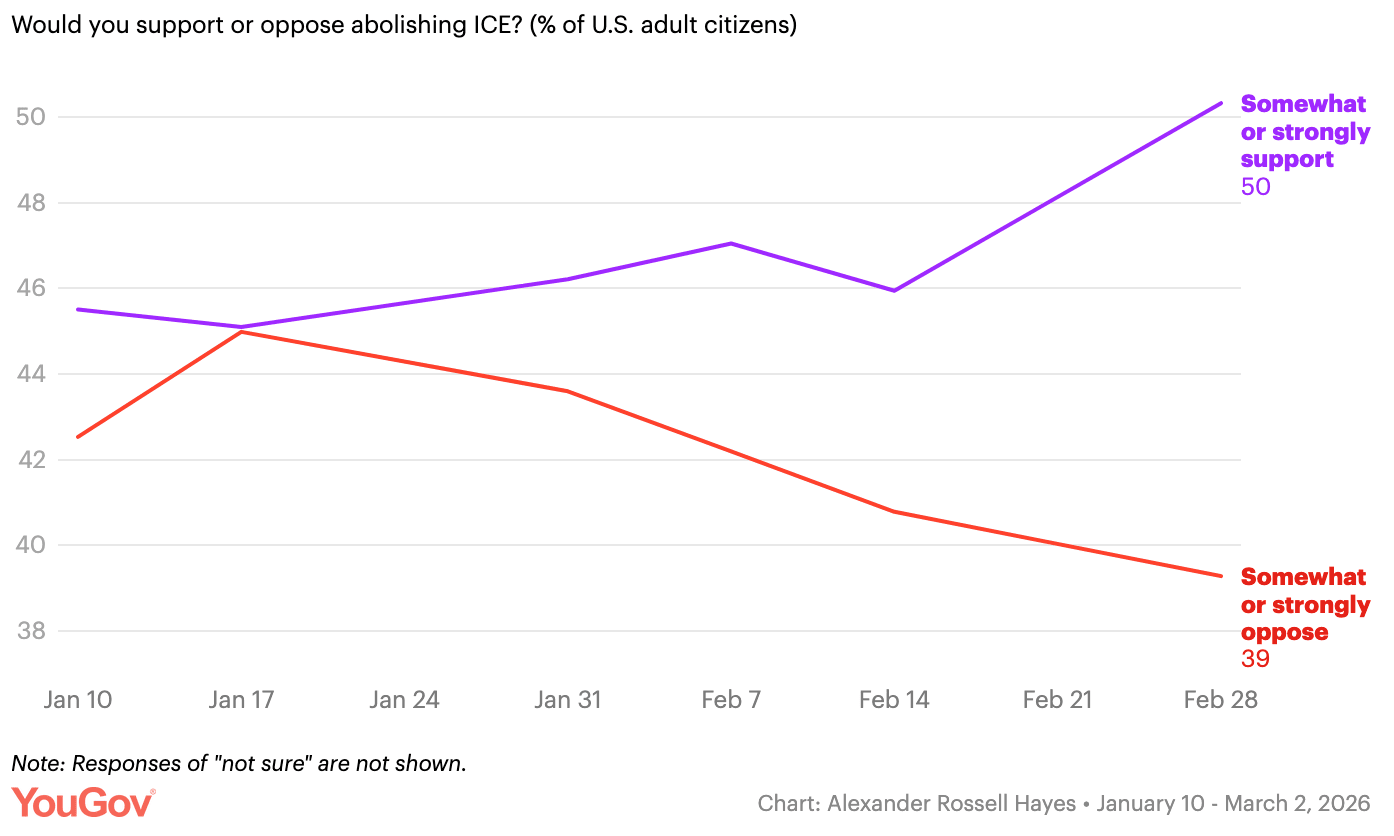
In July, an additional YouGov poll showed that Democrat support for abolition had actually dropped 4 points to 73%. For Independents, it grew 4 points to 52%, and, even for Republicans, support for abolition grew 1 point to 24%. Overall, due only to the Democrat responses, support for abolition support had dropped to 48%. 

DNC Chairman Ken Martin noted that “Clearly, the one thing that unites Democrats, regardless of their position on reform versus abolish or whatever other ways to change what’s happening, is people believe that what ICE is doing right now — and CBP and the federal government — should stop.” This year State Futures published a report showing 242 bills were introduced to prevent federal encroachment by regulating federal immigration: about a fifth of them passed. While the report indicates that all the bills submitted in New York were passed, it also notes that they were only part of the NY For All and the MELT bills: so they are not reflective of all the legislation NY can implement. 

What Can We Do?
  • Join an ICE Watch group and learn to use the SALUTE reporting tool to craft a text to share ICE on the street actions with the ICE Hotline: (229) 304-8720
  • Follow @nycicewwatch on instagram and share SALUTE messages with them too.


In solidarity and with collective care,

Jackson Heights Immigrant Solidarity Network (JHISN)


Follow @JHSolidarity on Facebook and Twitter and share this newsletter with friends, families, neighbors, networks, and colleagues so they can subscribe and receive news from JHISN. 
JHISN Newsletter 03/08/2025

Dear Friends,

As a smothering blanket of white nationalism and authoritarianism descends over the US, sanctuary cities are a crucial line of defense against the regime’s plans for mass deportation. In our last newsletter, we saw that many US cities are reaffirming their sanctuary city status in defiance of ICE threats. Today’s newsletter adopts the definition of “sanctuary city” as “a collection of policies and political will” and discusses Mayor Adams’ corrupt betrayal of NYC’s promise of sanctuary.

Our second article introduces you to TRAC (Transactional Records Access Clearinghouse). We explain how this unique and valuable tool has provided public access to data from various federal government agencies and explore its current transformation.


1. Adams Attack on Sanctuary Causes Fear and Confusion

“I think Mayor Adams does not know his own city or does not care to know his own city. The people who pay taxes in his city. The people who go out and shop every morning. The people who are up at 4 a.m. driving deliveries. Those are the people who run this city and are being served up on a silver platter for President Trump.” Carina Kaufman-Gutierrez, Street Vendor Project

The term “sanctuary” evokes mental images of families sheltering from ICE in church basements or private homes. For instance, during the first Trump administration, Aura Hernandez and her children, fleeing violence in Guatemala, lived inside the Fourth Universalist Society in Manhattan for almost a year, successfully holding off ICE attempts to deport them. Today, churches are quietly discussing their options for similar actions. 

But what is a “sanctuary city”? After all, we can’t put walls around NYC. As a November article in The City explains, “‘sanctuary city’ isn’t really a hard-and-fast legal edict. It’s more of a collection of policies, combined with political will, that guide how local and federal authorities [such as ICE] interact.” 

In practice, this includes guaranteeing legal rights and access to public services for all residents, whatever their immigration status. It often involves outlawing immigrant detention centers. Of critical importance today, it usually means refusing to help ICE deport people in city facilities like schools, jails, courts, and hospitals unless they have a warrant signed by a judge. 

But in NYC, both political will and policies are under attack from right-wing forces and the Adams administration. While undocumented immigrants were hailed as heroic “essential workers” only a few years ago, they are now endangered because of a failure of solidarity, manufactured confusion, and the mayor’s craven and self-serving accommodation with the Trump regime’s plan for mass deportation.

Adams has claimed on many occasions that he upholds New York’s sanctuary city status. But since Trump’s reelection, the mayor has turned sanctuary into a bargaining chip, cynically offering up the city’s 400,000 undocumented immigrants as a potential sacrifice to get himself out from under federal corruption charges. In December, he declared, falsely, that immigrants accused of crimes were not eligible for due process under the Constitution. He floated the idea of using executive orders to get around current sanctuary laws and help ICE arrest more immigrants. 

On February 10, a federal Justice Department memo announced that serious criminal charges against Adams would be suspended—not because they lacked merit, but because they might supposedly interfere with Adams’ ability to fight crime and “illegal immigration.” On February 14, Adams and Trump “border czar” Tom Homan appeared on “Fox and Friends” to celebrate their new collaboration. A visibly perspiring Adams, laughing nervously, told Homan, “I want ICE to deliver.” Homan, for his part, told the Fox audience that “If he [Adams] doesn’t come through, I’ll be back in New York City and we won’t be sitting on the couch, I’ll be in his office, up his butt, saying, ‘Where the hell is this agreement we came to?”

During a partisan Capitol Hill hearing designed to attack sanctuary city mayors earlier this week, anti-immigrant Republicans treated Adams with kid gloves. House Oversight Committee Chair James Comer even praised him for his willingness to work with ICE. It was Democrats who challenged Adams, denouncing his collaboration with Homan. 

Even before Trump’s February 16th executive order to open up sensitive areas like churches and schools to deportation raids, the Adams administration was pushing city agencies to loosen sanctuary city protections and to cooperate with ICE. Instead of instructing city employees to follow sanctuary policy, keeping ICE out unless they showed a legal warrant, Adams directed that “if you reasonably feel threatened or fear for your safety, you should give the officer the information they have asked for or let them enter the site.” This is widely viewed as undermining the intent of sanctuary city legislation. Since then, the mayor has promised to “coordinate” with ICE on deportations.

Immigrant advocates are proactively organizing on several fronts against what they see as an ominous weakening of the spirit and letter of sanctuary city provisions. On February 6, state Sen. Zellnor Myrie and other Democrats held a news conference outside Kings County Hospital to protest a memo from NYC Health + Hospitals that warned workers not to help patients avoid ICE. Other hospitals have circulated similar memos, causing widespread controversy and anxiety among patients, employees and immigrant communities.

Immigration activists are also trying to stop the reopening of an ICE outpost at Rikers Island, which was closed down in 2015 as a result of sanctuary city legislation. The ICE facility was using fingerprints and other jail data to deport many prisoners awaiting trial. This kind of synergy between prison systems and ICE contributed to a surge of deportations under the Obama administration. Adams now hopes to use an “executive order” of dubious legality to restore the Rikers ICE station. 

On February 9, in the wake of reports that immigrant families are keeping their children home due to worries about ICE in the schools, Chancellor Melissa Aviles-Ramos released a video to reassure parents. “As always, non-local law enforcement is not permitted in any of our school buildings without a judicial warrant or unless there are exigent circumstances,” she said. However, given Adams’ support for ICE, Make The Road Action’s Manuel Ordonez found Aviles-Ramon’s words less than comforting. “It’s impossible that my community is going through this difficult time, that they can’t even go to church, they can’t take their kids to school, they can’t shop at supermarkets because of fear of being arrested and deported.”

To the best of our knowledge, mass ICE raids have not yet occurred in NYC schools, hospitals, courthouses or churches. But activists are concerned that Adams is helping Trump to lay the groundwork: criminalizing immigrants, cheerleading ICE, releasing memos and executive orders that challenge sanctuary laws, and generally stoking fear. “This mayor has been running amok in this city for too long, all for his own self interest,” says Murad Awawdeh, president and CEO of the New York Immigration Coalition. “He’s enabling Trump’s mass deportation machine by sowing confusion.”

What Can We Do?

2. The Return of Vital Immigration Data

On January 8, 2025, a critical and unique reporting tool, which JHISN has often used for reliable data reports about US immigration, abruptly went silent. The esoterically named Transactional Records Access Clearinghouse (TRAC) was established in 1989 by Susan Long and the late David Burnham. As Director of the Center for Tax Studies at Syracuse University (SU), Susan had leveraged the 1966 Freedom of Information Act (FOIA) to gather Internal Revenue Service data for her work and dissertation. David was an investigative reporter of some renown. She was into numbers, and he was into words. They both advocated for public access to information and so, together, established TRAC with its purpose of “providing the American people with comprehensive information about staffing, spending, and enforcement activities of the federal government.” 

David and Sue created a FOIA model for gathering data from non-cooperative federal organizations that would simply claim they did not have the information to share. Their TRAC process begins with a FOIA demand for available metadata about the topic of their research. After analysing the documents from that demand, they initiate further FOIA requests for the data disclosed by the initial metadata. The final step of their process uses data analysis to produce validated reports for general consumption. This makes it possible for us to discover, for example, that at this same time last year, over 600 people at the Genesse detention facility in New York state had been detained by ICE for one to two years.

50% of TRAC staff time is spent on FOIA requests, and each request is lengthy. A recent settlement for immigration data took 20 years. They currently have three FOIA lawsuits against ICE, initiated in 2010. ICE challenged those requests by simply asserting that the immigration data was exempt from disclosure. The courts ruled in TRAC’s favor. This FOIA work is conducted by pro-bono lawyers, often from the Public Citizen Legislation Group, a public interest law firm litigating cases at all levels of the federal and state judiciaries. The work of Public Citizen primarily involves consumer health & safety and consumer financial protection, overseen by the federal agencies that Elon Musk’s Dept of Government Efficiency recently decimated based on the recommendation of Project 2025.

Over the past 35 years, TRAC has produced a huge trove of data describing US immigration, Judges, and the federal agencies of the ATF, DEA, FBI, and the IRS. They also have a TracPlus report revealing data about civil rights, Social Security, and the environment. Perhaps surprisingly, Federal organizations have relied on TRAC reporting data for internal use. They do this through a subscription model that allows organizations, news media, and lawyers to access the data compilations. The Federal Reserve board once held a subscription because the TRAC reporting was more accessible than any internal systems. Immigration departments also have subscriptions because they have to give criminal enforcement data to prosecutors, and TRAC provides that data. 

Sue points out that, although organizations may use TRAC data to assist in policy advocacy, TRAC itself is NOT a policy group: TRAC is focused on data availability. Since 1999, SU had hosted the TRAC database and reports on its website. Developing a new website with a better user experience was something Sue and David had been discussing over the last decade. However, the transition to the new tracreports.org site was fast-tracked in January. According to The Houston Chronicle, there had been a “sometimes testy internal [university] dispute” over the last two years, resulting in the recent deletion of the entire TRAC archive from the SU website. ⁠The university maintains there has been no external pressure to take down the TRAC site, however, the removal came at an inopportune time, just as the anti-immigrant Trump administration was about to return to power. 

The new website TRAC launched last month allows them to provide more effective access to data. For example, their new Quick Facts on Immigration reveals that over 50% of those held in ICE detention have no criminal record. They are still working to reestablish access to ALL the data that once lived on the SU website, but are currently prioritizing the release of key information. 

In addition to immigration data reporting, the TRAC website includes access to a substantial and always growing Reference Library of Government Studies on Immigration. The team has also been sending data to people who made specific requests for information that is not yet back online. In fact, the TRAC team had no sense of how broadly their data was in use until they started receiving emails from around the world, including from JHISN, asking what happened and if and when the website would be back online. 

Before 2015, the work of TRAC had been recognized by the Electronic Frontier Foundation as well as the FOIA Project. Since that time, David and Susan had discussed how the TRAC system could continue after they are no longer around, a question that has gained urgency following David’s passing last year. They had established TRAC as a non-profit organization so that it, not they, and not SU, owned the data. They have seen thriving non-profits fail after the founding leader retired, and they both knew that the co-directorship that worked so well for them may not be the way for future leadership. Sue is certain that much of TRAC’s future will rely on volunteer support, and she is actively seeking and inviting discussion from others with solid ideas as to what the next stage in TRAC’s life will look like and determining how that future can be led.

What Can We Do?


Jackson Heights Immigrant Solidarity Network (JHISN)

Follow @JHSolidarity on Facebook and Twitter and share this newsletter with friends, families, neighbors, networks, and colleagues so they can subscribe and receive news from JHISN.