Tag: Supreme Court

JHISN Newsletter 06/27/2026

Dear friends, 

When good immigration news is hard to find, we look harder. The notorious Alligator Alcatraz detention camp in Florida is fully shut down as of this week, less than a year after it opened with sadistic fanfare from Trump’s minions. We hope, with many of you, that the expansion of Mayor Mamdani’s political power with this week’s primary victories will strengthen a pro-immigrant, anti-authoritarian agenda. And a Trump lawsuit targeting four NJ cities for allegedly “unconstitutional” sanctuary policies was just tossed out by a federal judge.

But the bad news is really terrible. Thursday’s Supreme Court ruling that allows the federal government to continue stripping Temporary Protective Status (TPS) from hundreds of thousands of US residents is a nightmare. Most immediately, 350,000 Haitians and 6,000 Syrians are now facing the reality of losing their TPS legal status by July 1—a loss that will affect everyone who is their neighbor, co-worker, healthcare patient, or friend.   

Our newsletter covers some of the mixed good/ bad immigration news out of this year’s NYS legislative session, which ended in early June. We then update you on the ongoing legal campaigns—and harassment—of two high-profile international students from Columbia University targeted for deportation.

Newsletter highlights:
  1. NY State Legislature gestures toward immigrant protections
  2. Deportation threats to Mohsen Mahdawi and Mahmoud Khalil


1. Latest NY State Legislation Falls Short On Immigrant Protection

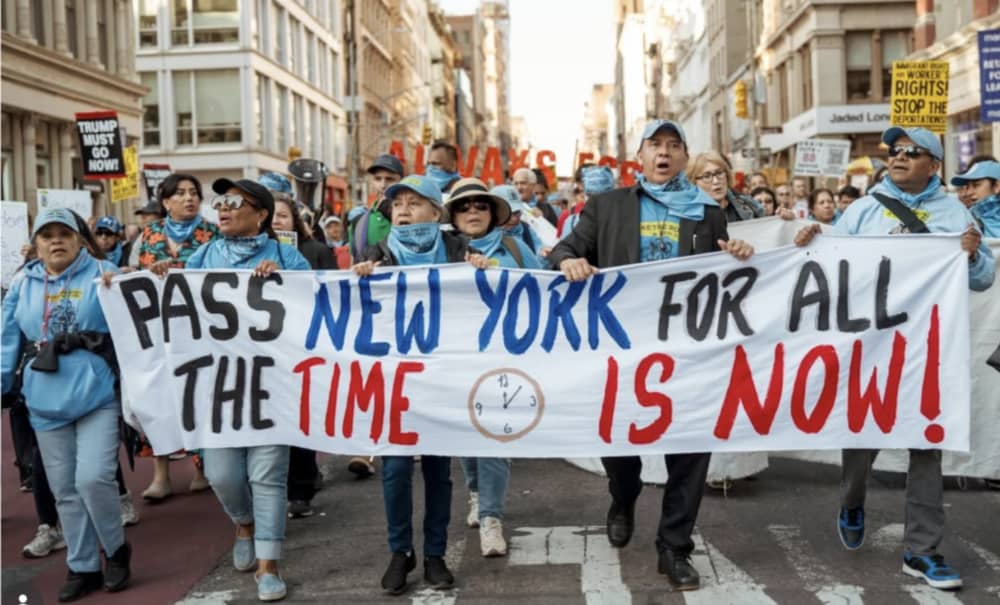
On May 21, NYS Assembly Speaker Carl Heastie noted that the 2026-27 state fiscal budget includes legislative provisions, signed by the governor, that protect our neighbors throughout New York from aggressive federal immigration enforcement. He suggested that local governments will be prohibited from collaborating with federal immigration enforcement officers and private detention facilities. He highlighted provisions that “will protect children in their schools and establish sensitive locations within our communities.” The official press release received endorsements from various elected officials, including Queens Assembly Member Catalina Cruz.

The perspective of immigrant justice supporters of the New York For All Act—proposed legislation which was never brought to a vote in the state legislature—was markedly different. The multi-organization coalition advocating for New York For All said, “The lack of political courage and moral leadership in Albany – and the failure to take a bold stand in the face of rising xenophobia – means that New York’s immigrant communities will continue to live with the threat that any encounter with government agencies can result in separation from their families.” 

The New York Civil Liberties Union (NYCLU) outlined some of the Enacted Budget’s key elements, explaining which protections were included or fell short:

  • State and local employees may not gather information about immigration status, and cannot share personal data of NY residents with ICE…but the police are excluded from this restriction.
  • “Sensitive locations,” including hospitals, churches, and private homes, can deny entry to ICE agents. 
  • The right to free public education for children, regardless of the family’s immigration status, was established.
  • State and local agencies may not rent space to ICE for immigration detention nor financially support immigration detention facilities.
  • New Yorkers can sue local, state, and federal officials in state court when their constitutional rights are violated using the newly established Office of Immigrant Trust.

Republicans claim that these new protections mean that “New York is now a sanctuary state on steroids.” But there are, in fact, at least three significant elements missing from the new budget that progressive forces had fought for. First, although the formal 287(g) agreements that allow local governments to work with ICE (previously signed by twelve New York law enforcement agencies) were banned in New York, informal collusion between local police and immigration enforcement was not prohibited—that was called for in the New York For All Act. Murad Awawdeh, Executive Director of the New York Immigration Coalition, noted, “The legislative package falls short of offering comprehensive protections by continuing to permit informal law enforcement collusion with ICE and Border Patrol.”

Second, state-funded counsel for immigrants facing deportation, part of the Access to Representation and the BUILD Act, was not included in the budget package. Although some money was secured for immigrant legal services, it was less than half of the $175 million called for by immigrant advocates.

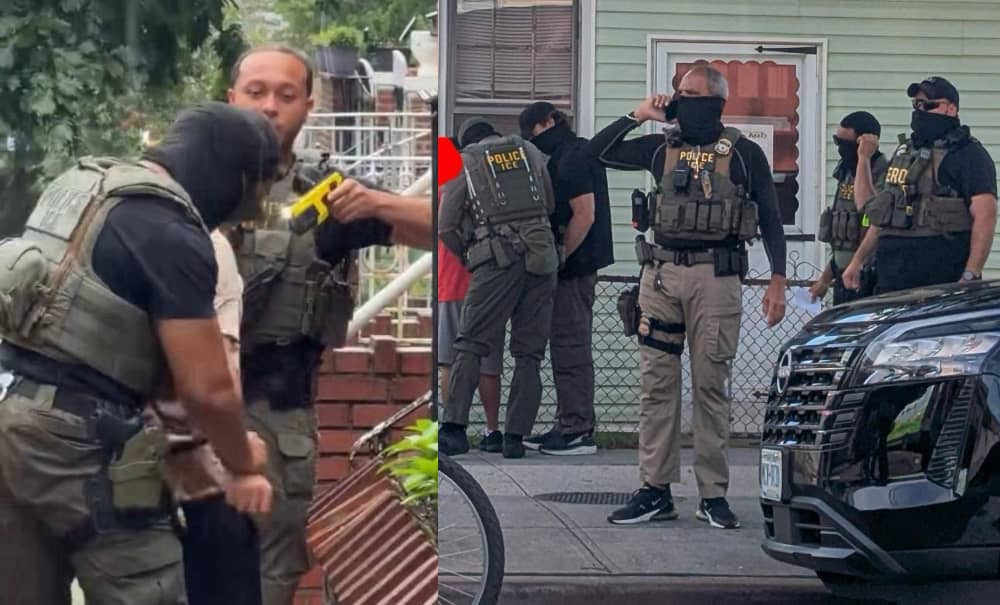
Finally, the new measures banning face coverings for state, local, and federal officers in New York still allow for “tactical equipment” that covers faces.  Even with this legal loophole permitting ICE to deploy with tactical face masks, the federal government initiated a lawsuit against New York four days before the face mask ban was scheduled to go into effect. The Department of Justice has also initiated legal action against New Jersey, California, and Virginia, which sought similar mask restrictions. 

The New York Bar has explained why many of the items demanded and signed into law do not violate federal laws about police power and preemption. None of those explanations will stop the threats from Homeland Security to conduct an ICE surge in NYC. Passing the entire New York For All Act would help strengthen legal action against the overreach and violations of basic rights by ICE and border patrol federal agents.

WHAT CAN WE DO?

2. Deportation Threat Ongoing for Palestinian Student-Activists at Columbia University

 “[T]he administration is abusing immigration law to silence me for speaking the truth about Palestinian suffering and genocide. When a government weaponizes immigration to punish speech, millions of immigrants and citizens feel that blow.Mohsen Mahdawi (June 10, 2026)

In Spring of 2025, Mohsen Mahdawi and Mahmoud Khalil, both Columbia University students, became two of the most prominent faces of international student-activists targeted for their Palestine solidarity work. The newly-installed Trump regime quickly weaponized immigration law and accusations of antisemitism to incarcerate both young men in its broader campaign to silence and punish university-based mobilizations against the US-backed Israeli genocide in Gaza.

Both men are Palestinian. Khalil was born in a refugee camp in Syria; Mahdawi in a refugee camp in the occupied West Bank. Khalil is a graduate of Columbia’s prestigious School of International and Public Affairs (SIPA); Mahdawi is currently enrolled in the MA program at SIPA. Both are green card holders and legal US residents. Both were accused of nothing beyond the memos” from Secretary of State Marco Rubio stating that their presence in the country might undermine US foreign policy goals. Both were eventually released from detention after public outcry and legal challenges. 

And … both are still threatened with deportation through legal proceedings pursued by the federal government, even as their names have faded from most headlines.

Their ongoing legal battles differ. An immigration judge in February 2026 ruled that the deportation case against Mohsen Mahdawi be dismissed. Trump’s DOJ fired that immigration judge (unlike other judges, immigration judges serve at the will of the federal government) and appealed the decision. The US Board of Immigration Appeals (BIA) ruled that the deportation case could go forward, and Mohsen’s case went to a second immigration judge who this month issued an order of removal that would send Mohsen to Jordan. Nevertheless Mohsen remains in the US while his legal team challenges the deportation order in the First Circuit Court on constitutional grounds. Mohsen declared:

“… I’m going to cut to the core of this issue, which is an issue that is related to the First Amendment. Do I have, as a green card holder, as a lawful permanent resident for 12 years, never committed a crime — do I have the rights that actually the citizenship questionnaire that I get tested on states that I do … do I have the right to free speech, freedom of assembly and freedom of expression?” on Democracy Now! (June 12, 2026)                                                              

Mahmoud Khalil’s case is on a different track, though he also is protected for now from a deportation removal order that has been set in motion. His legal team made a second appeal in May 2026 to the US Board of Immigration Appeals (BIA) to dismiss the deportation case against him, after new revelations of government misconduct. The Trump regime is accused of “secretly engineering” the outcome of his case. The allegations of misconduct are corroborated by statements from former immigration judges, former BIA workers, and accumulating evidence that top government officials pressured judges to “decide” cases with predetermined outcomes in spotlight cases like Khalil’s, and to expedite deportation orders. One legal decision against Khalil was handed down by the BIA in a mysteriously speedy nine days. 

Meanwhile, a legal challenge in the Third Circuit Court of Appeals was decided in late May against Khalil, and a new challenge was immediately filed by his team in the Fifth Circuit Court of Appeals, which also separately requested a Supreme Court review of the Third Circuit decision. “We hope the Supreme Court will recognize how dangerous the Third Circuit’s decision was, not just for Mahmoud but for other non-citizens the administration has its vengeful sights upon,” said Baher Azmy, legal director at the Center for Constitutional Rights.

Regardless of the outcome of their cases, Mohsen and Mahmoud remain targets of merciless legal harassment through a federal government campaign to deport themand to silence, repress, and frighten others who would speak out.  

Columbia University has to date made no public statements in support of Mohsen, a current student, or Mahmoud, a recent graduate. The University has been operating since July 2025 under an unprecedented “settlement”’ with the Trump regime, in which the University paid the government $221 million, and agreed to a set of institutional changes demanded by the federal government. One of those demands was that the University start asking all international applicants “questions designed to elicit their reasons for wishing to study in the United States.” Or, in the words of Marco Rubio, “we are not going to be importing activists into the United States.” 

WHAT CAN WE DO? 
  • Join the weekly vigil every Monday at 12pm near Columbia’s campus to protest DHS and ICE targeting of students, organized by CUIMC Stands Up.


In solidarity and with collective care,

Jackson Heights Immigrant Solidarity Network (JHISN)


Follow @JHSolidarity on Facebook and Twitter and share this newsletter with friends, families, neighbors, networks, and colleagues so they can subscribe and receive news from JHISN. 
JHISN Newsletter 05/31/2025

Dear friends,

With ICE thugs stalking our streets and universities and Eric Adams selling out to Trump’s Department of Homeland Security, the NYC mayoral election is unfolding in the middle of a human rights crisis, for migrants and for the city. Few of the candidates vying to replace Eric Adams address the issues of immigration and mass deportation with the urgency it demands. JHISN does not endorse candidates, but we ask that you pay attention to their platforms and use your ranked-choice vote to support candidates who will fight for immigrant justice. The mayoral primary will be held on June 24, with early voting running from June 14-22. Given how ranked-choice voting works, if you want to maximize your vote against a particular mayoral candidate, the best strategy is to fill in all five ranked slots (rather than just 2 or 3) provided on the ballot—while not listing/ranking the candidate you are trying to defeat! 

Our newsletter today addresses palpable fear. We begin with the voice of one of our city residents who shares personal stories of fear, not just for how families will be torn apart by executive priorities, but also the fear of speaking out against Enforcers. We then look at the confusing and contradictory information about arrests, detentions, and deportations. We see how the clickbait social media productions from official government accounts attempt to spin a narrative of criminal deportations which is simply false.

Newsletter highlights:
  1. “Due process be damned”—living in constant alert
  2. Trump regime twists the narrative re: deportation numbers


1. The Voice of a Neighbor and Concerned Citizen

Under the draconian practices of this regime, fear has gripped undocumented New Yorkers. But many citizens also live in fear. A citizen, and former resident of Jackson Heights, has suffered and learned so much about our immigration system after successfully bringing her deported husband to the US that she decided to volunteer for an organization that provides free (pro bono) legal advice to people held in immigration detention centers. While studying to become a lawyer herself, she has developed a private paralegal clinic and handles a few cases that don’t require an attorney. 

Here is her anonymous testimony about what she is experiencing, feeling, and the state of constant alert in which she lives:

“I have a client from Honduras—let’s call her Claudia M. She came around 10 years ago to the United States, fleeing violence and gangs in her native country. Honduras has the highest femicide rate of all the countries in Latin America, which also affected her since she was fleeing her aggressive domestic partner. When Claudia left Honduras, she left her three children behind with her mother. 

“Her oldest child—let’s call him Diego, who is now 23 years old—had a childhood friend who was killed by the MS-13 gang around three years ago. That is when Claudia decided to pay for his voyage to come to the United States. She also financed the trip for her two other children to come to the United States. 

“During the 10 years that Claudia was here, she had been in a relationship. As that relationship was coming to an end, she got a letter for her last court appearance regarding her asylum petition. During the turmoil of her breakup and fearing deportation, she missed her final immigration appointment. Due to this, the judge automatically gave her an order of deportation. Every day, she lives with fear that she will be deported. She is scared when she has to drive to work or pick up her kids from high school. 

“One of the hardest parts for me is not being able to help her file paperwork with USCIS because of my fear of “activating” her case. 

“When Claudia’s two youngest children were held in ICE detention in Texas, they were released to her care, and her address is listed on that release form. If we begin to move one of their cases along by applying for Temporary Protected Status (TPS), I am afraid that she might end up on a list of people with active orders of removal. 

“Her second oldest son is doing very well in high school and is getting ready to go to college. However, he is unable to apply to be admitted to college or get financial aid without a work permit and Social Security Card. In order to do this, he needs to file a petition under TPS. Once that is approved, then he might be eligible to get a work permit and Social Security card. However, under this current administration, by trying to do the right thing for her son, I might inadvertently negatively impact his mother. 

“This is the same fear that my own family felt when I was getting ready to do an interview about my own experience of being the wife of a deported husband, and that might be watched by current immigration officials. Since my husband was deported about 10 years ago and then given a waiver and pardoned, I am afraid of speaking out. It seems to me that this administration will stop at nothing to quiet people who oppose their methods. If by speaking out, I am harming my husband’s chance at staying in the United States and becoming a US citizen, then I would rather stay quiet. I can not rip him apart from my daughter’s life and go back to the way things used to be before. He is here now, and we are grateful for that. 

“Currently, many immigrants do not feel free to speak openly about things done to us by the previous or current government. Even my mother, who is a citizen, also fears losing benefits she got from the government. They might take any chance to send anyone back. They might be looking for any excuse. Due process be damned.”

WHAT CAN WE DO?

2. Deportation Misrepresentations Generate Fear

We repeatedly watch President Trump’s deception in action, particularly his lies about immigration. He states that actions will be taken, based on invalid or inaccurate source material, and then, regardless of the actual outcome, declares the outcomes met his stated goals. We see this again in the way his administration reports on immigrant deportations. While campaigning he promised the largest deportation program of criminals in US history. Now elected, he strives to control that narrative and claim he is delivering on that promise—despite facts and reality to the contrary. 

In the first weeks of his presidency, Homeland Security posts on ex-Twitter showed daily immigrant arrest numbers that made Trump look tougher than the Biden administration. A 627% increase in monthly arrests makes an impressive headline, but the DHS Press Release related to that post plays with nuanced deportation terminology, comparing different types of arrests while implying they are the same. Those headline-grabbing posts stated average counts of 800 arrests per day, but research by Hearst media suggested the daily numbers were closer to 300 arrests per day, similar to Biden. Also, back in 2021, the Government Accountability Office documented how DHS arrests and detentions of US citizens—which are taking place under Trump—have happened before. What is new is the self-aggrandized and inhumane reporting of immigration enforcement activity shared by DHS just to instill fear.

“While DHS has stopped reporting monthly data on removals, NBC reported that ICE removed 4,300 noncitizens from the U.S. interior in February, a slightly higher pace than the average 3,200 per month from FY 2021-24, under Biden, but lower than the 6,800 in the first Trump administration and well below those of the Obama administration, when ICE carried out about 12,900 removals from the interior per month.” Migration Policy Institute, April 24, 2025

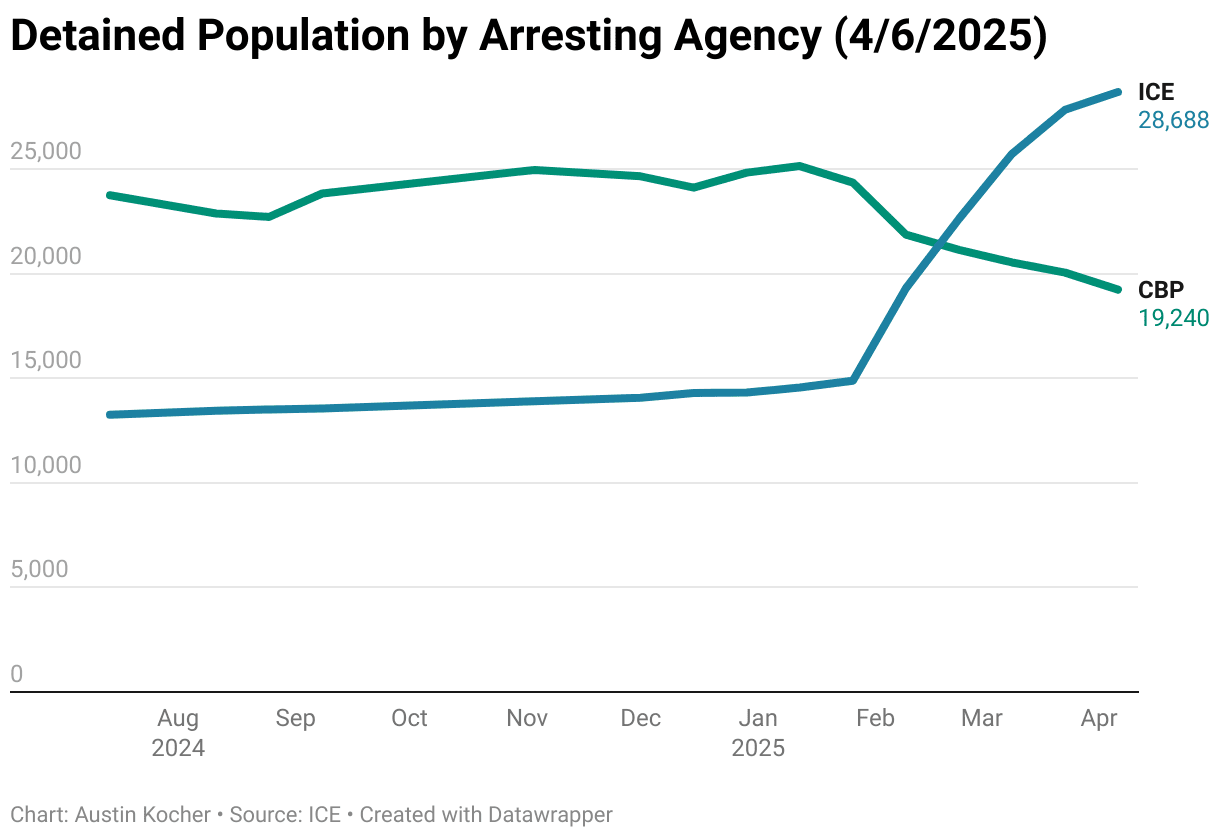
We are seeing how the Project 2025 blueprint is being implemented as the administration seeks to dramatically increase the number of people who can be targeted for removal. This month the Supreme Court ruled the administration can end Temporary Protective Status for over 800,000 people. Yet to be addressed are the threats made to cancel DACA for 540,000 Dreamers, and to end the asylum parole status for 240,000 Ukrainians. Also under threat are international students and green-card holders whose visas could be revoked. All these conditions set the foundation for yet more deportation increases in the future. But during these first months, the more accurate story is that ICE arrests in the US interior have increased while Border Patrol arrests have dropped significantly, as shown by TRAC-obtained data. This switch in arresting agencies has kept the overall numbers of arrests similar to the Biden administration. 

Source: Austin Kocher

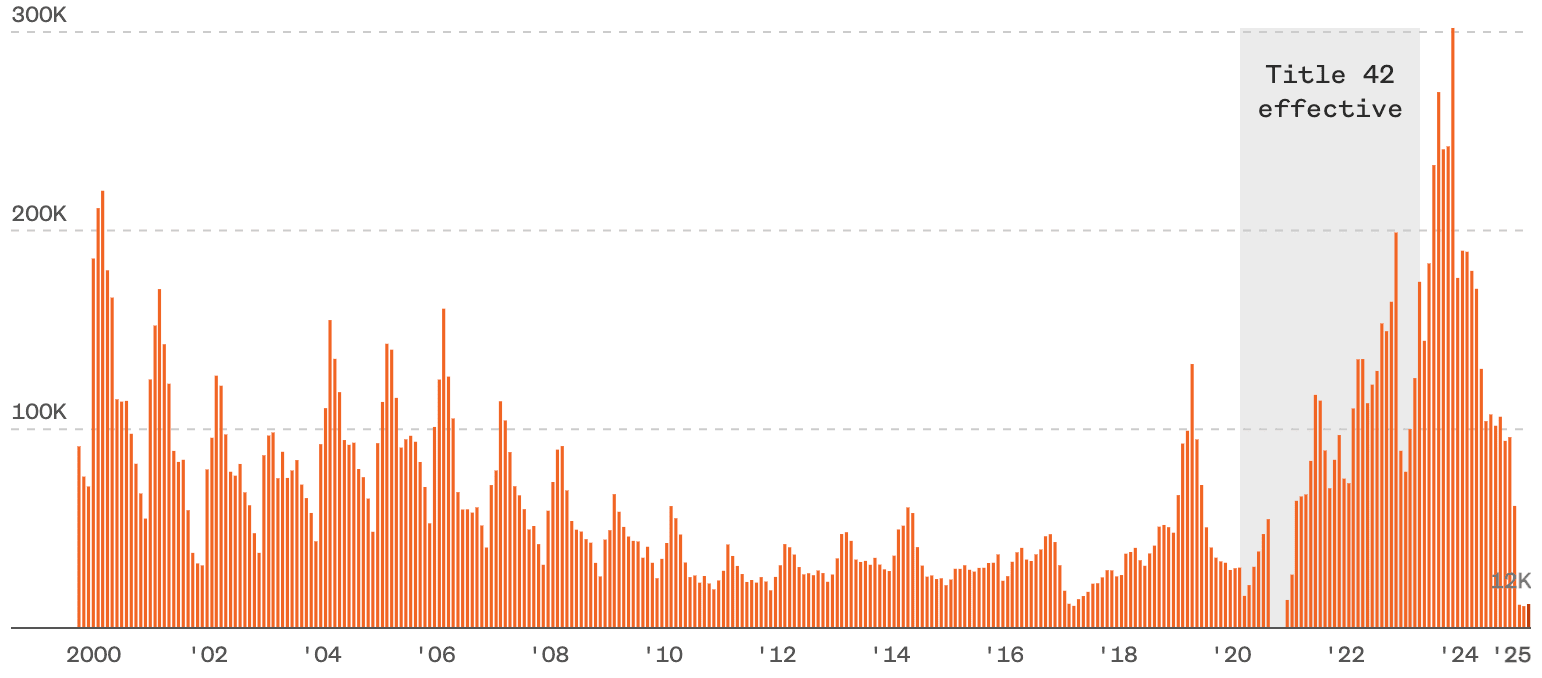
This means that Trump’s success in dissuading people from attempting to cross the border has negatively impacted the deportation numbers he desperately wants to show are growing. In the chart below, note the three short red lines (on the right) for Feb, March, and April 2025 showing that attempted SW border crossings have dropped from well over 100,000 to less than 12,000 monthly encounters. 

Southwest Border Encounters. Source: NBC News

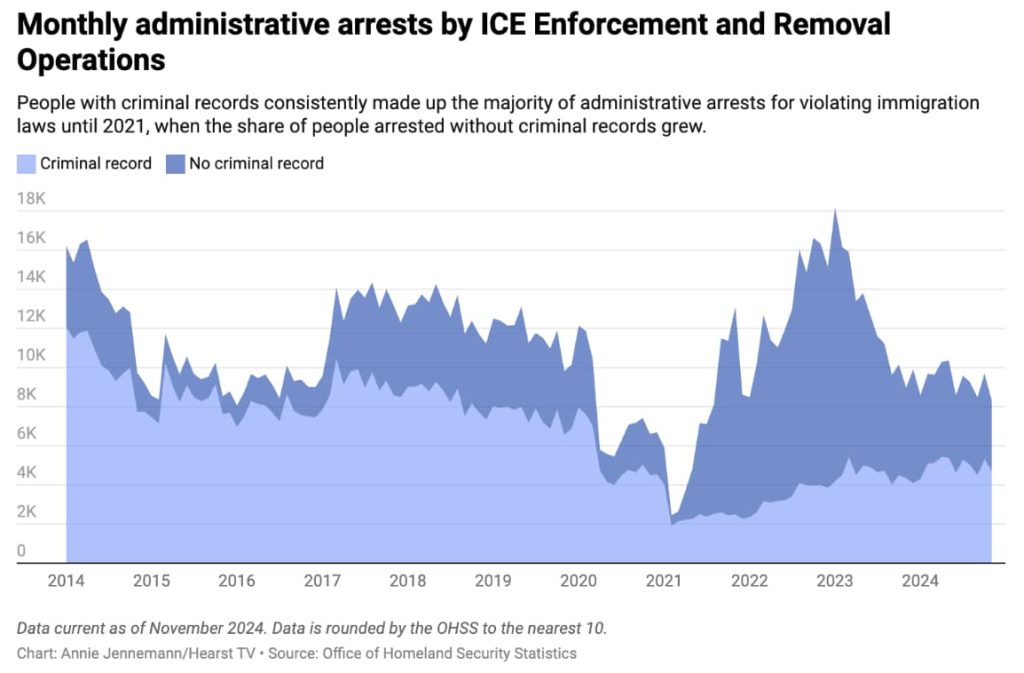
So how has Trump kept his overall arrest numbers slightly higher than Biden’s? The data shows, “ICE’s enforcement surge has largely targeted immigrants without criminal convictions or criminal charges, contrary to the Trump administration’s baseless public assertions.”  Throughout January 2025 the distribution of ICE detainees was steady at around 62% with criminal convictions, 32% with pending criminal charges, and just 6% with no criminal violation. But by April 20 the data shows that 18% of  ICE detainees have no criminal convictions (triple the percentage in January), while only 45% have criminal convictions. This is actually just a continuation of the Biden approach when, in 2021, the majority of people in ICE custody first started to have no criminal record.

 Source: WDSU – Hearst Media

Just because the current administration lies about their deportation numbers does not in any way suggest that the actions they are taking to reshape immigration law–sidestepping Congress–are not heinous. In week one of Trump’s ICE raids, 100 NYC immigrants were arrested, and little is known about their current situation. New York City’s rapid response immigration hotline tracked a 68% increase from prior months with 140 requests for help in January, 35 of which were for people in immigration detention. As if life was not hard enough as a street vendor, “vending without a license“ can be prosecuted in NYC as a criminal summons or misdemeanor rather than as a civil liability, which also puts vendors at risk of deportation if they encounter police. The fear of being deported has caused many vendors to stop working.

“It’s not about public safety anymore. It’s just about this volume number. And we are less safe for that.”
Former ICE Chief of Staff, Jason Houser

WHAT CAN WE DO?


In solidarity and with collective care,

Jackson Heights Immigrant Solidarity Network (JHISN)


Follow @JHSolidarity on Facebook and Twitter and share this newsletter with friends, families, neighbors, networks, and colleagues so they can subscribe and receive news from
JHISN. 


JHISN Newsletter 02/08/2025

Dear friends, 

As we come to the end of another tumultuous week of the new administration, we offer you a ray of hope with a link to two extraordinary examples of determination and resilience in the documentary Borderland: The Line Within. For a small fee you can follow the experiences of Gabriela, a DACA recipient from Mexico, and Kaxh, a Mayan environmental activist and asylum seeker from Guatemala, as the film exposes the extent of the Border Industrial Complex. 

We also join in congratulating Make the Road New York on the opening of its newest community center this week in Corona, Queens. A ribbon-cutting ceremony attended by electeds and community members was held on Wednesday for the nearly $40 million project launched in 2016. 

Today’s newsletter offers a wide-ranging look at how US cities are reaffirming their sanctuary city status in defiance of ICE threats. While NYC is not yet at the forefront of cities taking a stand, that battle is not over.  

Newsletter highlights:
  1. Sanctuary under siege: A nationwide look at how cities fight back


1. Sanctuary Cities Protect People And Do Not Violate Federal Law

Is it really true that if federal immigration authorities ‘command’ or ‘request’ that state officers participate in immigration enforcement, they could be prosecuted for refusing to comply? The answer is ‘no,’  and the law on the subject is quite clear.Just Security (01.23.25)

While the made-for-TV spectacle circulates of Dr. Phil joining an immigration raid in Chicago with ICE enforcers, a Congressional bill has been introduced that is also politically performative: it attempts to define a sanctuary jurisdiction, then makes such jurisdictions ineligible for federal funds. The funds identified for vindictive removal in this proposed bill are earmarked as being “for the benefit” of undocumented immigrants but, as the National Immigration Law Center notes: it is impossible to separate those funds from those that also benefit citizens. The bill therefore threatens funding for free school lunches, domestic violence shelters, all transportation projects, and Federal Emergency Management Agency (FEMA) funding. The new administration is making belligerent and unconstitutional threats against sanctuary jurisdictions in an attempt to bully them into abandoning the rights of the people living there. Many are standing up against the threats, while others may try to appease or benefit from Trump’s  ‘transactional’ power plays. 

James Comer (R-Kentucky), Chairman of the House Oversight and Government Reform Committee, recently sent letters to the Mayors of Boston, Chicago, Denver, and NYC requesting documentation from each about their sanctuary policies.  Why were these cities chosen? The Mayor of Denver said he would go to jail to protect people who are undocumented; the Boston City Council recently reaffirmed its sanctuary in the Boston Trust Act; Chicago recently reaffirmed its ordinance, The Welcoming City; and New York State and City have various sanctuary provisions

The online forum, Just Security, explains why these new demands are legally void, as were the January letter threats from Steven Miller’s America First Legal that warned of “serious consequences” over sanctuary policies. Sirine Shebaya of the National Immigration Project (NIP) concurs: “Letters like these are really more about sowing fear than they are about articulating anything that would hold up from a legal standpoint.” The NIP also published a document outlining how Sanctuary Policies Do Not Violate Federal Law. These arguments against sanctuary policies have had their day in the courts before and have lost. States can decline to help federal ICE agents because, under the Tenth Amendment, states retain police power within their own borders. They can also pursue legal remedies, support the rights of their residents to protest, and allocate funds for immigrant defense—as many did with the first Trump administration. Even the conservative Supreme Court Justice Antonin Scalia held that the framers intended states to have a “residuary and inviolable sovereignty” that barred the federal government from “impress[ing] into its service…the police officers of the 50 States.” 

Republican-led cities have also expressed concern about clear responsibilities in this sweeping approach to immigration enforcement. “We understand this uncertainty creates concerns and fear,” said Oklahoma Mayor Jean Stothert, a Republican running for a fourth term, adding “Enforcing immigration law is a responsibility of federal law enforcement agencies, not the Omaha Police Department.” Indeed, the reason that Trump wants to force local police to do his will is because the 6,000 deportation officers are insufficient to handle the quota he set of 1,500 daily immigrant arrests. He needs the 800,000 law enforcement officers of the 50 states to do his bidding. So local resistance becomes crucial.

In Illinois, several Chicago community-based organizations—Brighton Park Neighborhood Council, Organized Communities Against Deportations, Illinois Coalition for Immigrant and Refugee Rights Inc., and Raise the Floor Alliance—have sued the federal government over the mass deportation raids as a violation of the Administrative Procedure Act and their First Amendment rights. They point out that Florida and Texas are not subjected to the same enforcement, even though they have three times as many undocumented immigrants compared to Illinois. 

In California, in addition to San Francisco and Los Angeles city councils unanimously approving their sanctuary city policy, people gathered outside Alameda City Hall to show there is support for their existing sanctuary city status. Further South in National City hundreds of protesters gathered to voice opposition to the Trump Administration’s immigration policies and raids. The police used tear gas to disperse the crowd. Much further North in Yakima, WA, a rally in opposition to the national raids also took place, and local law enforcement agencies assured residents they would not be participating in any immigration raids. 

So what of New York City? NYC Public Schools prepared staff for ICE run-ins: reminding principals that enforcement officers must have proper legal authority to access school grounds; and noting that all children have a right to education regardless of immigration status. The New York Immigration Coalition published Getting the Facts Straight on Sanctuary Cities. And Manuel Castro, New York’s commissioner of migrant affairs, has vowed not to follow “the instructions of the federal government in cases of mass deportations.” 

On the other hand, NYC Mayor Adams is so far taking a conciliatory approach to Trump’s anti-immigrant actions, possibly because he is facing federal corruption charges that the notoriously transactional president could pardon. Instead of standing strong in support of New York City’s sanctuary policies, Adams said, “The American people have communicated with us loudly and clearly: We have a broken system. They want it fixed. We need to fix our immigration system. We need to secure our border”. He added: “I’m not going to be warring with this administration. I’m going to be working with this administration.” 

As truthout, a member of the important Movement Media Alliance, reported:

“A bully will hit you and then tell you that you made them hit you. Local elected officials and communities must not give in to Trump’s bullying and obey in advance, which will only set a dangerous precedent and groundwork for targeting and persecution of organizers, lawyers, advocates, and others working to protect immigrant communities.”

WHAT CAN WE DO?
  • Join the Vera Institute of Justice in pushing NY State elected officials to protect immigrant New Yorkers by passing the New York for All Act, Dignity Not Detention Act, Access to Representation Act, and Clemency Justice Act.
  • Circulate United We Dream’s resources, including Know Your Rights information sheets.
  • Check out the TV show ‘Mo’ about an asylum-seeking Palestinian family living in Texas – this fictionalized account shows the humanity of the people that Trump wants to deport.
  • Be healthy and support immigrants by signing up for the Immigrants Run NYC, For The Love of Queens, 5k run in Flushing Meadows Park on February 15. Queens Distance Runners are donating 50% of the registration fees to NICE.

In solidarity and with collective care,

Jackson Heights Immigrant Solidarity Network (JHISN)


Follow @JHSolidarity on Facebook and Twitter and share this newsletter with friends, families, neighbors, networks, and colleagues so they can subscribe and receive news from JHISN.