Tag: Tom Homan

JHISN Newsletter 03/21/2026

Dear friends,

There is some important good news this week amidst the cascade of bad news, national and global—including the grim assessment that the US is no longer a functioning democracy, according to the world’s leading democracy watchdog. Sweden’s prestigious Variety of Democracies (V-Dem) Institute writes in their newly-released report, “The scale and speed of autocratization under the Trump administration are unprecedented in modern times.”

But the autocrat’s project also has cracks, and good news includes the release from detention this week of Dylan Contreras, the Bronx high school student arrested by ICE in May 2025. And our second newsletter article reports the end of Leqaa Kordia’s incarceration by ICE, when she finally walked free on March 16.

Our first article investigates the very bad news of the Trump regime’s surge toward holding immigrant detainees in commercial warehouse spaces turned ‘mega detention’ centers across the US.  

Newsletter highlights:
  1. New architecture of deportation: ICE warehouses
  2. Leqaa Kordia freed after one year


Warehouse, Social Circle, Georgia


1. Amazon Prime, But With Human Beings: Warehousing Immigrants

In the run-up to the midterm elections, the Trump regime is signaling a tactical retreat from its increasingly unpopular policy of mass deportation. This change in public posture is reflected in the president’s firing of Homeland Security Secretary Kristi Noem, and his call for a “softer touch” on immigration enforcement. The White House has even quietly urged House Republicans to stop talking about mass deportation altogether. After meeting with Trump’s border “czar” Tom Homan in Albany on March 6, Governor Kathy Hochul sounded convinced that ICE won’t escalate enforcement in New York any time soon. 

Still, the machinery of mass deportation grinds on. Nationally, ICE arrests were down about 11% from January to February, but still four times higher than they were before Trump took office. More than 70,000 people are in immigration detention. In NYC, courthouse arrests continue. Rapid response teams in our neighborhood report continued ICE kidnappings, especially off the streets of Corona.

Perhaps the most damning evidence that mass deportation is still on the agenda—and might ramp up after the elections—is the regime’s rush to build out massive infrastructure for new immigrant detention centers. Flush with $45 billion appropriated for this purpose by Congress, ICE is buying a network of commercial warehouses that it plans to retrofit into immigration prisons. The goal, says ICE Director Todd Lyons, is to be “[Amazon] Prime, but with human beings.”

The plan includes 16 new “processing centers” and 8 large detention centers to hold 7-10,000 people each. Reportedly, 9 of the projected 24 warehouses have already been purchased. One of the planned detention centers, in South Circle, Georgia, is expected to confine more people than any prison in the US.

To speed things up, the regime is using the US Navy’s procurement system, which allows them to bypass federal contracting requirements. By purchasing and subcontracting out the renovation of its own detention facilities, ICE also evades many state and local sanctuary restrictions. GEO Group, CoreCivic, and other profiteering private prison contractors are being tapped to run the facilities.

Conditions at privately-run immigration lockups are particularly grim. Systematic abuse serves to pressure refugees, asylum seekers and others with provisional status to abandon their legal claims and agree to “voluntarily” self-deport.

GEO Group, the country’s largest private prison operator, has been “churning out deportations almost at the rate of approximately 100% of [the company’s detention facilities’] capacity per month,” executive chairman George Zoley said in an earnings call in November. “We’ve never seen anything like this before,” Zoley said on the call. “Our existing facilities are full throttle.”  —Huffpost (March 7, 2026)

This is a specific form of mass deportation that the Trump regime is committed to expanding at breakneck speed.

Local opposition to the new warehouses has been fierce in many places and has successfully prevented ICE from finalizing some pending purchases. For instance, after ICE announced it acquired a former Pep Boys warehouse in Chester, NY, local politicians, community activists, and national Democratic leaders reacted with outrage. A petition denouncing ICE’s plan quickly gathered tens of thousands of signatures. On February 17, ICE released a statement denying that it had bought the building, saying its previous claim was “a mistake.”

A major battle is currently taking place over the future of a giant warehouse in Roxbury, New Jersey, which ICE purchased from Goldman Sachs for $129.3 million—more than double its official taxable value. Several hundred local residents and activists attended a protest outside the site on February 28. Opposition is bipartisan, based on anti-ICE sentiment as well as the practical impact on local services and utilities. Gothamist reports that ”Many local Republicans also oppose the Trump administration’s plans for the ICE detention facility in Roxbury Township, despite saying they broadly support detention centers as a means of immigration enforcement, just not in their backyard.”

On March 11, a federal judge temporarily halted renovation work on an ICE warehouse in Williamsport, Maryland, ruling that the administration had illegally bypassed a required environmental review. It remains to be seen if this ruling will hold up on appeal, and what implications it may have for other facilities.

ICE’s plan–already underway–for a sprawling network of detention warehouses cuts against the narrative that the Trump regime is “softening” immigration enforcement. In fact, they are literally laying the groundwork for a new, intensified stage of mass deportation.

WHAT CAN WE DO?


2. Palestinian detainee and solidarity activist Leqaa Kordia walks free

“DHS insists they are targeting criminals. But all I see here [at Prairieland Detention Facility] are mothers, sisters, daughters, grandmothers. Some have active green cards. Nevertheless, they are transferred from detention center to detention center. It is human trafficking, by another name.Leqaa Kordia, Zeteo (March 9, 2026)

She is the name many of us could not remember. She was never a Columbia student but was regularly referred to as one. She was held by ICE for 12 months and 3 days inside a women’s detention center in Texas, 1,500 miles from her home and community in New Jersey, and largely out of the media spotlight. In February, Leqaa Kordia fainted, had a seizure, and was hospitalized, in shackles. Her story started to receive national attention.

On International Women’s Day this month, Kordia, still imprisoned, published an essay that shared the stories of the women she lived with inside Prairieland: “We laugh together. We cry together. When somebody is crying, everybody is crying. When somebody is laughing, everybody is laughing. We try to do anything to make anybody happy …. We have each other. We only have each other.” In Kordia’s first public speech after her release on March 16, she spoke of her sadness at leaving behind the beautiful, courageous women and men still living in “ICE dungeons.”

In April 2024, Kordia was arrested by NYPD alongside more than 100 protesters outside Columbia University’s locked gates. The group was supporting students inside who had launched the historic Gaza solidarity encampment, demanding a ceasefire and university divestment from the Israeli war-machine. Nearly 200 members of Kordia’s extended family in Gaza have been killed. Although charges were dropped against Kordia and the other protesters in 2024, ICE obtained Kordia’s sealed arrest record from NYPD. Federal prosecutors then tried to build trumped-up “money laundering” charges based on a $1000 check that she sent to support relatives under siege in Gaza. 

One year after participating in the protest, Kordia was ambushed by ICE during what she thought was a routine check-in in Newark, NJ, in March 2025. The Trump regime had just started its campaign of politically targeting noncitizen students and protesters who called for an end to the genocide. Many of those targeted, like Leqaa, are Palestinian.

The Trump regime’s rounding up of international students and faculty who stood in solidarity with Palestine was found to be unlawful in September 2025. Yet Kordia—not a student but a waitress in Paterson, NJstill languished in detention long after more well-known detainees like Columbia graduate Mahmoud Khalil were released. Khalil published a moving public letter to Kordia during Ramadan this month while she was still incarcerated: 

“I keep replaying what it felt like to walk into those detention centers. How impossible it is to describe to anyone who hasn’t lived it …. Leqaa, I want so badly to tell you that the world has stood by you. But I refuse to lie to you. The truth is that the world has failed you, and so have we. I cannot grasp that you remain, a full year later, thousands of miles away from your home, from your family, from the life you were building. And for what? For the crime that has followed our people across continents and generations: being Palestinian and daring to speak our truth.”

On Monday, March 16, the world stopped failing Leqaa Kordia. Mayor Mamdani had reportedly asked for her release; Columbia-Barnard faculty had organized a week-long relay hunger strike in solidarity with Leqaa; and her legal team and community in Paterson had never given up their efforts to bring her home. Leqaa finally walked out of Prairieland Detention Facility in Texas after 368 days. She still faces ongoing deportation proceedings.

Tens of thousands of detainees remain in cages. Kordia’s challenge to us is to remember their dignity and reinvent what solidarity can mean in this era of ‘mass deportation’ and massive social suffering in immigrant communities.

WHAT CAN WE DO?

  • If you are able, consider a donation of any amount to the LaunchGood fundraising campaign for Kordia to help with medical expenses and the ongoing legal fight against her deportation.
  • Support Justice for Migrants which offers material assistance and information for women and men detained at Batavia Federal Detention Facility outside Buffalo, NY.


In solidarity and with collective care,
Jackson Heights Immigrant Solidarity Network (JHISN)

Follow @JHSolidarity on Facebook and Twitter and share this newsletter with friends, families, neighbors, networks, and colleagues so they can subscribe and receive news from JHISN. 


JHISN Newsletter 10/25/2025

Dear friends,

Rarely do we start with a set of asks, but extreme times give our newsletter a sense of urgency. So first, please take a few minutes to fill out our JHISN reader survey, and share how you might imagine and participate in neighborhood defense if escalated ICE raids land in central Queens. Thanks to all of you who have already responded.

Next, please check out and circulate this new state government portal to report disturbing or violent actions you witness by ICE and other federal agents in NYC; photos and videos can be uploaded to the site. The public portal was created by the NYS Attorney General one day after the militarized ICE attack on immigrant street vendors—and New Yorkers who came to their defense—on Canal Street this week. 

Our newsletter below looks more closely at the role of citizen immigrants, our own Jackson Heights-based organization DRUM Beats, and immigrant politics more broadly in Zohran Mamdani’s historic campaign for NYC mayor. And we give an update on the precarious situation affecting members of our Nepali community in Queens who have had their Temporary Protective Status terminated by the Trump regime—part of a larger campaign to rip away the legal status of hundreds of thousands of TPS holders nationwide. 

Newsletter highlights: 
  1. Zohran Mamdani: immigrant organizing boosts support for an immigrant mayor
  2. Update on cancellation of TPS for Nepali residents


1. Mamdani’s Campaign Success: Grassroots Immigrant Organizing

“[Trump] just threatened to have me arrested, stripped of my citizenship, put in a detention camp and deported. Not because I have broken any law but because I will refuse to let ICE terrorize our city.”—Zohran Mamdani

Jackson Heights group DRUM Beats, the sibling organization of Desis Rising Up and Moving (DRUM), was featured by many news organizations this year for its political advocacy work. You may have seen them last weekend at Jackson Heights Farmer’s Market doing henna tattoos, canvassing for Zohran Mamdani, and providing voting registration assistance. They are a major contributing factor to the success of Mamdani’s campaign to become the next, and first Muslim and South Asian, mayor of New York City, and, as he says himself, the first immigrant mayor in generations. DRUM Beats was one of the first grassroots groups to endorse him. Along with CAAAV Voice, the political arm of the CAAAV: Organizing Asian Communities, South Asian residents were engaged across all five NYC boroughs in support of Mamdani’s campaign. Turnout for the primary saw a 40% increase in South Asian voters for the Democratic Socialist candidate. This came less than a year after many of those same populations appeared to swing right by supporting Trump for president. One reason for Mamdani’s success is his showing up in person in their districts.

30% of the election districts won by Trump in 2024 supported Mamdani in the June 2025 Democratic primary. Many of those districts are in majority Asian neighborhoods. Indeed, across all immigrant-majority neighborhoods, Mamdani won by 7 points. New York Communities for Change has announced that a coalition of organizations representing 50,000 working-class Black and immigrant New Yorkers endorsed Mamdani. Make The Road New York officially endorses him, as does Congressmember Adriano Espaillat, an influential Latino leader for upper Manhattan and the Bronx. He also secured support from the head of the NYPD Bangladeshi American Police Association at a time when 13 other law enforcement organizations had backed the incumbent and former policeman, Mayor Adams, before he dropped out of the race. Despite having higher financial earnings than the working-class immigrants campaigning for Mamdani, many young, well-paid, white collar workers in New York’s tech sector are also giving him their support; they also worry about the affordability of life in the city. 

Mamdani, who worked as a housing counselor with the local immigrant services and housing support organization Chhaya CDC, does not include an “immigration” section on his campaign website. He clearly is a strong supporter of our sanctuary city status, but his platform emphasizes affordability, housing and food security, health, and education as the critical issues facing working-class populations. His policy memo about Trump-Proofing New York is not just about standing up to the ICE invasion, but about protecting all vulnerable New Yorkers from the multiplicitous attacks by Trump. During the first Mayoral debate last week, the topic of immigration and our sanctuary city laws was raised—Mamdani distinguished himself from the others by being more personal and talking of the horrific and ongoing abduction activities conducted by ICE at 26 Federal Plaza.

In private, Trump has indicated he thinks Mamdani is unbeatable. Trump has threatened to withhold federal money from New York if Mamdani is elected Mayor and has already moved forward to cut federal counterterrorism and transit funds. The president has stated that he will arrest Mamdani if he tries to stop masked ICE agents from deporting our neighbors. Trump, along with Tennessee Representative Andy Ogles, also questioned Mamdani’s citizenship. Ogles has been called out for censure for his bigoted and racist speech, including his letter asking the Justice Department to denaturalize and deport Mamdani. (Vickie Paladino, a Queens Council member, who also called for Mamdani to be deported, was met with minimal criticism from city officials and the current mayor.) After Mamdani won the Democratic primary, Tom Homan, Trump’s so-called Border Czar, said that ICE would double up and triple up agents in New York (and this week we watched New Yorkers defend their street vendors from ICE on Canal Street). 

These are the actions of authoritarians who will use any means, even if illegal, to silence and punish the people opposing their anti-democracy political dogma, which is hidden behind a show-of-force facade of nationalism and patriotism. Meanwhile, Mamdani was interviewed on Fox News and stated he will lead this city by building partnerships with people, and that he would do so, “not only in Washington, D.C., but [with] anyone across this country.” He has already proven he can do that by building a multi-asian coalition of support, which has expanded further and made him the current leader in the election polls.

WHAT CAN WE DO?
  • Be inspired by The Queensborough restaurant and organize a fundraising event for your favorite local immigrant-led support organization. After the No Kings March, The Q raised over $600 in cash for NICE (New Immigrant Community Empowerment).
  • Help DRUM Beats continue their political advocacy by making a financial donation

2. Brief History of TPS for Nepal, and Its Termination

As of 2023, there were more than 200,000 Nepalis in the US, with almost 17,000 living in Jackson Heights, many with Temporary Protective Status (TPS). As of October 2025, more than 12,000 Nepalis residing in the US–some of them our neighbors here in Queens–have had their legal TPS status abruptly canceled by the Trump administration. 

TPS was created by the Immigration Act of 1990, and grants permission for people to stay in the US if conditions in their country are unsafe from a natural disaster, an armed conflict, or some other unusual and temporary situation making it unsafe for people to return. TPS protects people from deportation, and they can be authorized to work in the US. TPS is granted for 18 months, and at the end of that time it can be extended or revoked for another 6, 12, or 18 months. At least 60 days before the period ends, the Secretary of Homeland Security must review conditions in the target country and publish the decision in the Federal Register.

In April 2015, there was a 7.8 magnitude earthquake in Nepal, followed by several strong aftershocks. There was extensive damage throughout the country: 755,000 homes were damaged; 9,000 people died and 22,000 were injured. That is why TPS was granted for Nepalis residing in the US until June 2018. Then, in 2017, serious flooding and landslides impeded food production and reconstruction of the earthquake damage. As a result of two separate court cases (Bhattarai v. Nielsen and Ramos v. Nielsen), TPS for Nepal was extended three times until June 2024. 

However, in 2018, Trump revoked the TPS status for Nepal, which was quickly challenged in court. Then, in 2023, DHS under Biden rescinded that termination and extended TPS until June 2025. On June 6, 2025, DHS Secretary Noem terminated TPS for Nepal, effective August 5, 2025. She claimed “there are notable improvements in environmental disaster preparedness and response capacity, as well as substantial reconstruction from the earthquake’s destruction such that there is no longer a disruption of living conditions and Nepal is able to handle adequately the return of its nationals.”

In July 2025, the National TPS Alliance and individual plaintiffs with TPS status challenged Secretary Noem’s actions as arbitrary and capricious, failing to provide the required 60-day notice, and violating the equal protection portion of the Fifth Amendment because the motivation was partially racial animus. On July 31, US District Judge Trina Thompson granted the plaintiffs’ motion to postpone the cancellation. The court ordered that TPS remain in effect until at least November 18, 2025. But on August 20, 2025, the District court’s stay was overridden by the Ninth Circuit Court of Appeals, allowing TPS cancellation for Nepal, Honduras, and Nicaragua to go forward. 

Meanwhile, in September 2025, there was a political crisis in Nepal when economic dysfunction and disillusioned youth led to widespread protests, government buildings burned, a national curfew, and finally the installation of a new president, Sushila Karki, the first woman president of Nepal.

It is not clear if that political crisis will have any bearing on the status of Nepalis in the US. With the removal of work authorization and the threat of deportation the Nepali community is in danger.

WHAT CAN WE DO?
  • Make a donation to our local immigrant-led organization Adhikaar which represents the Nepali-speaking community. 


In solidarity and with collective care,

Jackson Heights Immigrant Solidarity Network (JHISN)

Follow @JHSolidarity on Facebook and Twitter and share this newsletter with friends, families, neighbors, networks, and colleagues so they can subscribe and receive news from JHISN. 


JHISN Newsletter 12/14/2024

Dear friends,

 As New York City sits on the precipice of the largest mass deportation in US history as threatened by Trump, the city’s Mayor—indicted under federal charges of corruption and abuse of power—sat down this week with incoming “border czar” Tom Homan. Discussion topic: Adams’ cooperation with the feds’ deportation plans. Already on record saying, “I’m not going to be warring with this administration, I’m going to be working with this administration,” Mayor Adams declared after the meeting that he will consider using executive power to change the city’s sanctuary laws to expedite deportations. Homan declared that the meeting “went great.” 

Immigrant justice activists, including Make the Road NY and Adhikaar, rallied outside City Hall during the Adams-Homan meeting to oppose our city’s collaboration with Trump’s promised spectacle of punishment, caging, and exile.

JHISN will continue to highlight, and fight for, immigrant justice struggles as the enemies of justice gather power and popular support. This week’s newsletter reports again on the draconian Operation Restore Roosevelt and its militarized presence in our neighborhood. We then look at how national immigrant advocacy organizations are stepping up in the face of the incoming administration’s anti-immigrant violence and scapegoating.  

Newsletter highlights:
  1. Roosevelt Avenue: new home for NYPD and NY state troopers
  2. Immigrant advocates gear up for the struggle

1. Political Fault Line on Roosevelt Ave.

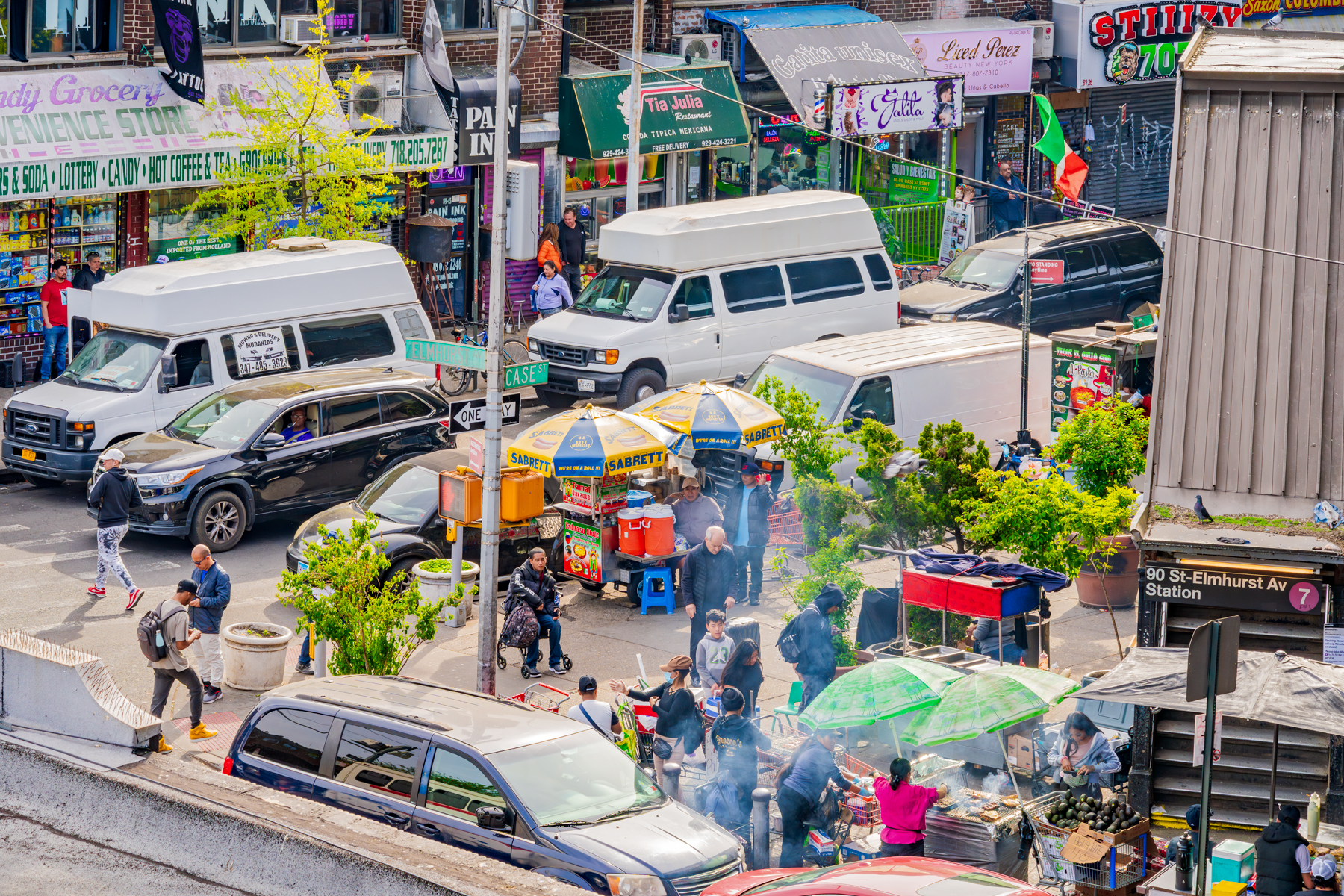
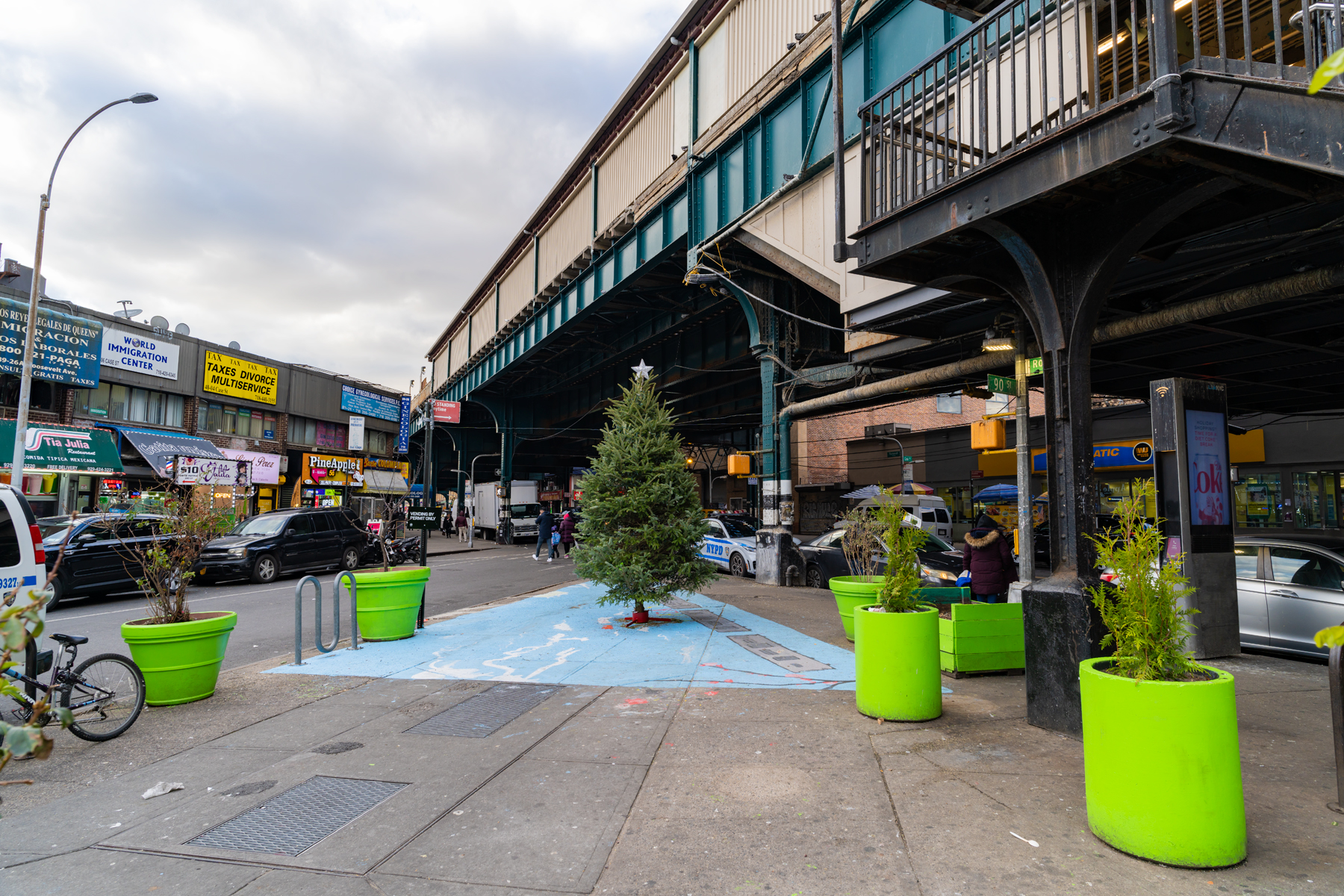
Roosevelt  Avenue, along with its plazas, has long been known for its vibrant street life. It’s a microcosm of working-class New York: a human tapestry of immigrant vendors from all over the world, creating an ever-changing, 24-hour open-air market and food destination in the shadow of the elevated 7 train. Today, the Avenue is mostly blank concrete and asphalt. And cops, hundreds of cops. Cops hassling street vendors and sex workers. Cops supervising the bulk seizure of unregistered e-bikes and mopeds. Cops just standing around, in pairs and groups, owning the street.

Answer Triangle, Roosevelt Avenue, May 2024


Answer Triangle, December 2024

This new, dreary, police state version of Roosevelt Avenue comes to us courtesy of Operation Restore Roosevelt, a 90-day enforcement crackdown previously described by JHISN (10/26/24). The crackdown is the brainchild of an energetic conservative initiative called the Let’s Improve Roosevelt Coalition, led by disgraced right-wing politician Hiram Monserrate, local church groups, embattled Mayor Adams, and City Councilmember Francisco Moya.

Operation Restore Roosevelt represents another advance for a spreading right-wing politics of respectability and scapegoating of recent immigrants. The current cop takeover of Roosevelt Avenue builds on an earlier conservative victory: largely destroying the internationally famous and much-loved vendor marketplace at Corona Plaza. Operation Restore Roosevelt is an even bigger spectacle of morality policing and criminalization, again directed at the poorest and most vulnerable immigrants in our community.

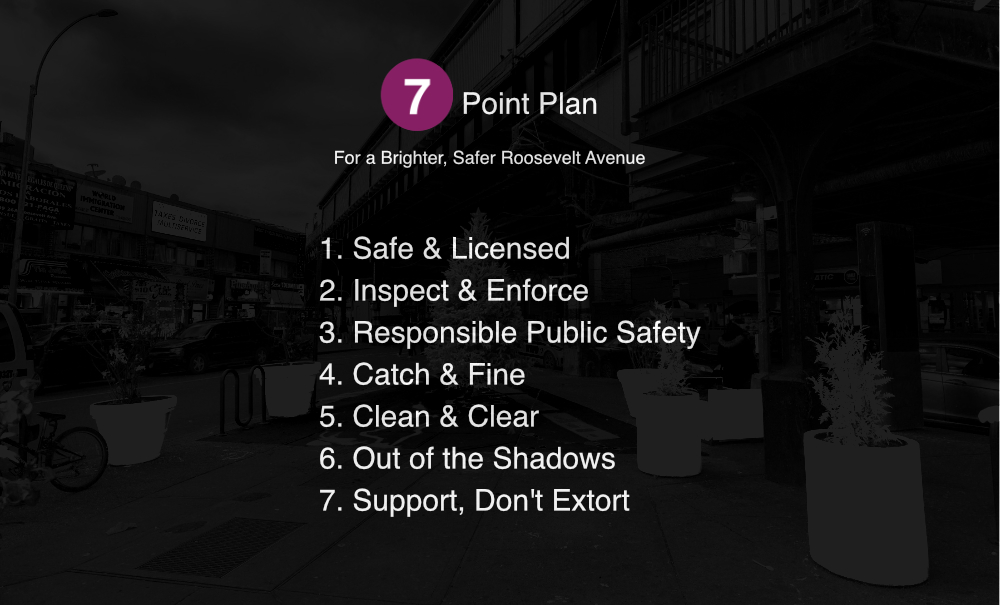
Acknowledging that there are long-standing problems with crowding and trash on Roosevelt, progressive politicians have attempted to get ahead of the conservative groundswell by promoting their own improvement plans for the Avenue. After Operation Restore Roosevelt was announced in mid-October, State Assembly member Jessica González-Rojas held a roundtable discussion on how to prevent sex trafficking in the community without police action. City Councilmember Shekar Krishnan and Assemblymembers Steven Raga and Catalina Cruz quickly announced a “7 Point Plan,” emphasizing social services, licensing, inspections and infrastructure improvements rather than massive police presence. Cruz told the Queens Eagle:

“I think historically, there has been a relationship of fear, and that’s the reality of the members of the community with the police. It cannot be the only measure or solution…because if the only approach is enforcement, we’re going to have the exact same result that we’ve had for the last 10 years.”

Conservative organizers told news outlet QNS that they “repudiated any efforts by ‘radical fringe groups’ to oppose the policing plan and ‘return control’ of Roosevelt Avenue to cartels and street gangs.Nevertheless, the 7 Point Plan has had recent mainstream successes. It was endorsed by Leslie Ramos of the 82nd St. Business Improvement District. Also, Governor Hochul just agreed to provide a million dollars to support four local grassroots organizations in implementing the Plan. The organizations include New Immigrant Community Empowerment, AIDS Center of Queens County, Korean American Family Service Center, and Commonpoint. 

It should be noted that Leslie Ramos and Hochul each originally supported Operation Restore Roosevelt––Hochul even supplied state troopers to beef it up. But they also are both aware that the police crackdown on the Avenue is due to end in January, while the 7 Point Plan aims for long-lasting solutions.

Looming in the background of the struggle over Roosevelt Avenue is the issue of big money real estate development. As JHISN previously reported, there has been major controversy over the proposed Metropolitan Park casino project, a giant development which would be adjacent to Roosevelt Avenue. The plan is slowly advancing, despite resistance by many progressives including State Senator Jessica Ramos. Part of the Senator’s concern about the plan, which a majority of her constituents oppose, is that it would bring the wrong kind of development and visitors to Roosevelt Avenue. “Why are casinos our prime economic development idea in New York City?”, she asks. Meanwhile, Mayor Adams’ new “City of Yes” housing plan, which was just passed by the City Council, eases zoning requirements and promotes larger scale real estate development along transit lines, such as the 7 train.

Battle lines on Roosevelt Avenue are being drawn according to where to assign blame for economic problems and quality of life issues. One group of activists has chosen to “punch down” at their most vulnerable immigrant neighbors, resorting to criminalization and demonization. While another group of activists is promoting social solidarity, demanding that all levels of government, community and business live up to their responsibility to provide work opportunity and social services in an environment free from repression and fear.

WHAT CAN WE DO?
  • Consider volunteering with New Immigrant Community Empowerment (NICE) here in Jackson Heights.
  • Subscribe to the Street Vendor Project’s newsletter.

2. Strategies for Future Immigrant Advocacy

“As the new Trump administration takes office, Adhikaar stands resolute in our commitment to grassroots organizing and providing essential, direct services to our community.” Adhikaar Newsletter (11/15/24)

Last weekend the US president-elect stated clearly his intent to circumvent the 14th amendment in his pursuit to end birthright citizenship. This came after he proposed placing anti-immigrant hardliner and family separator, Tom Homan “in charge of our Nation’s Borders”. They plan to create the largest deportation force in US history, violating the rule of law, by using the US military on home soil despite knowing there are serious financial, legal, and logistical obstacles. Trump’s heartless strategy to avoid separating families that have a mix of undocumented members and citizens is to deport the entire family.

Also last weekend, in counterpoint, the National Immigration Inclusion Conference was held in Texas. The three-day gathering showcased immigrant groups’ intersectional approach to stand against the current and future administration. Building justice coalitions with unions and anti-racist, gender, housing, and youth groups, was a significant daily focus. Also on the agenda were sessions about turning arts and storytelling into impact strategies, examining how funders can support immigrant rights, and discussing various legal and mobilization strategies that the 1,500 people from 450 groups in attendance can implement.

Another organization that brings together immigrant advocacy support is Grantmakers Concerned with Immigrants and Refugees. At their two-day 2024 Convening, just a week before the election, they examined:

  • the state of the immigrant justice movement 
  • power-building strategies
  • how to intersect immigrant justice with racial justice
  • strategies for amplifying groups historically excluded from philanthropic investment. They called on funders “to act boldly, moving beyond financial investments to leverage their privilege and power to tackle the challenges that deny individuals the freedom to stay, move, work, transform, and thrive.”

Immigration Equality is an intersectional advocacy group that focuses on immigration rights for LGBTQ and HIV-positive people in the US. They recently published their Strategic Plan for 2024-2026 which includes demands for equity, secure paths to safety for LGBTQ refugees, robust resources for legal and self-help, and training enforcement officers and judges. They also demand the release of all LGBTQ and HIV-positive people from immigration detention centers.

Simply put—immigrant advocacy organizations are not silenced by Trump’s election victory and vicious rhetoric. They continue to work and provide the support their communities need.

According to Naomi Braine, a longtime activist and sociologist at CUNY, any thought of “resignation and retreat” is largely confined to people “who have never been engaged with sustained forms of action and resistance”. The election, she says, hasn’t affected the immigrant rights movement as a whole. The President of the New York Immigration Coalition (NYIC), Murad Awawdeh, stated after the election, “We’re going to fight it…we’re as prepared, if not more prepared than the first time around.” He identified a three-prong approach: protests, local legislation, and lawsuits. Soon after that statement, NYIC published its 10-year Blueprint for Immigrant Progress and Justice. In November, Manuel Castro of NYC’s Mayor’s Office of Immigrant Affairs said they are working with all community groups and agencies to ensure everyone understands the sanctuary laws of our city. 

New York Congressman, Adriano Espaillat, is running unopposed to lead the Congressional Hispanic Caucus in the next Congress. He has said he will oppose any efforts to pursue the additional threat of denaturalizations as promoted by American Firster Stephen Miller. “I think it’s a radical approach, one that is unprecedented in America, and I think that the vast majority of American people will oppose it as well.” The ACLU is also looking at various ways to oppose deportations. Their National Prison Project is looking to shine a light on the shadowy operations of the deportation machine. Using Freedom of Information litigation, the ACLU is preparing lawsuits against mass detention and deportation actions. One of the organization’s recent public record lawsuits demands more details about ICE Air, the government’s method for carrying out deportation flights.

To immigrant advocates, legal support, and immigrant rights groups, the threat of deportation and anti-immigrant rhetoric and legislation is simply not new. Advocates have been providing groups with Know Your Rights materials and are now adding to their presentations family safety planning. They also anticipate a marked escalation of what was seen during the first Trump administration. They anticipate drastic changes without any prior announcements from the administration and will rely on word of mouth as a way for people to learn about what is happening. As Adhikaar concluded in their newsletter:

“The election outcome is a reminder of the entrenched systems that seek to undermine the rights and dignity of marginalized communities…We refuse to let our communities be silenced or pushed into the shadows. Together, we will continue to build power, advocate for justice, and demand a future where all can thrive with dignity and self-determination.”

WHAT CAN WE DO?


In solidarity and with collective care,

Jackson Heights Immigrant Solidarity Newsletter (JHISN)


Follow @JHSolidarity on Facebook and Twitter and share this newsletter with friends, families, neighbors, networks, and colleagues so they can subscribe and receive news from JHISN.