Tag: JHISN

JHISN Newsletter 05/24/2026

Dear friends,

Like the volatile Spring weather, the battle for NYC immigrants’ future runs hot and cold. We were glad last Monday when a federal judge ruled that ICE arrests at Manhattan immigration courts must be significantly curtailed. But that feeling of relief was soon tempered by learning that ICE detained a man at immigration court the very next day—and by awareness that ICE might respond to the ruling by increasing its presence on our streets. 

Today’s newsletter begins on a positive note by describing how NICE (New Immigrant Community Empowerment) has expanded its programs and physical presence in the neighborhood. Our second article dives into the little-known story of Omni Airlines, a billionaire-funded company noted for its particularly cruel ICE deportations. We share a revealing map that quickly shows the story of ICE activity in Corona, and conclude with information about an upcoming volunteer event—one where we hope you will join us.

Newsletter highlights:
  1. Going “beyond one-time assistance” for immigrants at NICE
  2. The airline you’ve never heard of that transports ICE deportees
  3. Mapping ICE activity in NYC


1. NICE: “From Surviving to Thriving”

Migration and displacement are overwhelming experiences. Community members must navigate complex U.S. systems—healthcare, employment, housing, and financial services—that are often unfamiliar and difficult to access. —NICE Fact Sheet

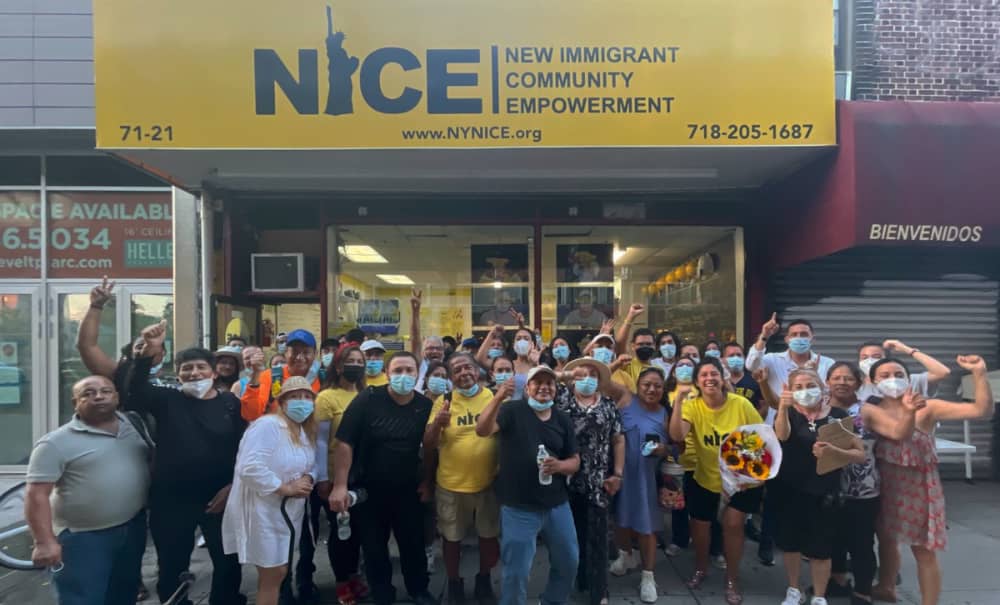
Since 1999, New Immigrant Community Empowerment (NICE) has been a crucial first point of contact in our neighborhood for thousands of recent Spanish-speaking immigrants seeking access to social services, legal advice, community, and basic survival assistance. NICE has long been known for its support for day laborers, its OSHA and ESL classes, and for political action in support of immigrant rights.

In recent years, NICE has expanded both its role and its facilities. Their current strategy gives priority to “holistic, culturally competent support that goes beyond one-time assistance.” A key feature of this strategy is the Pre-Apprenticeship Program for Life and Work (Pre-APLW). This apprenticeship program offers English-language, legal, and job-related training. But it also helps immigrants build other practical skills useful in navigating life in the US, including:

  • accessing health and mental health services
  • learning more about transportation systems
  • strengthening financial literacy
  • dealing with New York’s rental and real estate markets

Pre-APLW is organized around intensive workshops. These typically include 25 to 30 participants, who devote 30 to 40 hours a week for four weeks. NICE has contacts and partnerships with potential employers, allowing Pre-APLW Apprentices to obtain hands-on experience and job opportunities. Like all NICE programs, Pre-APLW aims to promote social and political leadership and build community among immigrants.

NICE has recently acquired and renovated additional spaces around Roosevelt and 72nd Street, becoming a small campus. This includes a community center, event and meeting areas, classrooms, and offices. The organization hopes to keep expanding to further meet the needs of their members and all recent immigrants. 
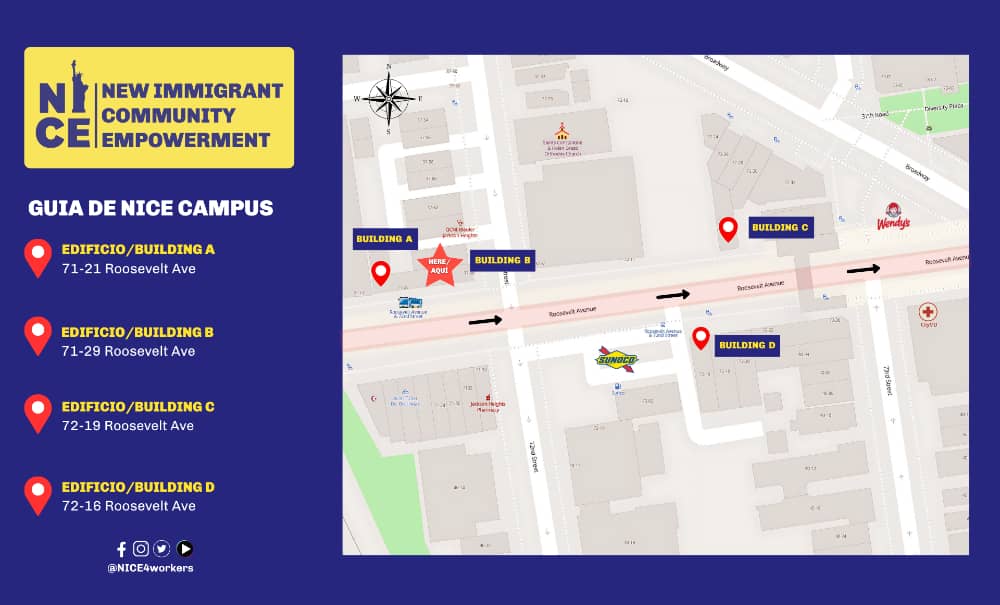
Funding for NICE’s work comes from a combination of government grants, philanthropic or corporate donors, and private contributions. Volunteers are encouraged to assist at the organization’s community events, such as their winter toy giveaway and their Thanksgiving distribution. NICE is currently campaigning to build community support by sponsoring runners in this year’s New York Marathon.

WHAT CAN WE DO?

2. Omni: ICE’s “Special” Airline

“To leave human beings warehoused on a tarmac for hours reveals a system that does not see them as people. This is not simply a logistical error; it is a feature of ICE’s inhumane mission.”Jo Jordon of No ICE NH

Michael Dorrell, an immigrant from Australia, made billions as a financial investor in logistics companies like the Air Transport Services Group, ATSG, which owns Omni Airlines, a passenger airline that, through the broker Classic Air Charter, contracts with ICE to provide airline deportations. Omni is reportedly the sole provider of “special high-risk charter” (SHRC) deportation flights. Since other airlines refuse to provide that service, Omni charges ICE twice the standard rate for similar flight services, over $33,000 per hour. Comparing the ICE deportation machine to Amazon for people is more than a metaphor: between 2016 and 2024, Amazon acquired over 13 million shares in ATSG, and ATSG expanded the number of cargo planes leased to Amazon in an operating agreement that is good to 2029.

The Torture Abolition and Survivors Support Coalition demanded, in 2022, that Omni suspend cooperation with ICE due to the many human rights violations created by their deportation work. Omni did not stop. In fact, that year, the US government gave Omni $67 million in COVID bailout funds and awarded them a $78 million contract. The airline’s treatment of immigrants actually got worse: flights have become longer and crueler. In 2024, Omni had just six trips that took more than 24 hours to complete, using multi-destination hops. By the end of 2025, 31 flights took between 24 and 50 hours—some have taken 70 to 80 hours. Deportees are held in shackles for the entire duration–an ICE requirement–and deportees have sometimes gone 10 hours without food or water. 

ICE talked publicly last year about possibly purchasing its own fleet, but for now, it works with between 8 and 14 aircraft from about 10 contractors to oversee about 15,000 deportations every month. To reach Trump’s goal of 1 million annual deportations would require 83,300 removals every month, which would require more than 50 planes.

Thomas Cartwright offers a stark contrast with Dorrell.  He is a retired financial investor who, when working with Witness at the Border in 2019, learned about the dehumanizing deportation flights leaving small border airports. He used his skills to track deportation planes using flight-tracking apps. It was his work that revealed the details about the notorious CECOT flights last year. He trained others in his process and has transferred the bulk of the work to Human Rights First, which now publishes monthly reports. April’s report holds 32 pages of revealing details, including:

  • The number of flights for both internal transfers and removals.
  • The use of coast guard flights in the deportation machine.
  • The number of planes provided by each airline carrier.
  • The path of a 51-hour flight carrying deportees to 6 countries.
  • How many times each airport is used: Alexandria, in Louisiana, had the most usage at 2,439 flights.

The contrast of the work these two people have done reveals the difference in mindset between a person who is seeking to make money regardless of how people’s lives are horrifically impacted, and a person who is looking to help his community do well by other people instead of blaming and abusing them.

WHAT CAN WE DO?

3. Locally Mapping ICE 

There are data analysts, such as Danielle Harlow, who examine ICE records nationally to produce public data visualizations showing deportation flights and the locations from which people were taken.  NYC activists are also gathering data to tell the stories of local people kidnapped by ICE enforcers. Corona-based Queens Neighborhoods United (QNU) has been tracking neighborhood ICE raids and verifying the locations where they have kidnapped people. 
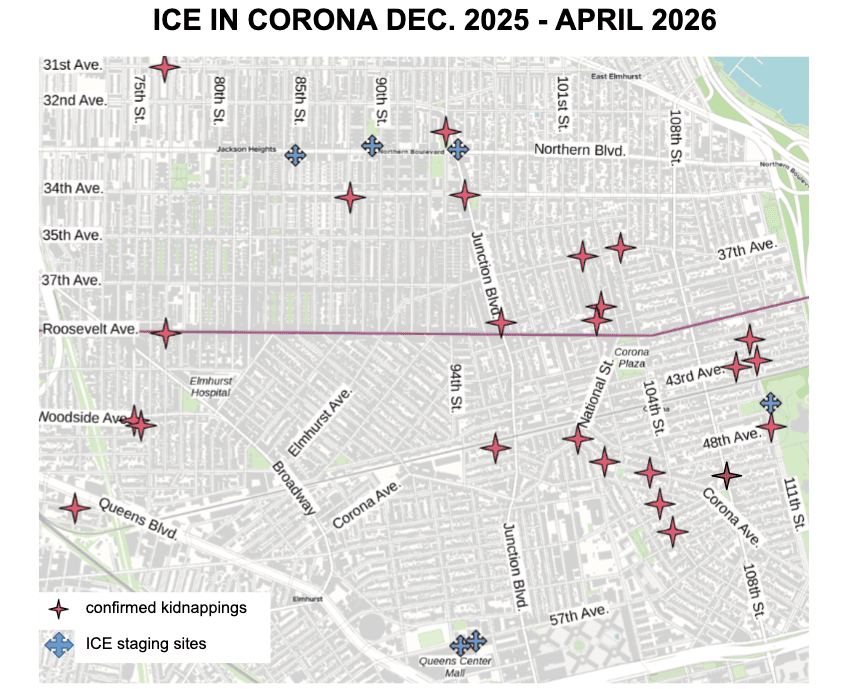
 

NYC Icebreaker has been tracking ICE actions throughout the city: their work has revealed that raids are most likely to take place between 7-8 am and 3-5 pm. Monday seems to be the most popular day of the week for ICE to stage their raids in Corona, Tuesday in Bushwick, and Thursday in Sunset Park.

Maps like these are helpful, but incomplete. At last weekend’s anti-casino town hall meeting, it was noted that hundreds of people per month are taken from NYC streets to endure the excruciating flights and inhumane detention centers. Neither maps nor figures can show the full extent or cruelty of the process. 

Like so much immigrant justice work, tracking and mapping ICE is the work of small, local, volunteer-led groups who need support from neighbors and progressive journalists to continue raising awareness and speaking out against the injustices of the deportation machinery.

WHAT CAN WE DO?
  • Join JHISN, Brave of Us, and others at the Community Volunteer Morning organized by Documented, the multilingual, immigrant-driven news outlet we have covered in this newsletter (and often use as a source):

    “Saturday, June 6, from 10:00 AM to 12:00 PM: Distribute newspapers and guides to community spaces (houses of worship, small businesses, community centers, and busy public areas). Engage with residents about their information needs and build community in real time, together— and over food and drink.” INFORMATION AND RSVP


In solidarity and with collective care,

Jackson Heights Immigrant Solidarity Network (JHISN)

Follow @JHSolidarity on Facebook and Twitter and share this newsletter with friends, families, neighbors, networks, and colleagues so they can subscribe and receive news from JHISN. 


JHISN Newsletter 12/18/2021

Dear friends,

The days grow short as the winter solstice approaches. At this darkest time of year, we celebrate the power of community and the promise of collective warmth in our immigrant neighborhood here in the heart of Queens. We celebrate the political promise of hundreds of thousands of immigrants now enfranchised to vote in local elections, as NYC joins over a dozen US communities where non-citizens have the right to vote.

In this issue, we offer you a local story of how the historic fight to fund excluded workers in New York State has been curated into a museum exhibition in Queens. And we report on the statewide campaign to end ICE detention of immigrants, in the context of the 20th-century criminalization of immigrants of color in the US.  

Newsletter highlights:

  1. ‘Nuevayorkinos: Essential and Excluded’ at PS1
  2. Shutting Down ICE Detention 

1. Immigrant Activism Meets Museum Space: Art & Politics @MoMA PS1

The room is sunny, spacious, and quiet. The white museum walls are adorned with colorful banners in Spanish, and photographs of immigrant activists taken last spring at Corona Plaza. In the middle of the room is a comfortable couch and chairs circled around a table with Spanish- and English-language books on immigration history and politics, including a neatly stacked pile of tales of resistance for children.

The exhibition in the “Homeroom,” a community-engagement space at MoMA PS1 in Queens, invites reflection: What is the place of community activism in a museum that contributes to gentrification and community displacement? How can we build popular memory of immigrant struggles using the tools of art and visual culture? Who is this exhibition created for, and who may be excluded by ticket price and social class?

PS1’s exhibition Nuevayorkinos: Essential and Excluded (on view through January 10, 2022) brings together the work of artist Djali Brown-Cepeda and local immigrant groups Make the Road NY, the Street Vendor Project, and NY Communities for Change. At the center of the exhibition is the historic struggle of the Fund for Excluded Workers, and their 23-day hunger strike in spring 2021 that culminated with an unprecedented victory: a $2.1 billion fund in NYS dedicated to immigrant workers excluded from federal programs of pandemic relief and emergency support.

In a corner of the exhibition, providing a rolling soundtrack, are two videos by Jose Armando Solis, filmed on Day 5 and on Day 17 of the hunger strike. As visitors wander in and out of the exhibition space, the voice of hunger striker Ana Ramirez cries out, over and over, “It is not just me but thousands of families—families that went to the bakery to bake the bread so that the rich can eat during this pandemic comfortably. I am forgotten, I am one of the excluded. We are house cleaners, construction workers, restaurant workers, retail workers, laundry workers, all of whom have worked hard for this nation…”

For those of you unfamiliar with the Fund for Excluded Workers, the hunger strike, or the cultural power and beauty of immigrant justice struggles, we encourage you to visit the exhibition. To not forget those who were systematically forgotten. For those of you who have participated in the victorious fight for essential and excluded workers – a fight that is ongoing – we honor your power and the possibility that this exhibition can help strengthen community support and solidarity. For the struggles ahead.


2. ‘Dignity Not Detention’: Decriminalizing Immigration 

“This hard-fought victory reflects the resilience and tenacity of our communities – and reaffirms that our vision of a world without detention is within reach.” Tania Mattos, Freedom for Immigrants (August 2021)

Sustained activism on the part of immigrants, their families, and immigrant justice activists has succeeded in shutting down ICE detention in the state of New Jersey. The Hudson County Jail processed out its last immigrant prisoner in October. And the last 12 immigrant detainees in the Bergen County Jail were transferred out on November 12. Ending the use of these jails for immigrant detention was a result of militant protests outside the facilities, hunger strikes by prisoners, and an intense publicity and organizing campaign run by activists including the Abolish ICE NY-NJ coalition. 

Unfortunately, while some immigrants have been released, most of the New Jersey detainees have been transferred to New York State jails such as the Orange County Correctional Facility in Goshen and the Buffalo Service Processing Center in Batavia. This puts them hundreds of miles farther away from friends, family, and lawyers.

New York State activists hope to keep the anti-detention momentum going with the “Dignity Not Detention Act”  now making its way through the state legislature (it is currently in committee in both houses). The Act would require the termination of all existing ICE contracts for immigrant detention in public jails in New York, including the Goshen and Batavia facilities. Local groups including Centro Corona, DRUM, Queer Detainee Empowerment Project, NICE, and Street Vendors Project are supporters of the statewide mobilization for the Act. Similar legislation has already become law in Maryland, California, Washington, and Illinois. Activists in New Mexico launched their own Dignity Not Detention movement in 2019.

But as the ICE detainee transfers from Bergen County make clear, passing state-by-state laws isn’t a panacea. In fact, some immigrants may find themselves transferred even farther away from where they were arrested, to completely different parts of the country. They might also end up in brutal private for-profit jails –  still widely used for ICE detention, despite pledges by the Biden administration to eliminate them.

Nationally, ICE continues to detain tens of thousands of immigrants. Most of these people are simply waiting for their backed-up immigration hearings, which they could do without being jailed. The number of undocumented migrants imprisoned has increased 50% since Joe Biden took office. Conditions in the facilities are often brutal. When immigrants speak out about rampant abuses, they face severe retaliation and ongoing surveillance

The criminalization of migrants to the US began in the 1920s with a wave of reactionary anti-immigrant politics that led to a series of quotas, exclusions, and other restrictions on immigration, mainly targeting immigrants of color. In 1929, the Undesirable Aliens Act – authored by an avowed white supremacist and pro-lynching advocate – epitomized the hardening of immigration policing. Entering the US illegally–which had been processed as a civil complaint–suddenly became a misdemeanor, punishable by up to a year’s imprisonment and a fine. Returning to the US after deportation was now defined as a felony, resulting in up to two years imprisonment and a $1,000 fine. The Act was intended specifically to control and regulate Mexican labor. In the years after the passage of this law, Mexicans made up as much as 99% of the newly-criminalized immigrants filling just-built federal prisons in El Paso, Tucson, and Los Angeles. (Today, Latinx immigrants still make up 92% of people prosecuted for illegal entry and re-entry to the US.)

The 1929 law was eventually updated by the Immigration and Nationality Act of 1952. This legislation cut the sentences for crossing the border in half but continued to criminalize migrants through its notorious Sections 1325 and 1326. During periods when Mexican labor was in demand, immigrant detentions and prosecutions fell. But starting in 2005, as the “war on terror” ramped up during the Bush and Obama administrations, the federal government once again began prosecuting tens of thousands of migrants and jailing them until their cases could be heard. Donald Trump used Section 1325 as a basis for his infamous “zero tolerance” and family separation policies.

The most effective means of stopping the large-scale detention of immigrants would be a national law that overturns the criminalization of border crossing. (For example, by returning illegal border crossing to its previous status as a civil offense.)  Hundreds of immigrant justice groups have been demanding this kind of federal legislation for years, including local groups like DRUM, Adhikaar, and JHISN. However, decriminalization of border crossing is not included in the current Build Back Better draft legislation. A 2019 decriminalization proposal introduced by Representatives Pramila Jayapal and Jesus Chuy Garcia, has been stalled in Congress, despite the fact that it is endorsed by many immigrant justice groups and has 44 co-sponsors – all Democrats.

And so the end of immigrant detention in New Jersey must be seen as only one hopeful step in a long struggle. Local activists have turned their full attention to fighting against the abuses of immigrant detention in New York State, including punitive transfers, detainee mistreatment, and deportations. At each step, they raise the need for the Dignity Not Detention Act. 

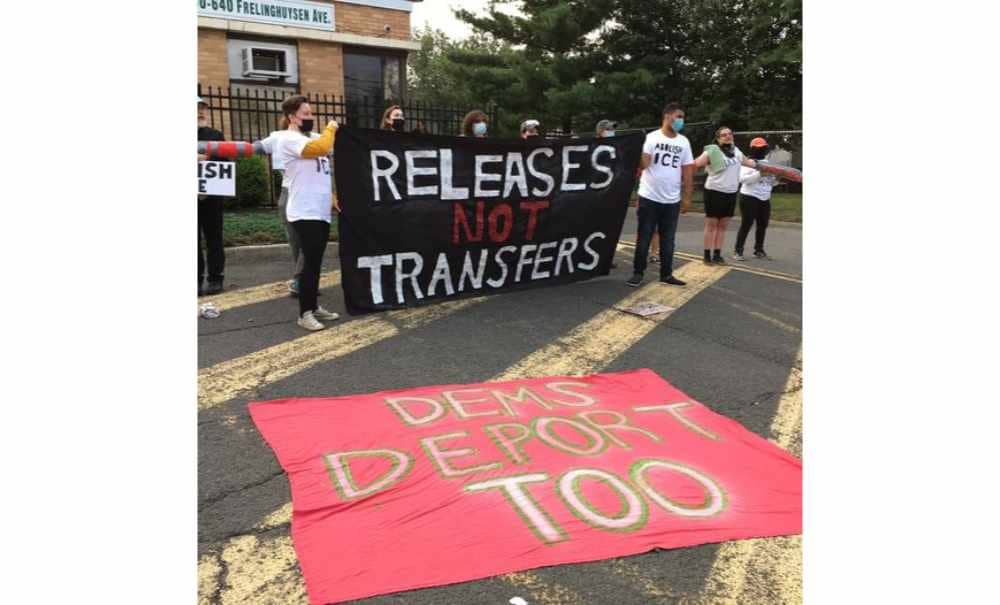
Last Sunday, December 12, a small demonstration took place outside the Bergen County Jail. It commemorated the one-year anniversary of a violent clash with cops that led to the arrest of ten immigrant justice activists. Protesters carried signs saying “Releases Not Transfers,” “Close the Camps,” and “Abolish ICE.”  As Shamz Azanedo, one of the organizers, said, “We didn’t feel right just letting today pass. Today was a huge day last year, and we needed to be here together.”


WHAT CAN WE DO?

In solidarity and with collective care,

Jackson Heights Immigrant Solidarity Network (JHISN)

Follow @JHSolidarity on Facebook and Twitter and share this newsletter with friends, families, neighbors, networks, and colleagues so they can subscribe and receive news from JHISN. 

 

JHISN Newsletter 05/01/2021

Dear friends, 

We are delighted to devote this week’s newsletter to the story of Famoro Dioubate—musician, migrant, teacher, griot. In October 2019, Famoro’s live performance was the opening and closing act for JHISN’s third annual Community Gathering, ‘We All Belong Here: Jackson Heights Fighting for Migrant Rights.’ In April 2021, Famoro is working to obtain US citizenship and stay in his adopted homeplace, Harlem. JHISN invites you to listen below to his story, and his music. Please check out the GoFundMe page and help support Famoro’s path to citizenship. 

The living history book of Famoro Dioubate

Famoro Dioubate had just sent his band home and was setting down roots in Sydney, Australia, when he got a call from a friend.

The United States was in need of good balafon players, his friend said. Dioubate was famous in his native Guinea and was known internationally for his skill on the balafon—known as a xylophone in the States. And so, his friend asked, would he come here and help make an album?

More than 20 years later, he’s still here. And after preparing more than once to up and go, Dioubate now has family, friends and a career in the United States, with students and the prospect of live performances once again on the horizon. He also has a mother in Guinea he hasn’t seen since he left. To assure his future here, and to make it possible to see his mother, he’s officially begun the long and expensive road to citizenship.

Dioubate is a djeli, also called a griot, part of a storytelling tradition in West Africa. (“Djeli” is pronounced with a j sound at the beginning.) The djeli tradition is a history passed within families from generation to generation through things like stories, music and poetry.

“It’s called a living history book,” Dioubate said in an interview with the Jackson Heights Immigrant Solidarity Network. “That’s what we are.”

Djeli history is passed down orally. Nothing is written down. It was within this tradition that Dioubate learned to play the balafon, which he started at the age of six.

He carried the tradition with him after he left Guinea, playing his music in places from Paris to Bangkok to Sydney, ultimately landing in New York. Dioubate performs ceremonies here as a djeli with his balafon, and in pre-pandemic times, he played many live concerts as a professional musician. Whether it’s a baby shower or a show onstage, “anything is like a concert for me,” he said.

Dioubate didn’t plan to stay in New York long when he arrived in 2000. But soon after he came, he found out that he was going to have a newborn daughter here. His original plan was to help her mother through the pregnancy and then leave, but instead he got sick. So he stayed to get surgery, planning once again to leave after that. But now broke and with no work or money to return home, he had to stay.

Eventually, as he prepared to leave once again, a friend of his, a cellist, stopped him. “Famoro,” he said, “stay here. You are a good musician. We don’t want you to leave.” He invited Dioubate to stay in his living room while he figured out his next steps.

“So I stayed,” Dioubate said.

Dioubate’s daughter is 21 years old now, which means she can sponsor him as he seeks citizenship. It’s important for him to attain citizenship status, not just so he can live and work in the United States, but also so he can travel to Africa to visit his mother.

Death has thinned his family back home, and he and his mother want to be reunited after 22 years apart. But “if I go, I could not come back,” he said. So he tells her, “When I get my citizenship, I’m going to come see you.”

Dioubate has become well-known throughout the United States. He has a band here, called Kakande, which usually tours around the country. He offers classes to students, who learn in his living room in Harlem. He makes his own balafons, using wood sent from Guinea by relatives.

“Balafon is not only music,” he said. “It’s like school.” He passes stories on to his students, helping the djeli tradition expand here. His daughter, too, is part of the tradition. “It’s happiness for me,” he said. “I’m happy to have a baby in the United States, and to have a djeli girl from America. We are like that. The living history book, the djeli, we are everywhere in the world.”

***

Famoro Dioubate has begun the process of seeking citizenship, retaining the services of a New York-based lawyer. This process, which typically takes years, is also very expensive. To lessen the burden, Dioubate is hoping to receive donations of any amount to a GoFundMe page.

With collective care, 

and respect for our living histories,

Jackson Heights Immigrant Solidarity Network (JHISN)

Follow @JHSolidarity on Facebook and Twitter and share this newsletter with friends, families, neighbors, networks, and colleagues so they can subscribe and receive news from JHISN.