Tag: NYPD

JHISN Newsletter 10/24/2026

Dear friends,

As we fight for immigrant justice and empowerment during a brutal mass deportation campaign, there is something new we may need to fight against: the ‘normalization’ of all that’s happening. Outrage can turn to weary avoidance of the news. Collective action can start to weaken. Motivation can diminish. With profound respect for the continued struggle on many fronts, we also want to name the threat of normalization that can creep into our lives, especially for US citizens not directly endangered by anti-immigrant state violence.

This newsletter highlights the relentless commitment of Win Rozario’s family and community advocates in the face of the NYPD quietly retiring and immunizing one of the cops charged with excessive force in Win’s murder. We stand with the thousands in the streets on October 9, the day after ICE shot Oscar Belgal in the Bronx, calling for Police Commissioner Jessica Tisch to be fired. And we offer a review of the just-published memoir of Mahmoud Khalil, who spent over 100 days in an ICE cage in Louisiana and now continues to fight for justice as the Trump regime still threatens to deport him.

Newsletter highlights:
  1. Justice for Win Rozario? The Injustice Continues
  2. Mahmoud Khalil’s memoir of ICE detention


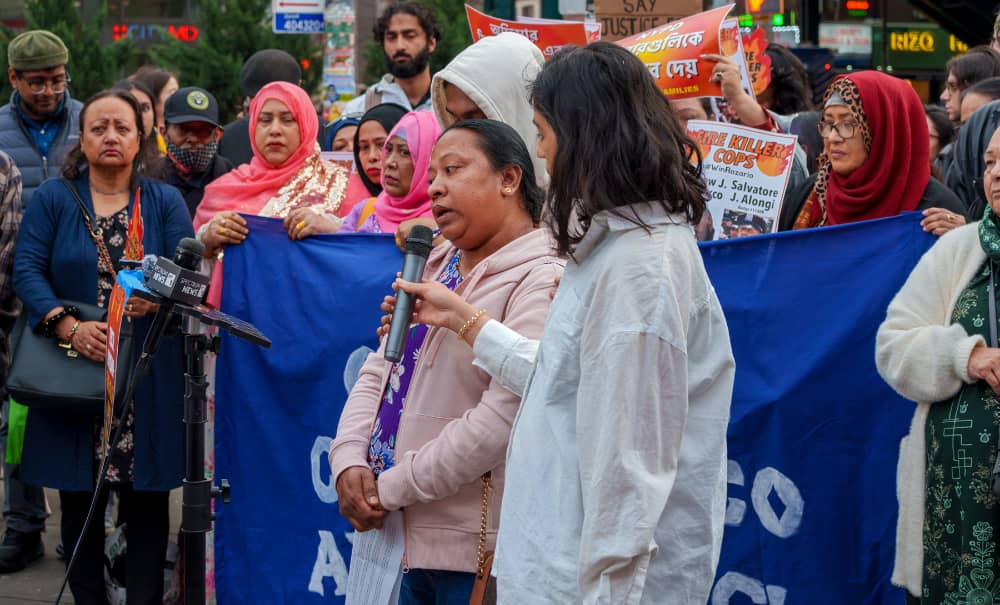
Notan Eva Costa, Win Rozario’s mother (Diversity Plaza, 4/1/26)


1. Years Later, Win Rozario Shooting Still Roils NYC

“We are 10 months into a new administration that purported to be different from the administration that came before…I want to hear answers of why this person was allowed to retire and no one knew, and when the hell the trial will begin for the officer who’s still here.” —Public Advocate Jumaane Williams, (October 8, 2026)

Almost three years after 19-year-old Bangladeshi immigrant Win Rozario was gunned down by cops in his Queens kitchen, his death continues to reverberate within city politics. As we previously reported, NYC’s Civilian Complaint Review Board (CCRB) ruled in September 2025 that NYPD Officers Matthew Cianfrocco and Salvatore Alongi used excessive force and abused their authority during the deadly shooting. Despite extended delays, the Rozario family and their supporters, including local immigrant justice group Desis Rising Up and Moving (DRUM), have continued to demand accountability from the two cops and city officials.

Now it’s been revealed that the NYPD—violating its own policies—allowed Alongi to take a disability retirement this May, receiving a lucrative pension and evading the disciplinary trial previously ordered by Police Commissioner Jessica Tisch. The Department also delayed notifying state agencies that Alongi was retiring under a threat of disciplinary action, notification required by law. This left the door open for the disgraced cop to potentially seek employment with a different police department.

At a City Hall press conference on October 8, the Rozario family, supporters and community activists responded with fury to the news. They accused Tisch and Mayor Mamdani of “betrayal.” Win’s mother, Notan Eva Costa asked:

“How is it possible that an officer charged with killing a teenager could file for retirement and actually leave the NYPD with his pension without even being flagged? How is that even legal? Is Jessica Tisch not a mother too? Does she not understand what it means to lose a child?” —Queens Daily Eagle, October 8, 2026

Win’s father, Francis Rozario, charged that the mistake “is not negligence. I feel it’s a deliberate cover-up and corruption at the highest levels of the NYPD.” Utsho Rozario, Win’s brother, added: “Our family’s tax dollars are paying for a pension for a man who killed my brother. Do you understand what that feels like?”

About an hour after the October 8 press conference, Tisch publicly apologized for the violation of NYPD policy. Ignoring the department’s long history and documented pattern of disciplinary impunity, she characterized it as “human error.”

Mayor Mamdani’s election campaign prominently featured pledges to end the practice of police responding to mental health crises, a change which has not yet occurred. Instead, four days after the Rozarios’ press conference, City Hall announced a series of measures intended to increase police accountability. Among these is a comprehensive review of police use-of-force practices, an additional $2.6 million to fund the NYPD’s Office of the Inspector General, and a pledge of greater transparency when cops kill or seriously injure a resident. The accompanying statement from the mayor’s office declared, “When the government uses force against a New Yorker, the standard for accountability must be at its highest. Every New Yorker deserves to know that force will be used lawfully, carefully and only when necessary.” 

The administration’s announcement occurred at a time of widespread anger at the NYPD for its violence against protesters following the recent ICE shooting of Oscar Belgal in Marble Hill. But reports by CBS and other news outlets make it clear that the new policies had already been in the works, and were drafted mainly in response to the Win Rozario scandal. 

City Hall’s reform measures have provoked a range of reactions. Patrick Hendry, president of the police officers’ union, claimed that “The mayor’s radical base wants a wholesale dismantling of the NYPD, and it’s clear this announcement is an attempt to appease them.” On the other hand, the Justice Committee, while endorsing the mayor’s new policies, argued that he didn’t go far enough. “Previously, administrations tried to require the NYPD to review and adjust its own policies, and it has never worked.”

WHAT CAN WE DO?

2. The Cruelty Is Not Incidental: Mahmoud Khalil’s Story 

Mahmoud Khalil’s recently published memoir No Land to Stand On: Notes from Detention, is a disturbingly professional recounting of the 104 days he spent in ICE detention in the spring of 2025. As a permanent resident, married to a US citizen, a recent graduate of Columbia University’s School of International and Public Affairs, he never expected the US government would treat him just like the Assad regime had when he grew up Palestinian in Syria, with forced disappearance and arbitrary detention. When he was a teenager, the Mukhabarat (secret police) disappeared his aunt for three months. When he was an expectant father living in New York, standing next to his pregnant wife, ICE took him. His transgression: being a Palestinian spokesperson for the student mobilization calling for Columbia’s divestment from the US-Israeli war machine. 

By reading Khalil’s narrative, people can start to understand the inhumanity of existing inside a private ICE detention camp. His writing helps you imagine yourself in his situation. You are taken into custody and, because you have not done anything illegal and you have so much faith in the legal system, you believe this will not last long. When they ask you to remove your shoelaces, you decide to remove your shoes entirely, thinking you will put them back on when you go home soon. But soon you are walking in cheap blue canvas shoes from New York to New Jersey, and while shackled on a flight to Louisiana. You wear them in a late-night drive to a parking lot from which you are transferred and taken to a remote detention center outside a town you do not know. Far away from anyone who knows you, cares for you, or can help you.

You learn the shoes are blue because they color-code the uniforms of detainees. You feel fortunate to hear that blue uniforms represent low risk. You learn that you are allowed to mix with the orange low-medium risk uniforms. You will not interact with the high-medium yellow or high-risk red uniforms. They are separated from you by a fence in the yard. Someone in blue gives you a handbook that explains the rules and the rights of detainees. He warns you that none of the rules are implemented. “The handbook described a facility that did not exist. It was a document written for auditors and lawyers, not for the men who were actually held there. These were rights on paper, absent in practice” (p. 59).

You slowly get to know the social norms in a massive dorm where the lights are never turned off. Those who have been there the longest have claimed the corner beds, which allow them to hang two sheets across the bunk to create some privacy. The guards can remove the sheets whenever they choose. You meet Ricardo, who worked in construction and became a foreman after 24 years. He raised two daughters; one works for the federal government. He has a nephew in the US Air Force. He owns a farm with horses. A month later, you learn Ricardo was deported: a judge ruled that he had “No connection to the community” (p. 147).

In addition to constant light, you feel the constant cold of air conditioning stronger than the thin blankets and color-coded clothes. The food lacks color. People roll bread into balls, color them with toothpaste and create prayer beads. The currency for goods exchange is packets of dried noodles. You cannot eat. Friends are made when they can eat your, at best bland, rations. The constant rerunning of ads for fast food chains on the always-on TV screens becomes torturous.

Although you are famous outside, and occasionally seen on the news screens inside, you learn you are just a line on a ledger to make money for the GEO Group detention corporation. Your tiny bed space, rigid clothes, awful food, phones and tablets that are past their prime make communication almost impossible. These are cheap by design to save costs in the ledger. The people are being moved through the system and so will not be around to register complaints that the rules in the handbook are not being followed.

While you have 25 lawyers, and are thankful for hundreds of strangers writing to you in support of your unintended bravery, the one benefit that brings is a congressional visit to see you. For this visit, you can meet people for the first time without a glass visitation wall separator. No need for them to shout into plastic telephones, their mouths constantly touching the plastic that so many other mouths have touched. For this visit, the yards were painted, and the moldy sagging ceiling repaired. Pavements were pressure washed. Grimy windows replaced. Rusty gym equipment was given a coat of paint. Despite your fame and team of lawyers, your request to see your newborn son for the first time as a contact visit is denied: you see him through the glass visitation wall. You cannot hold him.

You find out that Kishor, who is married to a US citizen, is possibly going to make bond. You ask him if he will contact the media outlets and speak out against the conditions inside. Out of fear of retaliation and the possibility of being sent back inside, he says he would not. “Fear was contagious. Everyone was afraid, inside and outside” (p. 115).

“The cruelty was not incidental. It was structural. Every obstacle, every distance, every risk was designed to wear you down, to make you feel so alone that eventually you would sign the papers and leave” (p. 162). When asked by Lopez if he should ask for his undocumented mother to visit him—what would you say? And, if things are this bad for the blue and orange uniforms, what is it like for those people in yellow and red? 

Khalil notes that his life in detention was not as bad as it was for Victor Frankl, or Solomon Northup. Even the guards he thinks of as being simply indifferent. They are doing their time inside the one place in town that offers them a low-paid job (they are, after all, just part of the GEO Group’s ledger too). After Matsuye Endo successfully challenged the incarceration of Japanese Americans during WWII, what we were left with is not a legal triumph but the constant reminder that over 120,000 people, two-thirds of them citizens, had been locked away until finally the government was forced to release them (p. 130).

There is, of course, more yet to unfold of Khalil’s personal story: just this week, on October 19, his legal team made a formal request to the Supreme Court to overturn a ruling that could return him to ICE custody, facing the threat of deportation again. There are so many hundreds of thousands of stories that will never be known of the blue, and yellow, and orange, and red uniformed people taken by ICE to benefit the earnings of private prison corporations.

WHAT CAN WE DO?


In solidarity and with collective care,

Jackson Heights Immigrant Solidarity Network (JHISN)


Follow @JHSolidarity on Facebook and Twitter and share this newsletter with friends, families, neighbors, networks, and colleagues so they can subscribe and receive news from JHISN. 
JHISN Newsletter 04/25/2026

Dear friends,

Remain vigilant? Breathe a temporary sigh of relief? The mass targeting of immigrants for deportation in central Queens has not yet materialized. We share recent wisdom from Queens Neighborhoods United: “[W]e can’t always live in fear that ICE is around, and we can’t pretend that ICE is never around. Finding a balance and arming ourselves with information to inform our day-to-day lives is important.” Find a balance; stay informed; build and hold our collective strength.

Yet, every day, police violence against immigrants continues, and our first article highlights the pursuit of justice for two Queens families shattered by NYPD shootings in their homes.

Our second article dives into the mess of government propaganda, misinformation, missing data, and realistic “best estimates” of the number of immigrants in the US who have been recently detained and/or deported. Who really counts in US society? All those whose lives have been upended by a revved-up mass detention and deportation machine deserve to be counted.

Newsletter highlights:
  1. Where is justice for two Queens families shattered by NYPD violence?
  2. Checking the numbers on US detentions and deportations


1. Justice for Win Rozario and Jabez Chakraborty!

On March 27, 2024, struggling with a mental health crisis in his Ozone Park home, 19-year-old Bangladeshi immigrant Win Rozario called 911 for help. What showed up was two aggressive cops, who provoked, tased, and gunned him down without mercy in front of his family.

“After shooting Win, the NYPD forced Win’s mom and brother to go to the precinct immediately, refusing to let them accompany Win to the hospital. Win’s mother and brother were separated and interrogated without lawyers and before being notified that Win had died. The NYPD then refused to let the Rozario family back into their apartment for over 48 hours, refusing to let them retrieve critical medications or even feed their cat. It took the advocacy of the Public Advocate to get the Rozario family back into their home – which the police had neglected to clean up after murdering Win.” —The Justice Committee

In September 2025, NYC’s Civilian Complaint Review Board (CCRB) found that Officers Matthew Cianfrocco and Salvatore Alongi used excessive force and abused their authority. But so far, they have not faced any consequences. State Attorney General Letitia James refused to prosecute the cops, a decision the family called “cowardly.” Potential disciplinary action is now at the discretion of New York Police Commissioner Tisch, who is considered likely to order the loss of some vacation days—or no punishment at all. Only Mayor Mamdani can overrule whatever she decides.

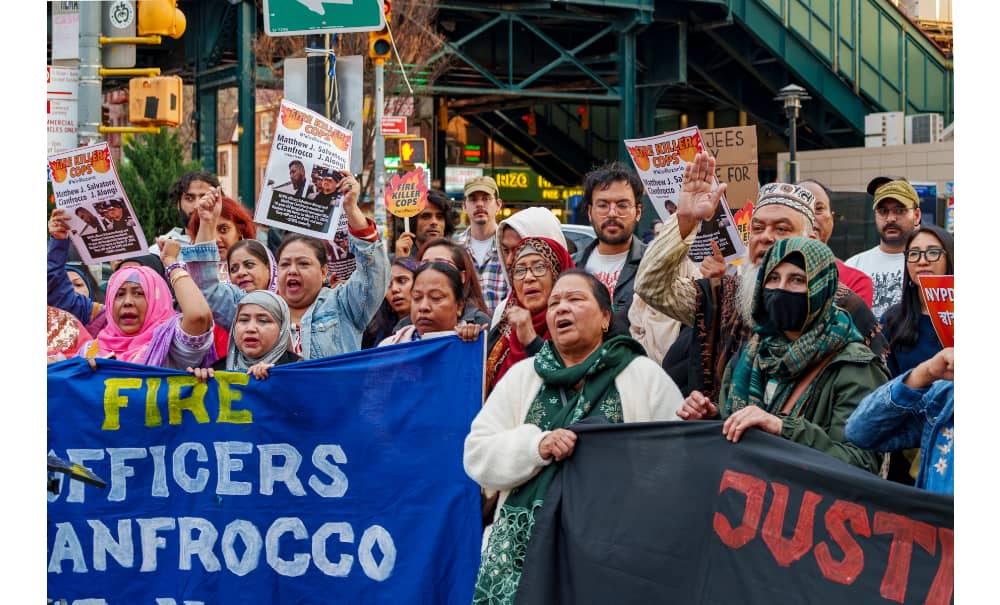
This April 1, the Rozario family and local immigrant justice group Desis Rising Up and Moving (DRUM) led a demonstration at Diversity Plaza, solemnly marking the second anniversary of Win’s murder and calling on the city to fire Cianfrocco and Alongi:

“Win’s mother shared her experiences and demands: ‘I can’t believe two years have passed and still the police have not been punished… I want to say that police should not be sent to respond to situations involving illness or mental health crises. Otherwise, more families like mine will be forced to live with this emptiness and grief.’” —@DRUMNYC

The Diversity Plaza protest also mobilized support for another Queens immigrant family brutalized in a similar way by the NYPD. Jabez Chakraborty, 22, who lives with schizophrenia, was shot by cops in a January 2026 confrontation that his family insists was completely unnecessary.

“We are shocked and outraged by the NYPD’s treatment of our son and brother, Jabez Chakraborty, and our family. We called for help. We called 911 for an ambulance to provide medical attention for our son, who was in emotional distress. We did not call the police. Instead of medical responders, the NYPD arrived and shot our son multiple times right in front of us.” —Chakraborty family, 1/30/26

Although he was severely wounded, Jabez Chakraborty survived. But District Attorney Melinda Katz rushed to arraign him on assault and weapons charges as he lay chained to his hospital bed—ignoring objections from Mayor Mamdani.

“What purpose does it serve to punish someone who needed medical and mental health care, and got bullets instead? This shooting was not an isolated incident: it’s a devastating example of how our systems repeatedly fail the most vulnerable New Yorkers.” —Fahd Ahmed, Executive Director of DRUM

WHAT CAN WE DO?

2. The Reality Behind Detention & Deportation Propaganda Numbers

“We know of no reliable count of the total number of deportations during the first year of the Trump administration.” — Deportation Data Project (January 2026)

Those managing the anti-immigrant agenda of Trump and his hatemongering Homeland Security advisor, Stephen Miller, regularly obfuscate their arrest, detention, or deportation numbers. Such transparency problems are not new. Before Trump took office in 2024, the American Immigration Council (AIC) published Transparency Recommendations identifying numerous legally mandated reporting requirements that ICE failed to fulfill. The AIC reported that ICE, under Biden, was “severely undercounting the number of people it has in immigration detention.” In July of last year, Robert Garcia, a representative on the House Committee on Homeland Security, stated, “I actually just don’t trust numbers the administration is putting out, and I don’t think the American public should.” Thankfully, the diligent work of non-profits and university researchers does serve as a lighthouse in the fog.   

The number of people processed through the deportation machine is obscured by the administration’s hyperbolic statements. Only through the independent work of organizations, reporters, and pro bono lawyers, who process Freedom of Information Act (FOIA) lawsuits to delve into Homeland Security data, can we get a sense of how many people are actually being processed through the deportation machine.

In March of last year, TRAC Reports won a major FOIA case against ICE and CPB when a court rejected all the government’s arguments for withholding records. In November 2025, TRAC released a report about detention and removals after the massive deployments of military and civil immigration enforcers: “The data show surprisingly little has been accomplished given the huge expenditure of resources devoted to this effort.” The increase in ICE removals under Trump in 2025 was reportedly only 7% higher than the 2024-25 numbers under Biden.

Before Trump’s second inauguration, data on border arrests, deportations, and other immigration metrics were published twice a month (as mandated by the DHS funding bill). An April 2026 visit to the DHS website finds that the immigration websites have not been updated since 2024. ICE Detention and Repatriation data has also not been updated since 2024. The 2025 numbers reported by Homeland Security on its detention management site are severely limited. Even a high school student’s online ICE Tracker project is making a better attempt than Homeland Security to share this data publicly.

While TRAC Reports highlighted the many data errors in ICE data releases, the Vera Institute of Justice reported that the “failure [of ICE] to regularly release accurate, complete, and accessible data is part of what enables it to operate this multi-billion-dollar network with little oversight or accountability.” With the support of the Deportation Data Project, the Vera Institute published its December 2025 report on ICE Detention Trends in 1,464 facilities. If the ICE reports from August of last year are accurate, then the 61,226 people detained by ICE is the highest ever level of detention. 

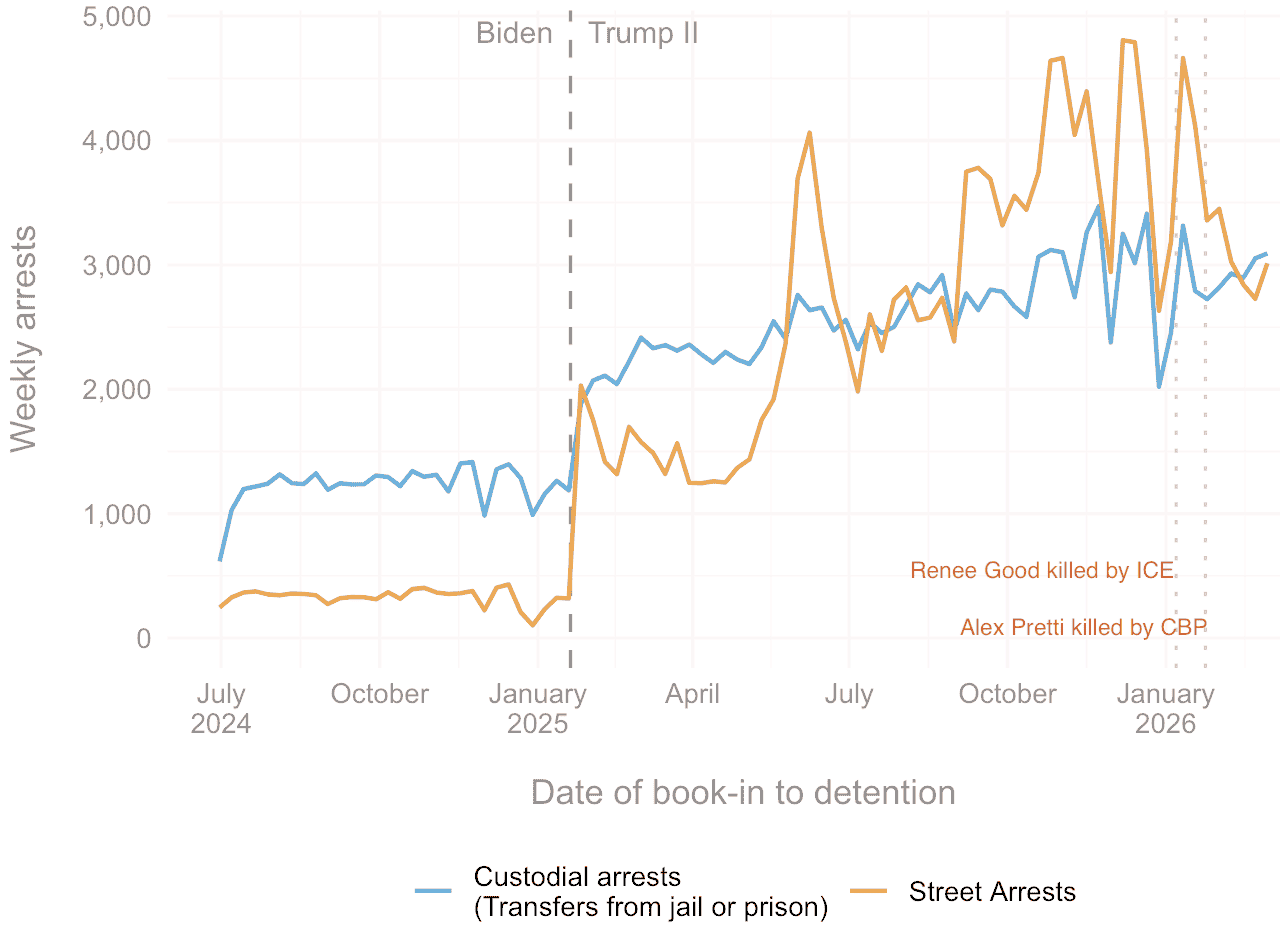
“First, ICE arrests quadrupled, including both street arrests and transfers from criminal custody to ICE immigration custody. ICE street arrests (i.e. arrests not at jails) went up by over a factor of eleven. Street arrests at this order of magnitude are a new phenomenon. For both types of arrests, ICE was much less likely to target people with criminal convictions. These changes led to over a sevenfold increase in arrests of people without criminal convictions.”—Deportation Data Project


Transfers from Jails and Prisons Doubled and Street Arrests Increased by 11x
—Deportation Data Project

The self-deportation component of the Miller-Trump strategy, despite a significant increase in numbers, failed spectacularly to deliver its promise as a cost-effective way to remove immigrants rapidly. Last September, DHS posted self-aggrandizing statements, and Kristi Noem talked about self-deportation numbers, which came from an estimate by the anti-immigrant think tank CIS that did not even use DHS data. 

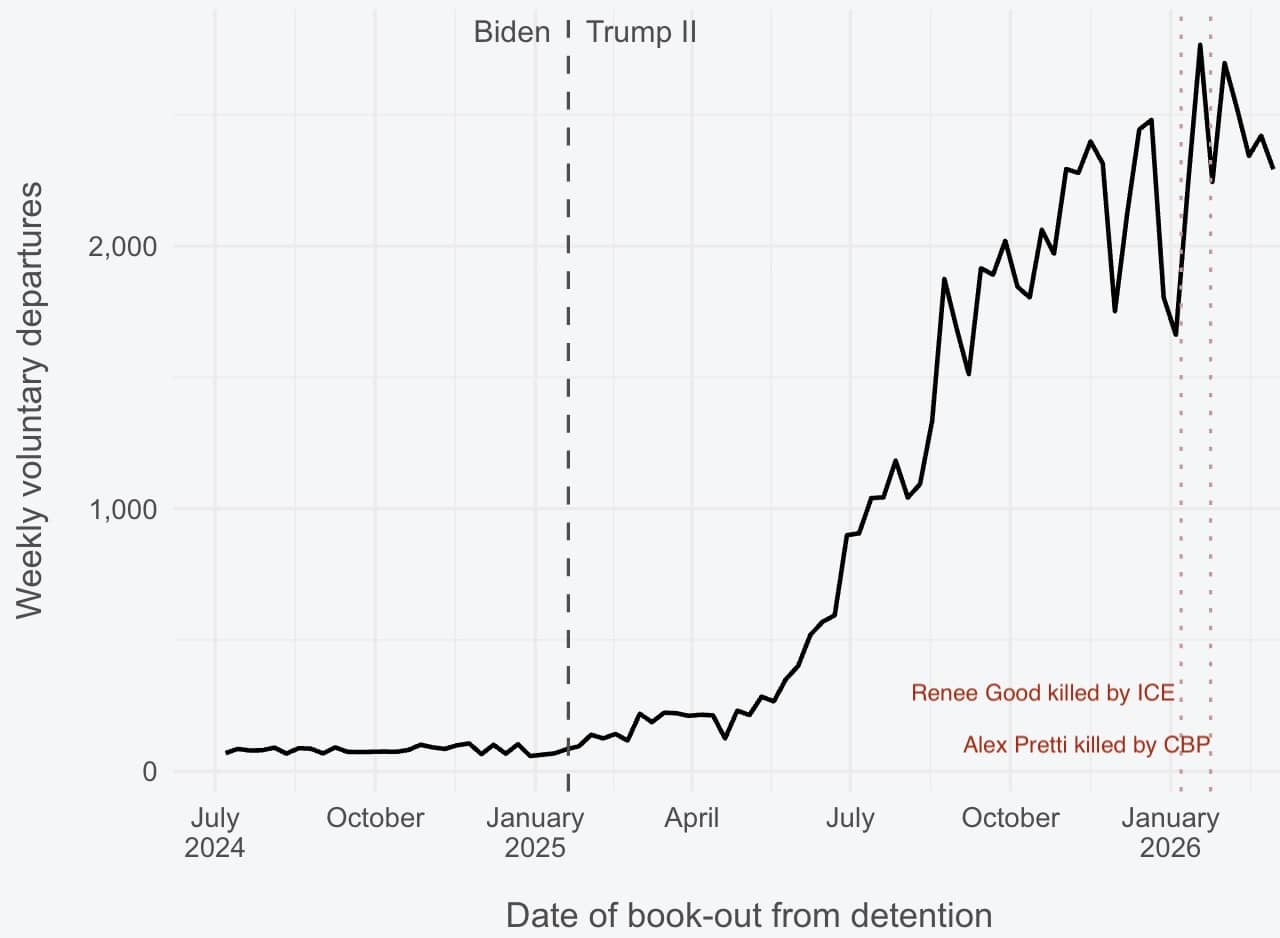
Homeland Security spent $200M on ads (created by agencies with direct ties to DHS staff) to urge self-deportation through the incongruously named Project Homecoming. The “voluntary” project claims to offer applicants a free plane ticket and a stipend of $1,000, recently increased to $2,600. Data review confirmed around 25,000 people registered for self-deportation on the CBP mobile app. Only half of those actually returned home with DHS support. The others face delays in paperwork processing, have not received payments, and still await their flights home. Immigration attorneys indicate their lack of trust in the program. In reality, only a minority of immigrants are eligible for those incentives to leave: those who do not meet the requirements are simply handing over their information and risking detention. 


Voluntary Departures Increased by 28x
—Deportation Data Project

Although the government’s Project Homecoming data is questionable, reliable data shows that the number of court cases ending in “voluntary departure” increased to 35,000—over three times those during the previous year. Looking at New York specifically, under Biden, less than 1% of people arrested by ICE opted for voluntary departure—today it is 22%. People are also deciding to self-deport without government intervention—but even at the point where they are boarding flights to return home, they are still being detained and handed over to ICE agents.

The end goal of this administration is really not just about deportation. It is about enabling white nationalism and authoritarianism through racial profiling, eroding constitutional rights, scapegoating and subjugating immigrants, and weaponizing a massive private, for-profit prison system. 

WHAT CAN WE DO?


In solidarity and with collective care,

Jackson Heights Immigrant Solidarity Network (JHISN)

Follow @JHSolidarity on Facebook and Twitter and share this newsletter with friends, families, neighbors, networks, and colleagues so they can subscribe and receive news from JHISN. 


JHISN Newsletter 10/26/2024

Dear friends,

As the US moves toward a national presidential election, with the straightjacket of a two-party system offering little hope for demilitarized immigration policies or the defunding of Israeli genocide of Palestinian refugees—we go local. Our newsletter looks at the corruption poisoning city contracts for migrant shelter and services, as a part of the deepening scandal that threatens the Mayor’s office and a functional city government. We then report on the deployment of police, troopers, and political theater with the launch of ‘Operation Restore Roosevelt,’ and the fight to create community-based solutions instead of carceral punishment.

Newsletter highlights:
  1. Using the ‘migrant crisis’ to line pockets of Mayor’s allies
  2. NYPD and state troopers descend on Roosevelt Avenue 


1. City Corruption Blights Migrant Shelter Contracting

It reads a bit like the opening chapter of a bad true crime novel: several senior aides to Mayor Eric Adams have their homes searched and devices seized in an expansive federal investigation; a stunning number of senior staff and City Hall officials then quickly resign. The Mayor himself faces federal bribery charges—but is so far left standing, and hoping we don’t read the rest of the book.

One character in the story who deserves our attention is Timothy Pearson, long-time friend and confidant of Eric Adams (who decades ago served as Adams’ supervisor in the NYPD). Pearson held a lucrative, if ambiguous, position in the Mayor’s administration, tasked, among other things, with overseeing contracts with the city’s migrant shelters, and ‘saving money’ as the costs of sheltering migrant arrivals rose.

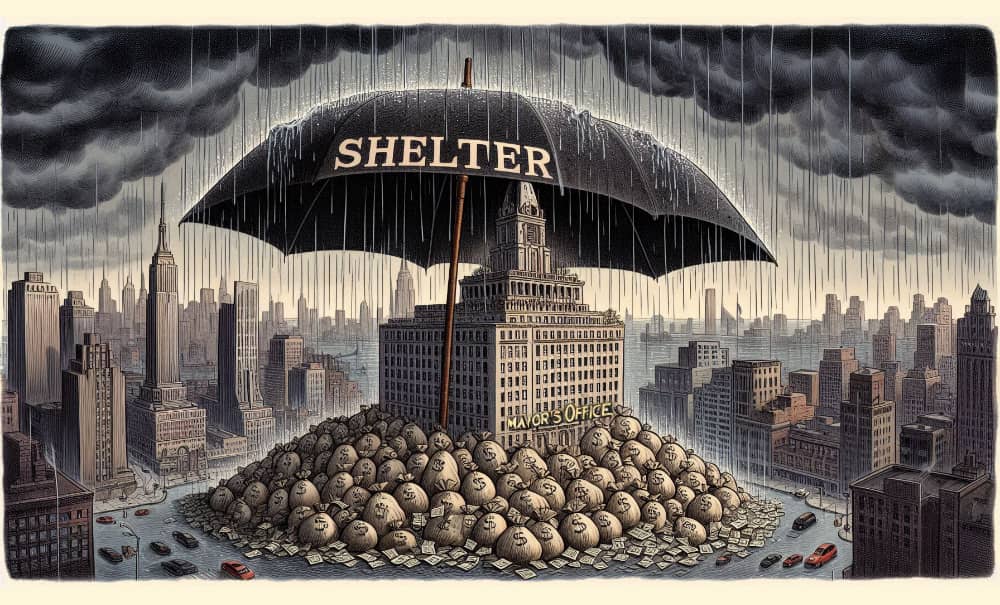
By late 2023, both the City Council and City Comptroller Brad Lander had already spotlighted how the city was overpaying for migrant services, hiring staff at sometimes astronomical rates and outside any competitive bidding process. In December, Lander revoked the Mayor’s blanket authority to contract for emergency migrant services, a process blighted by scandal and lack of transparency. Contracts would now require independent prior approval from the Comptroller’s office. Nevertheless, Pearson still maintained leverage over parts of the contracting process. In particular, one organization—the Health and Hospitals Corporation (HHC)—remained outside the new Comptroller oversight, because it is an independently-run public authority and not a city agency. 

HHC contracted with an outside company, Cherokee Nation Management & Consulting, to provide case management services to migrants in the shelter system starting January 1, 2024. These essential casework services help migrants get work authorization papers and exit the emergency shelters. Timothy Pearson delayed the HHC contract with Cherokee for three months in early 2024, as the population of migrants housed in NYC shelters rose from 24,000 to 25,000. Pearson has offered no explanation for his lengthy stall of the already-signed contract; we assume the ongoing federal probe will offer some answers. A court filing by a co-worker who accuses Pearson of sexual harassment and retaliation claims that he talked about his desire to personally benefit from his work overseeing shelter contracts. “I have to get mine. Where are my crumbs?” he allegedly said. 

Pearson’s interference with case management services for migrants was not the first time he meddled in multi-million dollar contracting protocols. In summer 2023, according to a Politico investigation, Pearson delayed the opening of a migrant facility at Floyd Bennett Field in Brooklyn. His aim: to garner a security contract for his buddy Bo Dietl, former NYPD detective, colleague of Steve Bannon and Roger Ailes of Fox News, and loyal fundraiser for Erik Adams.

Pearson resigned his position in the mayor’s administration as of October 4, citing a need to focus on “self-care and new endeavors.”

While the drama of unfolding corruption may fascinate, the obscenity of a City Hall committed at the highest levels to self-dealing—and on the backs of migrant lives—should also outrage us. And move us toward mutual aid and, hopefully, a new mayor.

WHAT CAN WE DO?

2. ‘Operation Restore Roosevelt’ Coming to a Theater Near You

“Mayor Adams and Governor Hochul have decided to launch a quasi-military operation designed to criminalize people just trying to put food on the table and keep a roof over their heads. It is absurd and dangerous for elected officials to scapegoat an entire neighborhood to cover up their own failures of leadership …. [They] talk about New York City as a city of immigrants but yet they put them at risk of deportation every time that they increase policing on the streets. [O]ur leaders have made a cynical play for headlines at the expense of a population that has already disproportionately borne the brunt of police violence.” –Make the Road NY (October 2024)

So now we have “Operation Restore Roosevelt,” press conference photo ops, and political posturing by Mayor Adams and Democratic District Leader Hiram Monserrate. The mayor needs to take the focus off his administration’s scandals, and Monserrate is running for office yet again. So, the fallback position is to send in the cops for 90 days and pacify the locals.

Let’s see what’s really going on here. Hiram Monserrate has a checkered history in Queens politics and is an unlikely person to be concerned about morality. He was expelled from the state Senate in 2010 after being convicted of domestic assault and later served time in prison for mail fraud. For years, he ran unsuccessfully for various state and city offices, but finally was elected Democratic District Leader in 2018. It is from that office that he organized rallies in early October on Roosevelt Avenue at 90th Street “to save the neighborhood” and capture Gov. Hochul’s attention.

This new operation with state troopers and NYPD will focus on Roosevelt from 74th Street to 111th Street over the next 90 days and will see city agencies target brothels and illegal vending. The operation claims it will help women the city said are victims of sex trafficking, forced into prostitution. 

This is not the first time for increased enforcement. Back in January there was a big push to close down brothels; and in April, City Council Member Francisco Moya relaunched the Roosevelt Avenue Task Force (first created in 1991) focusing on street vendors.

State Senator Ramos, quoted in the Queens Daily Eagle, commented:

“It seems like everything else he [Adams] does, a photo op. I think the mayor feels like he’s up against the wall, and he falls back to what he knows–performance policing …. There’s been traffickers along Roosevelt Avenue for nearly all of the 40 years of my life that I have known, and that I have seen. [The mayor] could have started an operation to help the women being trafficked and exploited years ago, when he first took office.”

Queens Borough President Donovan Richards added, “I thought we had a task force. I’m trying to understand why all of a sudden they’re beefing up police presence.” 

Make The Road NY and the Street Vendor Project issued a strong statement on Instagram condemning this criminalization of our Queens neighborhood. City Councilman Shekar Krishnan has put forward two bills to address alleged human trafficking and forced prostitution throughout the city.

On October 22, a coalition of groups including Decrim New York and MRNY hosted a rally in Corona Plaza opposing Operation Restore Roosevelt, claiming that it targets the vulnerable, including immigrants, transgender people, and sex workers. Speakers denounced the flood of cops now in central Queens, saying the operation is displacing street vendors who are afraid to work in the face of heavy police presence. When disgraced former State Senator Monserrate showed up, he was chased out of the Plaza by defiant transgender sex workers and their allies chanting “More resources, not more raids!” 

WHAT CAN WE DO?


In solidarity and with collective care,

Jackson Heights Immigrant Solidarity Network (JHISN)


Follow @JHSolidarity on Facebook and Twitter and share this newsletter with friends, families, neighbors, networks, and colleagues so they can subscribe and receive news from JHISN.