Tag: DRUM Beats

JHISN Newsletter 11/22/2025

Dear friends, 

It is now a fact. Zohran Mamdani won the NYC mayoral election—by an enthusiastic margin. He will be sworn in on January 1, 2026, as the immigrant mayor of this city built on immigrant labor, dreams, and community. Our own Jackson Heights-based DRUM (Desis Rising Up & Moving) sibling organization, DRUM Beats, mobilized its South Asian and Indo-Caribbean membership to play a major role in Mamdani’s successful campaign. 

Given the threats this week from Thomas Homan, Trump’s so-called ’border czar,’ the most important part of today’s newsletter may be our WHAT CAN WE DO? section at the very end. We report first on ICE’s recent escalation of attacks here in Queens, and next, on your responses to our reader survey on how to prepare for ICE invasions in our own neighborhood. We conclude with actions you can take, and trainings and groups you can join, to collectively defend our communities. Please join us in learning what solidarity will look like in our immigrant-led New York City. 

Newsletter highlights:
  1. Our neighborhood faces escalating ICE raids
  2. Reportback on JHISN reader survey: Actions and suggestions to confront ICE


1. ICE Is Here–How Do We Respond?

It seemed inevitable. After a months-long brutal mass deportation campaign at the Federal Plaza courthouses in Manhattan, ICE has now started ramping up street raids in Queens, knowing that almost half of us (over one million residents) were born outside the US. 

In the first week of November, 97th Street and 41st Avenue in Corona became the main focus of a major ICE dragnet, resulting in the confirmed abductions of 12 neighbors. Other parts of Corona were also hit. As reported by Queens Neighborhoods United (QNU), these were not targeted arrests of individuals using judicial warrants. Instead, Latinos walking down the street, sitting in their cars, or riding bikes were racially profiled and arrested by swarms of agents. ICE used deception tactics—for instance, rotating out agents who might be recognized, or pretending to be done for the day, then suddenly returning to trap more residents. 

We note that ICE has been active in our community for some time. According to one well-informed activist, an average of two people a day were already being detained in the Jackson Heights, Corona, and Elmhurst area prior to the 97th St. raids. ICE has recently been sighted, banging on doors on 79th Street near Roosevelt Avenue at 5:00 AM, presumably trying to serve a warrant. However, QNU says, “ICE is escalating. They are using more elaborate ruses and traps. We must respond.”

Parts of the Corona assault were recorded on video, and some local residents tried to warn pedestrians using whistles. These efforts need to grow into a mass response by our whole community. We need well-organized ICE Watch and rapid response teams to monitor federal agents and keep our neighborhoods informed. We need a widespread whistle campaign so that every resident can take part in sounding an alert when ICE appears. We need enough people in the street to make it hard to trap anybody. 

This counter-escalation has started to emerge. We encourage our readers to be active according to your capabilities. Please see our What Can We Do? section at the end of our next article.


2. JHISN Reader Survey: Take Local Action Against ICE’s Illegal Activity

[T]hey were here and they were everywhere. Smash and grab jobs happening across the city nearly simultaneously. But the things being stolen aren’t jewels, they’re lives. Off streets, from yards. One roofer plucked off a ladder. A landscaper thrown to the ground, tackled by a half-dozen men in camo with weapons …. What I need you to understand is that nobody is letting them go quietly. The Feds’ every movement is announced by a chorus of whistles, by a parade of cars honking in their wake, neighbors rushing outside to yell to film to witness these kidnappings that are unfolding in front of us. Neighbors running towards trouble.” Dan Sinker, “What I Need You to Understand, Notes from Chicago in Late October”

In our last two newsletters, JHISN invited feedback from our readers through our NYC Prepares for ICE Invasion survey—we thank all of you who participated for your thoughtful responses. While most of you said you had already participated in actions to show opposition to the outrageous abductions by ICE agents, more than a third of you indicated that you are ready to take action for the first time. We applaud you and will continue to use the newsletter, as best we can, to encourage more people to take even more steps. We suggest that readers review the reports on grassroots resistance coming out of Chicago by Dan Sinker and Kyle Kingsbury, a.k.a “Aphyr”—they show what NYC could become when we face ICE attacks like those in Chicago. 

Our survey also asked about the challenges facing our readers and suggestions for what can be done next. Overwhelmingly, our respondents shared that their biggest challenge is not being aware of actions they can take, even as several readers reported on actions they have already done: 

  • Distribute Know Your Rights (KYR) information to businesses and people
  • Make phone calls and complete petitions to politicians 
  • Accompany immigrants to court appointments or participate in court watching
  • Donate to immigrant support organizations

The main challenges our readers reported were a fear of physical risks and that work hours and mobility issues associated with age prevent participation in actions. One person responded simply: “Fear”.

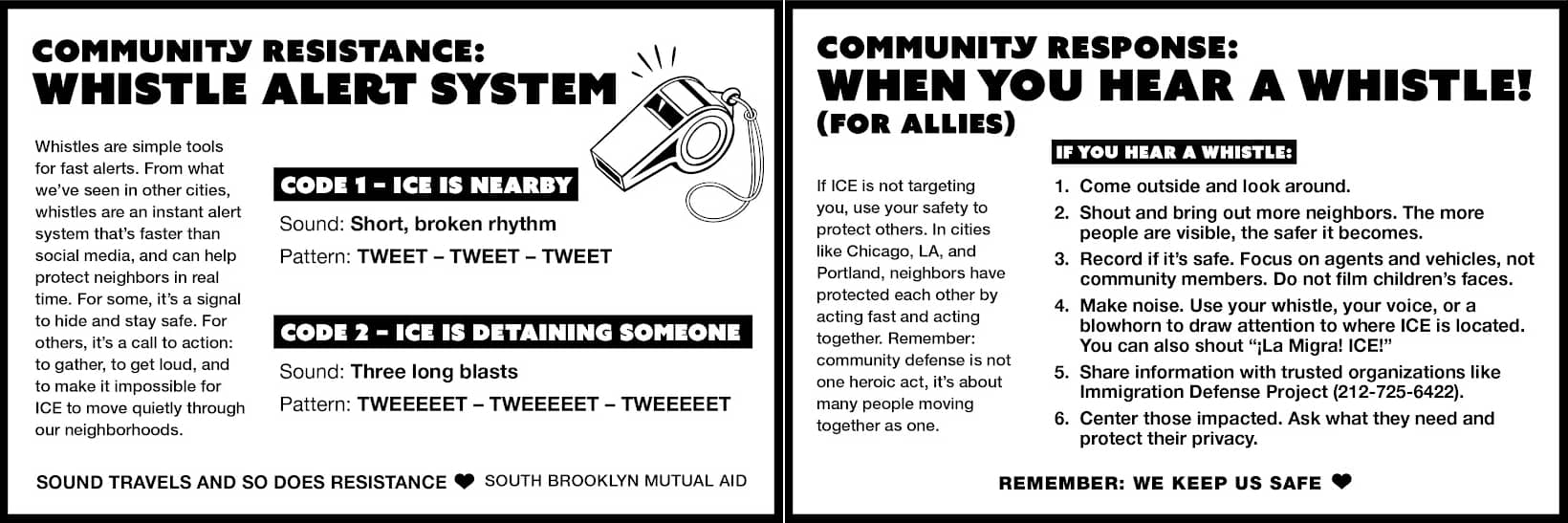
But for every challenge identified, survey respondents also offered two suggestions for future actions. Unawareness can be fixed through greater information sharing. One person suggested that we learn from other groups, such as DIRE (Deportation and Immigration Response Equipo) in New Jersey. Another suggested “Distribute whistles and publicize when/how to use them for rapid response. Like in Los Angeles and in Chicago, there has been a grassroots effort to distribute orange whistles that people can blow if they see ICE.” Another said, “Have a chat group | Patrol the neighborhood | Make noise to alert our neighbors.” 

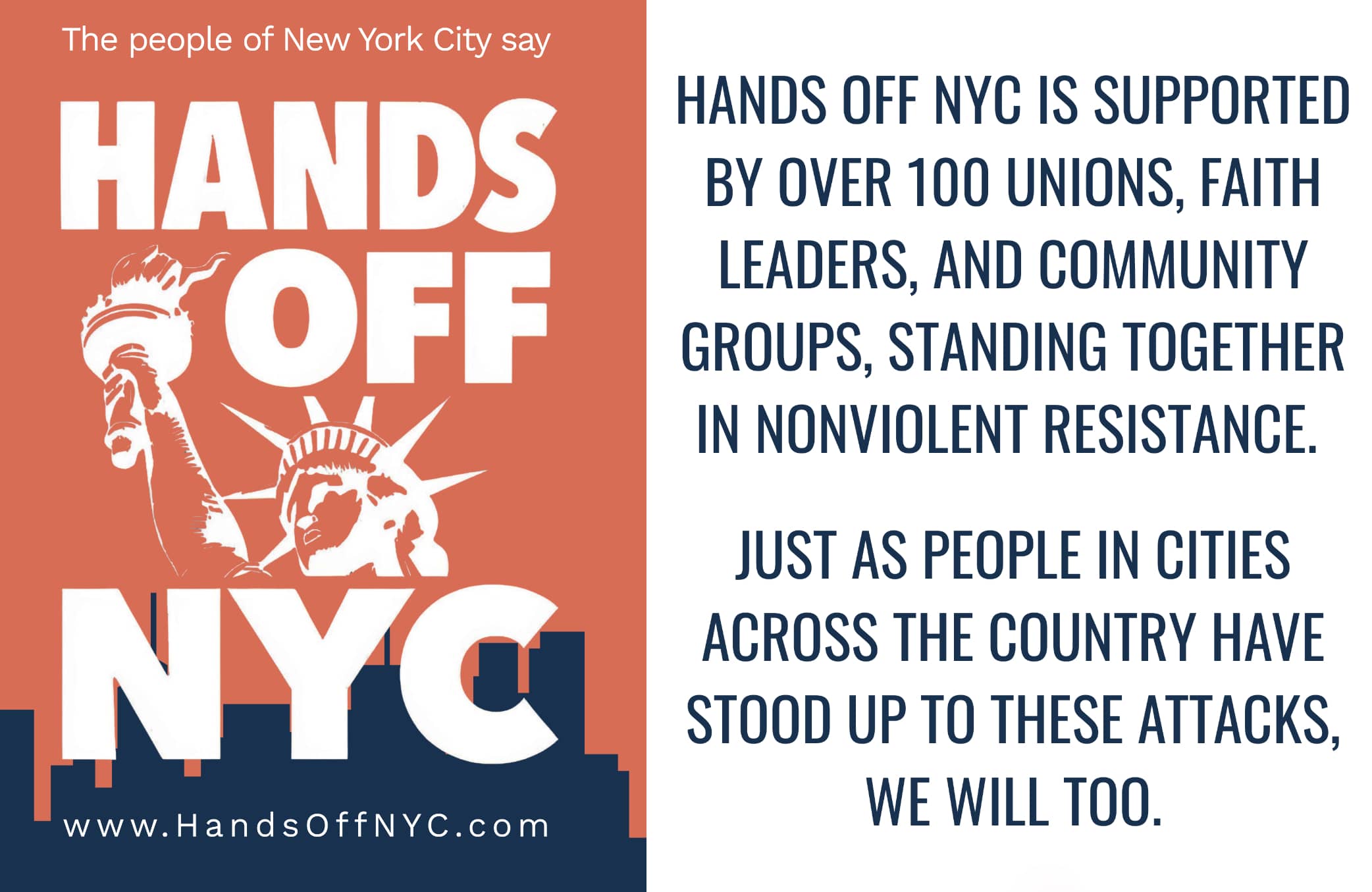
JHISN has now posted instructions about whistle use as Community Resistance Tools on our blog, borrowing flyer information from South Brooklyn Mutual Aid. If you have been at the Jackson Heights Greenmarket on 34th Ave., between 79th & 80th, you may have seen activists distributing whistles and instructions to our community. Whistles played a role in the recent day-long ICE raid in Corona, and Hands Off NYC has now distributed well over 10,000 whistles throughout the city. Last weekend, JH Indivisible joined with 10 people from the neighborhood (including JHISN members) to distribute ICE Packs to business owners, including a whistle, instructions in English and Spanish for how to use the whistle, and red cards with KYR information. 
Some of our active readers have connected with local ICE Watch groups. Most of these local groups create their own direct messaging communication methods to the immigrant population they serve; only trusted sources, who have been able to verify that ICE action is underway, post to the ICE Watch lists. So, although the federal government demanded Apple and Google remove the ICEBlock app from their app stores, which they did, most local ICE Watch groups were not significant users of that app. 

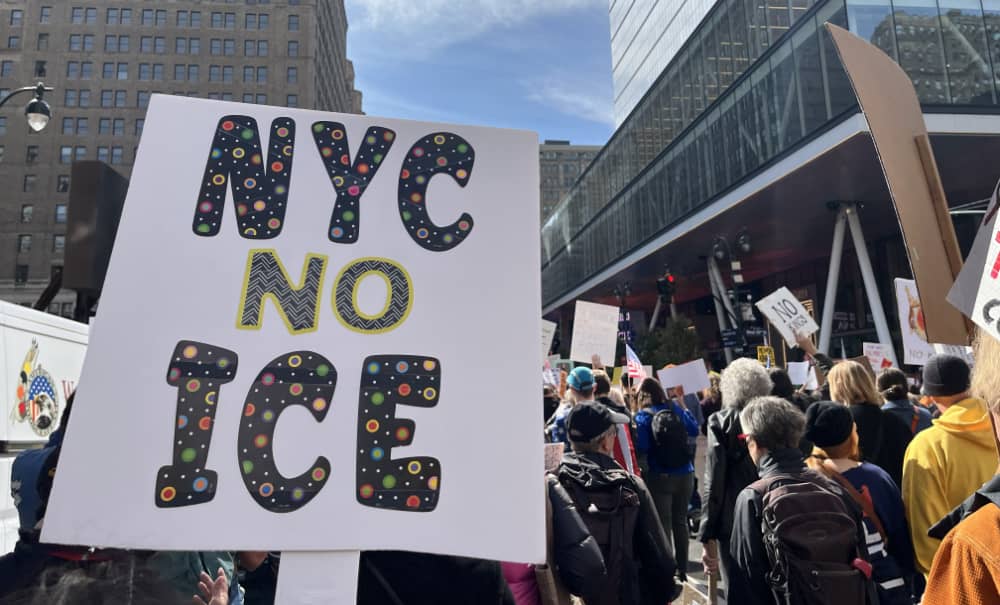
One of our respondents made a straightforward comment: “I think we all have to help each other out in whatever ways we can.” Some of us can march in weekend events. Some of us can donate money to support immigrant-led groups or the many GoFundMe pages of families seeking support to fight their deportation case (please support the pages of those you know to be local to Jackson Heights).  Some of us can wear a polka dot dress and block an ICE Humvee to slow its progress. Some of us can take successful legal action against discriminatory practices that intimidate immigrants with the threat of deportation. Some of us can tell NYC assembly members to get ICE OUT! Some of us can get ICE barred from operating in Rikers

One of us cannot do everything, but many of us, doing what we can in different ways, can make the difference between quiet surrender or effective solidarity.

WHAT CAN WE DO? 
  • Get trained by Hands Off NYC, a coalition of over 50 action-taking groups, to learn Know Your Rights, ICE Watch, and organizing and mobilization strategies. Sign up for their Queens training on Saturday. Dec. 13, 12 – 4 pm.
  • Attend one of the New York Immigration Coalition’s many Neighborhood Defense Training webinars.
  • Attend the monthly Zoom meeting of Jackson Heights Indivisible and get involved with their local actions. 
  • Join the Visibility Brigade (also known as the Rush Hour Resistance) every Wednesday evening from 6 – 7 pm in Jackson Heights.
  • Notify activists if you see ICE: 
  • NYC ICE Watch – DM via Instagram @nycicewatch – use the SALUTE page to quickly format your post
  • Call the Immigrant Defense Project’s NY/NJ ​Rapid Response Network Emergency ICE Raid hotline at 1-800-308-0878, or in New York City,​ call 1-212-725-6422.
  • Prepare yourself, your neighbors, and others by being familiar with Make The Road New York’s Deportation Defense Manualespecially read Part Two: Rapid Response to Raids; appendix D; and appendix F. (Note this is from July 2022, and many things have changed since then).

In solidarity and with collective care,

Jackson Heights Immigrant Solidarity Network (JHISN)


Follow @JHSolidarity on Facebook and Twitter and share this newsletter with friends, families, neighbors, networks, and colleagues so they can subscribe and receive news from JHISN. 


JHISN Newsletter 10/25/2025

Dear friends,

Rarely do we start with a set of asks, but extreme times give our newsletter a sense of urgency. So first, please take a few minutes to fill out our JHISN reader survey, and share how you might imagine and participate in neighborhood defense if escalated ICE raids land in central Queens. Thanks to all of you who have already responded.

Next, please check out and circulate this new state government portal to report disturbing or violent actions you witness by ICE and other federal agents in NYC; photos and videos can be uploaded to the site. The public portal was created by the NYS Attorney General one day after the militarized ICE attack on immigrant street vendors—and New Yorkers who came to their defense—on Canal Street this week. 

Our newsletter below looks more closely at the role of citizen immigrants, our own Jackson Heights-based organization DRUM Beats, and immigrant politics more broadly in Zohran Mamdani’s historic campaign for NYC mayor. And we give an update on the precarious situation affecting members of our Nepali community in Queens who have had their Temporary Protective Status terminated by the Trump regime—part of a larger campaign to rip away the legal status of hundreds of thousands of TPS holders nationwide. 

Newsletter highlights: 
  1. Zohran Mamdani: immigrant organizing boosts support for an immigrant mayor
  2. Update on cancellation of TPS for Nepali residents


1. Mamdani’s Campaign Success: Grassroots Immigrant Organizing

“[Trump] just threatened to have me arrested, stripped of my citizenship, put in a detention camp and deported. Not because I have broken any law but because I will refuse to let ICE terrorize our city.”—Zohran Mamdani

Jackson Heights group DRUM Beats, the sibling organization of Desis Rising Up and Moving (DRUM), was featured by many news organizations this year for its political advocacy work. You may have seen them last weekend at Jackson Heights Farmer’s Market doing henna tattoos, canvassing for Zohran Mamdani, and providing voting registration assistance. They are a major contributing factor to the success of Mamdani’s campaign to become the next, and first Muslim and South Asian, mayor of New York City, and, as he says himself, the first immigrant mayor in generations. DRUM Beats was one of the first grassroots groups to endorse him. Along with CAAAV Voice, the political arm of the CAAAV: Organizing Asian Communities, South Asian residents were engaged across all five NYC boroughs in support of Mamdani’s campaign. Turnout for the primary saw a 40% increase in South Asian voters for the Democratic Socialist candidate. This came less than a year after many of those same populations appeared to swing right by supporting Trump for president. One reason for Mamdani’s success is his showing up in person in their districts.

30% of the election districts won by Trump in 2024 supported Mamdani in the June 2025 Democratic primary. Many of those districts are in majority Asian neighborhoods. Indeed, across all immigrant-majority neighborhoods, Mamdani won by 7 points. New York Communities for Change has announced that a coalition of organizations representing 50,000 working-class Black and immigrant New Yorkers endorsed Mamdani. Make The Road New York officially endorses him, as does Congressmember Adriano Espaillat, an influential Latino leader for upper Manhattan and the Bronx. He also secured support from the head of the NYPD Bangladeshi American Police Association at a time when 13 other law enforcement organizations had backed the incumbent and former policeman, Mayor Adams, before he dropped out of the race. Despite having higher financial earnings than the working-class immigrants campaigning for Mamdani, many young, well-paid, white collar workers in New York’s tech sector are also giving him their support; they also worry about the affordability of life in the city. 

Mamdani, who worked as a housing counselor with the local immigrant services and housing support organization Chhaya CDC, does not include an “immigration” section on his campaign website. He clearly is a strong supporter of our sanctuary city status, but his platform emphasizes affordability, housing and food security, health, and education as the critical issues facing working-class populations. His policy memo about Trump-Proofing New York is not just about standing up to the ICE invasion, but about protecting all vulnerable New Yorkers from the multiplicitous attacks by Trump. During the first Mayoral debate last week, the topic of immigration and our sanctuary city laws was raised—Mamdani distinguished himself from the others by being more personal and talking of the horrific and ongoing abduction activities conducted by ICE at 26 Federal Plaza.

In private, Trump has indicated he thinks Mamdani is unbeatable. Trump has threatened to withhold federal money from New York if Mamdani is elected Mayor and has already moved forward to cut federal counterterrorism and transit funds. The president has stated that he will arrest Mamdani if he tries to stop masked ICE agents from deporting our neighbors. Trump, along with Tennessee Representative Andy Ogles, also questioned Mamdani’s citizenship. Ogles has been called out for censure for his bigoted and racist speech, including his letter asking the Justice Department to denaturalize and deport Mamdani. (Vickie Paladino, a Queens Council member, who also called for Mamdani to be deported, was met with minimal criticism from city officials and the current mayor.) After Mamdani won the Democratic primary, Tom Homan, Trump’s so-called Border Czar, said that ICE would double up and triple up agents in New York (and this week we watched New Yorkers defend their street vendors from ICE on Canal Street). 

These are the actions of authoritarians who will use any means, even if illegal, to silence and punish the people opposing their anti-democracy political dogma, which is hidden behind a show-of-force facade of nationalism and patriotism. Meanwhile, Mamdani was interviewed on Fox News and stated he will lead this city by building partnerships with people, and that he would do so, “not only in Washington, D.C., but [with] anyone across this country.” He has already proven he can do that by building a multi-asian coalition of support, which has expanded further and made him the current leader in the election polls.

WHAT CAN WE DO?
  • Be inspired by The Queensborough restaurant and organize a fundraising event for your favorite local immigrant-led support organization. After the No Kings March, The Q raised over $600 in cash for NICE (New Immigrant Community Empowerment).
  • Help DRUM Beats continue their political advocacy by making a financial donation

2. Brief History of TPS for Nepal, and Its Termination

As of 2023, there were more than 200,000 Nepalis in the US, with almost 17,000 living in Jackson Heights, many with Temporary Protective Status (TPS). As of October 2025, more than 12,000 Nepalis residing in the US–some of them our neighbors here in Queens–have had their legal TPS status abruptly canceled by the Trump administration. 

TPS was created by the Immigration Act of 1990, and grants permission for people to stay in the US if conditions in their country are unsafe from a natural disaster, an armed conflict, or some other unusual and temporary situation making it unsafe for people to return. TPS protects people from deportation, and they can be authorized to work in the US. TPS is granted for 18 months, and at the end of that time it can be extended or revoked for another 6, 12, or 18 months. At least 60 days before the period ends, the Secretary of Homeland Security must review conditions in the target country and publish the decision in the Federal Register.

In April 2015, there was a 7.8 magnitude earthquake in Nepal, followed by several strong aftershocks. There was extensive damage throughout the country: 755,000 homes were damaged; 9,000 people died and 22,000 were injured. That is why TPS was granted for Nepalis residing in the US until June 2018. Then, in 2017, serious flooding and landslides impeded food production and reconstruction of the earthquake damage. As a result of two separate court cases (Bhattarai v. Nielsen and Ramos v. Nielsen), TPS for Nepal was extended three times until June 2024. 

However, in 2018, Trump revoked the TPS status for Nepal, which was quickly challenged in court. Then, in 2023, DHS under Biden rescinded that termination and extended TPS until June 2025. On June 6, 2025, DHS Secretary Noem terminated TPS for Nepal, effective August 5, 2025. She claimed “there are notable improvements in environmental disaster preparedness and response capacity, as well as substantial reconstruction from the earthquake’s destruction such that there is no longer a disruption of living conditions and Nepal is able to handle adequately the return of its nationals.”

In July 2025, the National TPS Alliance and individual plaintiffs with TPS status challenged Secretary Noem’s actions as arbitrary and capricious, failing to provide the required 60-day notice, and violating the equal protection portion of the Fifth Amendment because the motivation was partially racial animus. On July 31, US District Judge Trina Thompson granted the plaintiffs’ motion to postpone the cancellation. The court ordered that TPS remain in effect until at least November 18, 2025. But on August 20, 2025, the District court’s stay was overridden by the Ninth Circuit Court of Appeals, allowing TPS cancellation for Nepal, Honduras, and Nicaragua to go forward. 

Meanwhile, in September 2025, there was a political crisis in Nepal when economic dysfunction and disillusioned youth led to widespread protests, government buildings burned, a national curfew, and finally the installation of a new president, Sushila Karki, the first woman president of Nepal.

It is not clear if that political crisis will have any bearing on the status of Nepalis in the US. With the removal of work authorization and the threat of deportation the Nepali community is in danger.

WHAT CAN WE DO?
  • Make a donation to our local immigrant-led organization Adhikaar which represents the Nepali-speaking community. 


In solidarity and with collective care,

Jackson Heights Immigrant Solidarity Network (JHISN)

Follow @JHSolidarity on Facebook and Twitter and share this newsletter with friends, families, neighbors, networks, and colleagues so they can subscribe and receive news from JHISN.