Dear friends,
There is some important good news this week amidst the cascade of bad news, national and global—including the grim assessment that the US is no longer a functioning democracy, according to the world’s leading democracy watchdog. Sweden’s prestigious Variety of Democracies (V-Dem) Institute writes in their newly-released report, “The scale and speed of autocratization under the Trump administration are unprecedented in modern times.”
But the autocrat’s project also has cracks, and good news includes the release from detention this week of Dylan Contreras, the Bronx high school student arrested by ICE in May 2025. And our second newsletter article reports the end of Leqaa Kordia’s incarceration by ICE, when she finally walked free on March 16.
Our first article investigates the very bad news of the Trump regime’s surge toward holding immigrant detainees in commercial warehouse spaces turned ‘mega detention’ centers across the US.
Newsletter highlights:
- New architecture of deportation: ICE warehouses
- Leqaa Kordia freed after one year
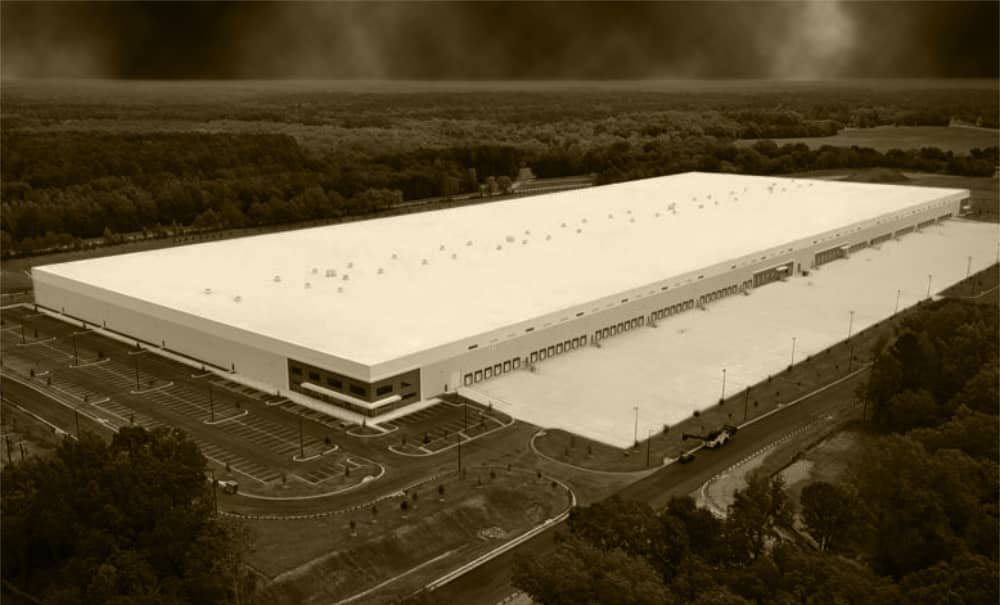
Warehouse, Social Circle, Georgia
1. Amazon Prime, But With Human Beings: Warehousing Immigrants
In the run-up to the midterm elections, the Trump regime is signaling a tactical retreat from its increasingly unpopular policy of mass deportation. This change in public posture is reflected in the president’s firing of Homeland Security Secretary Kristi Noem, and his call for a “softer touch” on immigration enforcement. The White House has even quietly urged House Republicans to stop talking about mass deportation altogether. After meeting with Trump’s border “czar” Tom Homan in Albany on March 6, Governor Kathy Hochul sounded convinced that ICE won’t escalate enforcement in New York any time soon.
Still, the machinery of mass deportation grinds on. Nationally, ICE arrests were down about 11% from January to February, but still four times higher than they were before Trump took office. More than 70,000 people are in immigration detention. In NYC, courthouse arrests continue. Rapid response teams in our neighborhood report continued ICE kidnappings, especially off the streets of Corona.
Perhaps the most damning evidence that mass deportation is still on the agenda—and might ramp up after the elections—is the regime’s rush to build out massive infrastructure for new immigrant detention centers. Flush with $45 billion appropriated for this purpose by Congress, ICE is buying a network of commercial warehouses that it plans to retrofit into immigration prisons. The goal, says ICE Director Todd Lyons, is to be “[Amazon] Prime, but with human beings.”
The plan includes 16 new “processing centers” and 8 large detention centers to hold 7-10,000 people each. Reportedly, 9 of the projected 24 warehouses have already been purchased. One of the planned detention centers, in South Circle, Georgia, is expected to confine more people than any prison in the US.
To speed things up, the regime is using the US Navy’s procurement system, which allows them to bypass federal contracting requirements. By purchasing and subcontracting out the renovation of its own detention facilities, ICE also evades many state and local sanctuary restrictions. GEO Group, CoreCivic, and other profiteering private prison contractors are being tapped to run the facilities.
Conditions at privately-run immigration lockups are particularly grim. Systematic abuse serves to pressure refugees, asylum seekers and others with provisional status to abandon their legal claims and agree to “voluntarily” self-deport.
GEO Group, the country’s largest private prison operator, has been “churning out deportations almost at the rate of approximately 100% of [the company’s detention facilities’] capacity per month,” executive chairman George Zoley said in an earnings call in November. “We’ve never seen anything like this before,” Zoley said on the call. “Our existing facilities are full throttle.” —Huffpost (March 7, 2026)
This is a specific form of mass deportation that the Trump regime is committed to expanding at breakneck speed.
Local opposition to the new warehouses has been fierce in many places and has successfully prevented ICE from finalizing some pending purchases. For instance, after ICE announced it acquired a former Pep Boys warehouse in Chester, NY, local politicians, community activists, and national Democratic leaders reacted with outrage. A petition denouncing ICE’s plan quickly gathered tens of thousands of signatures. On February 17, ICE released a statement denying that it had bought the building, saying its previous claim was “a mistake.”
A major battle is currently taking place over the future of a giant warehouse in Roxbury, New Jersey, which ICE purchased from Goldman Sachs for $129.3 million—more than double its official taxable value. Several hundred local residents and activists attended a protest outside the site on February 28. Opposition is bipartisan, based on anti-ICE sentiment as well as the practical impact on local services and utilities. Gothamist reports that ”Many local Republicans also oppose the Trump administration’s plans for the ICE detention facility in Roxbury Township, despite saying they broadly support detention centers as a means of immigration enforcement, just not in their backyard.”
On March 11, a federal judge temporarily halted renovation work on an ICE warehouse in Williamsport, Maryland, ruling that the administration had illegally bypassed a required environmental review. It remains to be seen if this ruling will hold up on appeal, and what implications it may have for other facilities.
ICE’s plan–already underway–for a sprawling network of detention warehouses cuts against the narrative that the Trump regime is “softening” immigration enforcement. In fact, they are literally laying the groundwork for a new, intensified stage of mass deportation.
WHAT CAN WE DO?
- Follow the blueprint for resistance to shut down ICE detention in warehouses.
- Check out and circulate awareness re: Project Salt Box, which tracks ICE warehouse purchases.
- Support Detention Watch Network, which campaigns against immigrant detention.
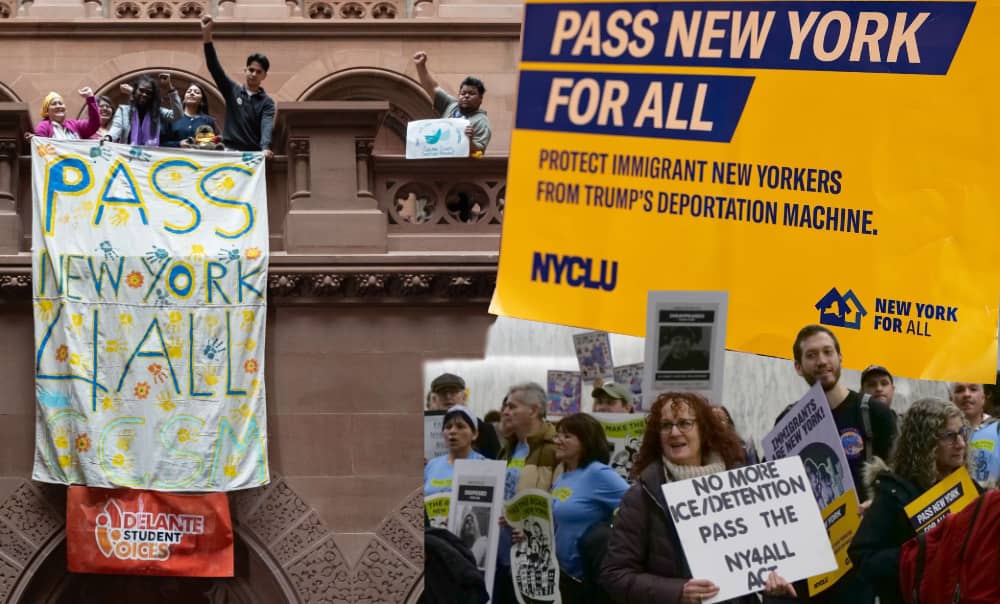
- Press Governor Hochul to support the New York For All Act, to protect immigrants from ICE arrests.
2. Palestinian detainee and solidarity activist Leqaa Kordia walks free
“DHS insists they are targeting criminals. But all I see here [at Prairieland Detention Facility] are mothers, sisters, daughters, grandmothers. Some have active green cards. Nevertheless, they are transferred from detention center to detention center. It is human trafficking, by another name.” –Leqaa Kordia, Zeteo (March 9, 2026)
She is the name many of us could not remember. She was never a Columbia student but was regularly referred to as one. She was held by ICE for 12 months and 3 days inside a women’s detention center in Texas, 1,500 miles from her home and community in New Jersey, and largely out of the media spotlight. In February, Leqaa Kordia fainted, had a seizure, and was hospitalized, in shackles. Her story started to receive national attention.
On International Women’s Day this month, Kordia, still imprisoned, published an essay that shared the stories of the women she lived with inside Prairieland: “We laugh together. We cry together. When somebody is crying, everybody is crying. When somebody is laughing, everybody is laughing. We try to do anything to make anybody happy …. We have each other. We only have each other.” In Kordia’s first public speech after her release on March 16, she spoke of her sadness at leaving behind the beautiful, courageous women and men still living in “ICE dungeons.”
In April 2024, Kordia was arrested by NYPD alongside more than 100 protesters outside Columbia University’s locked gates. The group was supporting students inside who had launched the historic Gaza solidarity encampment, demanding a ceasefire and university divestment from the Israeli war-machine. Nearly 200 members of Kordia’s extended family in Gaza have been killed. Although charges were dropped against Kordia and the other protesters in 2024, ICE obtained Kordia’s sealed arrest record from NYPD. Federal prosecutors then tried to build trumped-up “money laundering” charges based on a $1000 check that she sent to support relatives under siege in Gaza.
One year after participating in the protest, Kordia was ambushed by ICE during what she thought was a routine check-in in Newark, NJ, in March 2025. The Trump regime had just started its campaign of politically targeting noncitizen students and protesters who called for an end to the genocide. Many of those targeted, like Leqaa, are Palestinian.
The Trump regime’s rounding up of international students and faculty who stood in solidarity with Palestine was found to be unlawful in September 2025. Yet Kordia—not a student but a waitress in Paterson, NJ—still languished in detention long after more well-known detainees like Columbia graduate Mahmoud Khalil were released. Khalil published a moving public letter to Kordia during Ramadan this month while she was still incarcerated:
“I keep replaying what it felt like to walk into those detention centers. How impossible it is to describe to anyone who hasn’t lived it …. Leqaa, I want so badly to tell you that the world has stood by you. But I refuse to lie to you. The truth is that the world has failed you, and so have we. I cannot grasp that you remain, a full year later, thousands of miles away from your home, from your family, from the life you were building. And for what? For the crime that has followed our people across continents and generations: being Palestinian and daring to speak our truth.”
On Monday, March 16, the world stopped failing Leqaa Kordia. Mayor Mamdani had reportedly asked for her release; Columbia-Barnard faculty had organized a week-long relay hunger strike in solidarity with Leqaa; and her legal team and community in Paterson had never given up their efforts to bring her home. Leqaa finally walked out of Prairieland Detention Facility in Texas after 368 days. She still faces ongoing deportation proceedings.
Tens of thousands of detainees remain in cages. Kordia’s challenge to us is to remember their dignity and reinvent what solidarity can mean in this era of ‘mass deportation’ and massive social suffering in immigrant communities.
WHAT CAN WE DO?
- If you are able, consider a donation of any amount to the LaunchGood fundraising campaign for Kordia to help with medical expenses and the ongoing legal fight against her deportation.
- Support Justice for Migrants which offers material assistance and information for women and men detained at Batavia Federal Detention Facility outside Buffalo, NY.
In solidarity and with collective care,
Jackson Heights Immigrant Solidarity Network (JHISN)
Follow @JHSolidarity on Facebook and Twitter and share this newsletter with friends, families, neighbors, networks, and colleagues so they can subscribe and receive news from JHISN.