Tag: Dignity Not Detention Act

JHISN Newsletter 02/28/2026

Dear friends, 

It has been a wild winter in New York City since our last newsletter, and we hope this finds you warm and well. Our previous newsletter also landed in your inbox the day, January 24, that Alex Pretti was murdered in the street by Customs and Border Patrol (CBP) in Minneapolis. Alex Pretti and Renée Nicole Good, both US citizens, join six immigrants who died in ICE custody in January—Luis Gustavo Núñez Cáceres, Geraldo Lunas Campos, Víctor Manuel Díaz, Parady La, Luis Beltrán Yáñez-Cruz, and Heber Sánchez Domínguez—to make January 2026 a dreadful, deadly start to this new year of mass deportations.  

Today’s newsletter looks at the ongoing campaign to pass NYS legislation, the NY4All Act, that would strengthen protections for immigrants in the face of federal government attacks. Our second article reflects on how local sanctuary policies can help defend against the many border transgressions the Trump regime carries out in its selective “border war” against immigration.

Newsletter highlights:
  1. New York for All legislation: Can the New York State Assembly stand up?
  2. Protecting the borders we need: Local sanctuary against ICE incursions.


1. Pass NY4All Act Now, Or NY Will Have Normalized the Trump/Miller Agenda

“Silence is complicity. Inaction is complicity. We have the tools to protect our immigrant communities and we must use them. Federal immigration enforcement is cruel, chaotic, and unconstitutional. New York will not be complicit.” —Kristen Gonzalez, NY State Senator.

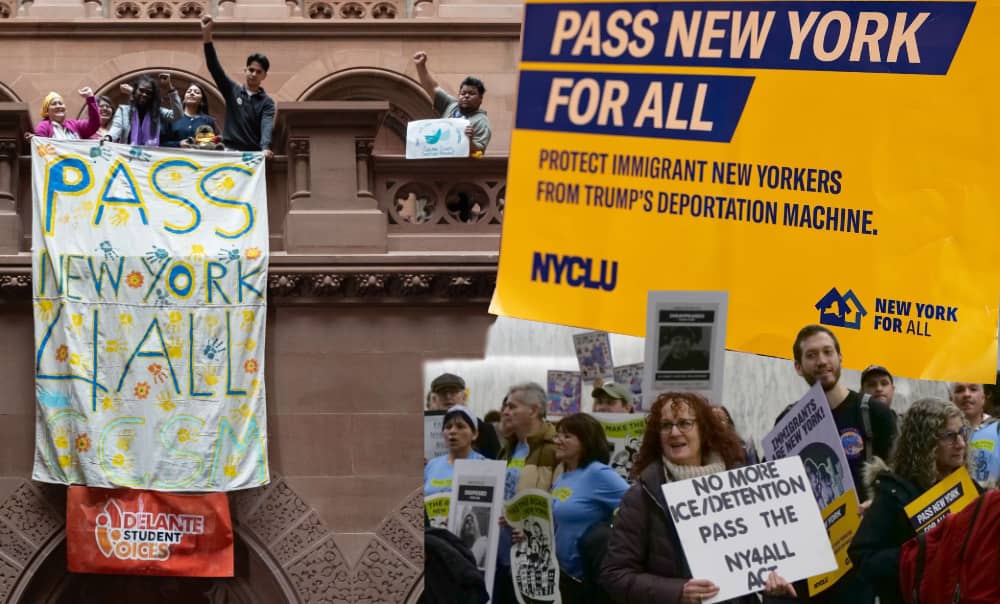
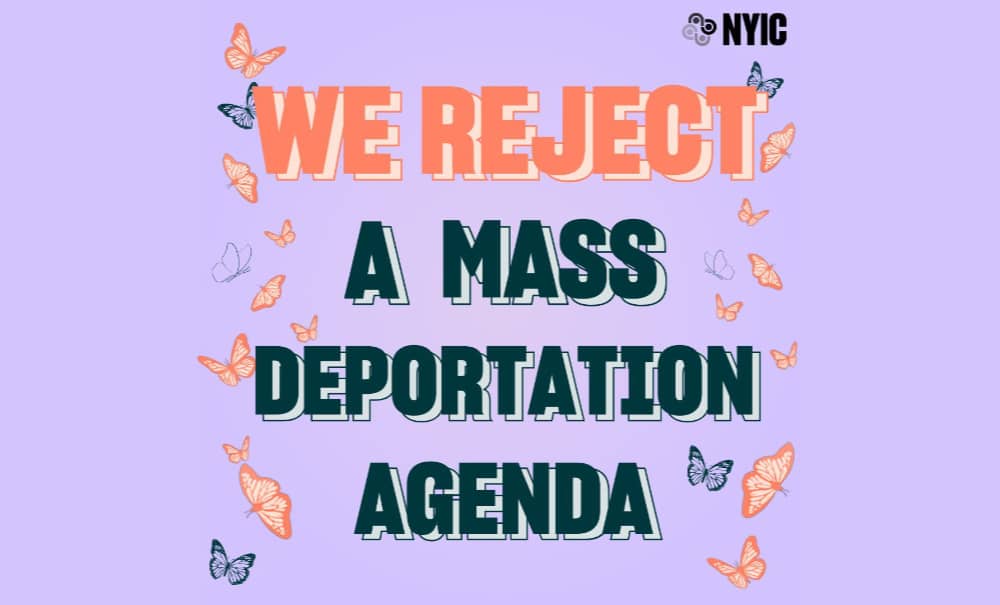
A February campaign by the NYCLU stated: “Pass the New York for All Act. Fight back against Trump’s mass deportation agenda and protect immigrant communities in New York.” That was back in 2020. The NY4All Act, if passed, would have prohibited the use of New York’s local and state resources to support federal immigration enforcement. That could have helped us stand in the courts with more challenges to the escalating inhumanity of the US deportation operations. The campaigns documented the social and economic benefits we would gain if New York’s communities did not cooperate with ICE. But no legislative action was taken.

Throughout the last six years, the cruelty of the detention and deportation machine has increased. Advocates like the New York Immigration Coalition, Make The Road New York, The Bronx Defenders, the Immigrant Defense Project, labor unions, the Association of Legal Advocates and Attorneys, and many other groups have continued to lobby Albany. They all demand the passage of the New York for All Act. In February 2025, NY legislators even reintroduced the Act because the guidance from NYC’s then-mayor Eric Adams was legally confusing. But no legislative action was taken.

On January 12, 2026, after the murder of Renee Good by ICE agents in Minneapolis, a NY For All: March For The Disappeared rally took place in Albany. Advocates returned once again to the state capitol on January 26–just days after the ICE murder of Alex Pretti–to demand passage of NY4All. Then, at the end of last month, Governor Kathy Hochul suddenly proposed her own Local Cops, Local Crimes Act. The purpose of Hochul’s act is to end the ‘weaponization’ of local police against their own communities by banning the 287(g) agreements that require them to cooperate with ICE. Even though many organizations, like the Asian American Federation, support this as a first step, the overwhelming preference of all groups is to pass the more substantial NY4All Act. 

There is concern that Hochul’s proposal might, in fact, preempt the NY4All Act and its more robust protections. As Assemblymember Dr. Anna Kelles pointed out, the 287(g) agreements that Hochul focused on are just one of the many proposals in the NY for All Act. Missing from Hochul’s proposal are additional safeguards, “designed to prevent immigration enforcement from happening through routine questioning, record keeping, database practices, probation operations, and behind-the-scenes information sharing.”

In addition to the NY4All Act, there are even more legislative proposals that Albany can pass to protect NY residents:

These many proposals are ready for the legislature to pass: let us demand our elected officials do more than just create media bites opposing ICE and, instead, take legislative action to protect our communities. A new proposal was even added this month, by Westchester’s State Senator Shelley Mayer, to prohibit ICE from gaining access to schools without a judicial order. The NYCLU, with the New York for All Coalition, published a press release urging Assembly Speaker Carl Heastie and Senate Majority Leader Andrea Stewart‑Cousins to work with the NY4All bill’s sponsors. One of the sponsors of the original 2020 New York for All Act said she had no explanation for why state Democrats have not pushed to vote on the bill:

“There is no reason to delay its passage any longer. As lawmakers, we have an obligation to not just speak out, but to actually pass legislation that will protect our immigrant communities.” —Julie Salazar, State Senator.

WHAT CAN WE DO?

2. Sanctuary Keeps Us Safe: The Borders in Our Backyards

On a recent Saturday afternoon, you may have seen them on 37th Avenue or Northern Boulevard: neighbors out in front of local TD Banks, flyering. You may have taken a flyer in English, or Urdu, or Spanish, or Hindi or Chinese or Bangla. You may have gone into the TD Bank, as the flyer suggests, to complain to a manager about TD Bank allowing ICE to use their parking lot on Northern as a staging area for harassing and arresting neighbors in Jackson Heights, Corona, and Elmhurst.

The Trump regime’s mass deportation campaign—hyperfunded by citizens’ and immigrants’ tax dollars—is violating a whole lot of borders as they escalate their border wars against migration. The border between local private property and federal un/lawful operations is transgressed when ICE or CBP (Customs and Border Patrol) uses TD Bank or Home Depot property to launch the targeting and arrests of community members. The border between municipal policing and Department of Homeland Security (DHS) agents’ activities is violated when the federal government tries to coerce local police to participate in federal enforcement. (Governor Hochul, as reported above, has recently proposed legislation that would bar NYS police from cooperating with ICE).

Most profoundly, the border between targeting crime—of so-called “illegal” aliens—and systematically committing crimes is blown up when Trump’s ICE/ CBP minions engage in breaking and entering, jailing people who are never charged with a crime, murdering US citizens, and illegally holding thousands of US residents in detention deemed unlawful by US courts.

What is at stake in this reckless violation of borders between private and public, local policing and federal persecution, or fighting crime and carrying out crimes? The politics of state terror and generalized fear require that none of us feel there is refuge or a reliable haven from arbitrary, even fatal, federal government violence. A key reason that sanctuary laws are under attack by this federal government is precisely because they promise refuge from government harassment, surveillance, and targeting.

Sanctuary laws, including in New York City, try to affirm and regulate the border between community safety and federal immigration enforcement. Drawing on the power and sovereignty granted by the Tenth Amendment of the US Constitution, local jurisdictions argue that sanctuary laws protect immigrant witnesses and victims of crime, and encourage all of us to participate in police and judicial processes without fear. While there is a wide range of sanctuary policies across different cities, counties, and states, almost all are aimed at promoting economic vibrancy and public safety within local communities, preventing local or state agencies from sharing protected data about citizenship status with the federal government, and allowing local or state governments to determine their own priorities and resource allocations. None of the policies actively prevent federal immigration authorities from carrying out their lawful operations.

Now the Trump regime is challenging sanctuary cities and states in the courts. Why? To stomp across the borders that we have drawn around community safety and immigrant solidarity. The DOJ dragged New York City into court in July 2025, and just last week New Jersey was sued by the DOJ for its sanctuary policies. 

This week, NY’s Attorney General filed an amicus brief defending New York City’s laws, stating, “Our city was built by immigrants, and this administration’s attempts to overturn local laws that protect them are unjust and unconstitutional.” On February 6, Mayor Mamdani signed an executive order strengthening the city’s sanctuary policies, requiring city agencies to comply with all relevant laws, and prohibiting ICE from entering city properties (schools, hospitals, shelters) without a judicial warrant.

“We keep us safe.” Let’s protect the borders between public assault and private space, between local jurisdiction and federal overkill. Between community safety and authoritarian threat.

WHAT CAN WE DO?

  • Support Jackson Heights Indivisible’s (JHI) email campaign asking TD Bank to not allow ICE staging operations in its parking lot. Email TD Bank at CustomerAdvocacyandInsights@td.com or Thomas.Rigg@td.com
  • Check JHI’s public calendar for local immigrant solidarity actions.
  • Attend NYIC’s Neighborhood Defense / KYR training at LaGuardia Community College on March 17 from 12 – 1:30 pm


In solidarity and with collective care,

Jackson Heights Immigrant Solidarity Network (JHISN)


Follow @JHSolidarity on Facebook and Twitter and share this newsletter with friends, families, neighbors, networks, and colleagues so they can subscribe and receive news from JHISN. 
 

JHISN Newsletter 02/08/2025

Dear friends, 

As we come to the end of another tumultuous week of the new administration, we offer you a ray of hope with a link to two extraordinary examples of determination and resilience in the documentary Borderland: The Line Within. For a small fee you can follow the experiences of Gabriela, a DACA recipient from Mexico, and Kaxh, a Mayan environmental activist and asylum seeker from Guatemala, as the film exposes the extent of the Border Industrial Complex. 

We also join in congratulating Make the Road New York on the opening of its newest community center this week in Corona, Queens. A ribbon-cutting ceremony attended by electeds and community members was held on Wednesday for the nearly $40 million project launched in 2016. 

Today’s newsletter offers a wide-ranging look at how US cities are reaffirming their sanctuary city status in defiance of ICE threats. While NYC is not yet at the forefront of cities taking a stand, that battle is not over.  

Newsletter highlights:
  1. Sanctuary under siege: A nationwide look at how cities fight back


1. Sanctuary Cities Protect People And Do Not Violate Federal Law

Is it really true that if federal immigration authorities ‘command’ or ‘request’ that state officers participate in immigration enforcement, they could be prosecuted for refusing to comply? The answer is ‘no,’  and the law on the subject is quite clear.Just Security (01.23.25)

While the made-for-TV spectacle circulates of Dr. Phil joining an immigration raid in Chicago with ICE enforcers, a Congressional bill has been introduced that is also politically performative: it attempts to define a sanctuary jurisdiction, then makes such jurisdictions ineligible for federal funds. The funds identified for vindictive removal in this proposed bill are earmarked as being “for the benefit” of undocumented immigrants but, as the National Immigration Law Center notes: it is impossible to separate those funds from those that also benefit citizens. The bill therefore threatens funding for free school lunches, domestic violence shelters, all transportation projects, and Federal Emergency Management Agency (FEMA) funding. The new administration is making belligerent and unconstitutional threats against sanctuary jurisdictions in an attempt to bully them into abandoning the rights of the people living there. Many are standing up against the threats, while others may try to appease or benefit from Trump’s  ‘transactional’ power plays. 

James Comer (R-Kentucky), Chairman of the House Oversight and Government Reform Committee, recently sent letters to the Mayors of Boston, Chicago, Denver, and NYC requesting documentation from each about their sanctuary policies.  Why were these cities chosen? The Mayor of Denver said he would go to jail to protect people who are undocumented; the Boston City Council recently reaffirmed its sanctuary in the Boston Trust Act; Chicago recently reaffirmed its ordinance, The Welcoming City; and New York State and City have various sanctuary provisions

The online forum, Just Security, explains why these new demands are legally void, as were the January letter threats from Steven Miller’s America First Legal that warned of “serious consequences” over sanctuary policies. Sirine Shebaya of the National Immigration Project (NIP) concurs: “Letters like these are really more about sowing fear than they are about articulating anything that would hold up from a legal standpoint.” The NIP also published a document outlining how Sanctuary Policies Do Not Violate Federal Law. These arguments against sanctuary policies have had their day in the courts before and have lost. States can decline to help federal ICE agents because, under the Tenth Amendment, states retain police power within their own borders. They can also pursue legal remedies, support the rights of their residents to protest, and allocate funds for immigrant defense—as many did with the first Trump administration. Even the conservative Supreme Court Justice Antonin Scalia held that the framers intended states to have a “residuary and inviolable sovereignty” that barred the federal government from “impress[ing] into its service…the police officers of the 50 States.” 

Republican-led cities have also expressed concern about clear responsibilities in this sweeping approach to immigration enforcement. “We understand this uncertainty creates concerns and fear,” said Oklahoma Mayor Jean Stothert, a Republican running for a fourth term, adding “Enforcing immigration law is a responsibility of federal law enforcement agencies, not the Omaha Police Department.” Indeed, the reason that Trump wants to force local police to do his will is because the 6,000 deportation officers are insufficient to handle the quota he set of 1,500 daily immigrant arrests. He needs the 800,000 law enforcement officers of the 50 states to do his bidding. So local resistance becomes crucial.

In Illinois, several Chicago community-based organizations—Brighton Park Neighborhood Council, Organized Communities Against Deportations, Illinois Coalition for Immigrant and Refugee Rights Inc., and Raise the Floor Alliance—have sued the federal government over the mass deportation raids as a violation of the Administrative Procedure Act and their First Amendment rights. They point out that Florida and Texas are not subjected to the same enforcement, even though they have three times as many undocumented immigrants compared to Illinois. 

In California, in addition to San Francisco and Los Angeles city councils unanimously approving their sanctuary city policy, people gathered outside Alameda City Hall to show there is support for their existing sanctuary city status. Further South in National City hundreds of protesters gathered to voice opposition to the Trump Administration’s immigration policies and raids. The police used tear gas to disperse the crowd. Much further North in Yakima, WA, a rally in opposition to the national raids also took place, and local law enforcement agencies assured residents they would not be participating in any immigration raids. 

So what of New York City? NYC Public Schools prepared staff for ICE run-ins: reminding principals that enforcement officers must have proper legal authority to access school grounds; and noting that all children have a right to education regardless of immigration status. The New York Immigration Coalition published Getting the Facts Straight on Sanctuary Cities. And Manuel Castro, New York’s commissioner of migrant affairs, has vowed not to follow “the instructions of the federal government in cases of mass deportations.” 

On the other hand, NYC Mayor Adams is so far taking a conciliatory approach to Trump’s anti-immigrant actions, possibly because he is facing federal corruption charges that the notoriously transactional president could pardon. Instead of standing strong in support of New York City’s sanctuary policies, Adams said, “The American people have communicated with us loudly and clearly: We have a broken system. They want it fixed. We need to fix our immigration system. We need to secure our border”. He added: “I’m not going to be warring with this administration. I’m going to be working with this administration.” 

As truthout, a member of the important Movement Media Alliance, reported:

“A bully will hit you and then tell you that you made them hit you. Local elected officials and communities must not give in to Trump’s bullying and obey in advance, which will only set a dangerous precedent and groundwork for targeting and persecution of organizers, lawyers, advocates, and others working to protect immigrant communities.”

WHAT CAN WE DO?
  • Join the Vera Institute of Justice in pushing NY State elected officials to protect immigrant New Yorkers by passing the New York for All Act, Dignity Not Detention Act, Access to Representation Act, and Clemency Justice Act.
  • Circulate United We Dream’s resources, including Know Your Rights information sheets.
  • Check out the TV show ‘Mo’ about an asylum-seeking Palestinian family living in Texas – this fictionalized account shows the humanity of the people that Trump wants to deport.
  • Be healthy and support immigrants by signing up for the Immigrants Run NYC, For The Love of Queens, 5k run in Flushing Meadows Park on February 15. Queens Distance Runners are donating 50% of the registration fees to NICE.

In solidarity and with collective care,

Jackson Heights Immigrant Solidarity Network (JHISN)


Follow @JHSolidarity on Facebook and Twitter and share this newsletter with friends, families, neighbors, networks, and colleagues so they can subscribe and receive news from JHISN. 


JHISN Newsletter 01/11/2025

Dear friends, 

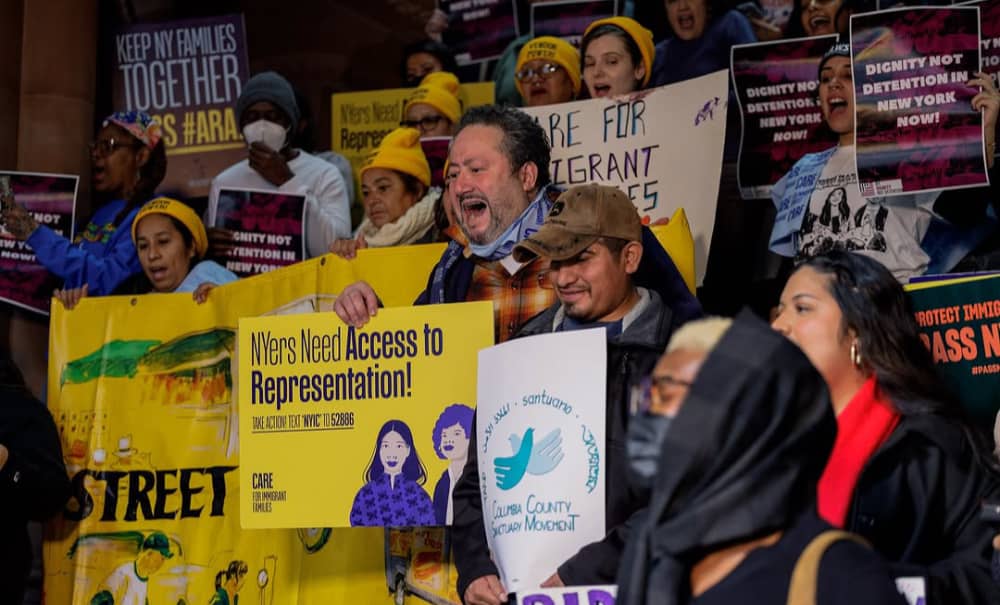
‘Happy New Year. You’re Deported’ was published by The Nation at the end of the year…in 2015…during the second term of the Obama presidency. Horrific, unacceptable, and unconscionable were key words the article used to describe Homeland Security’s plan to begin raids to deport families. Our first article for this new year 2025 looks at the ongoing state-sanctioned deportation threats to immigrant families and communities which promise to be significantly more aggressive than before. Just like a decade ago, our New York immigrant justice organizations today stand against the inhumanity of these policies. Even as our Mayor and Governor both talk about walking back our sanctuary policies and allowing more cooperation with ICE agents, hundreds of people rallied this past week at the state capitol in Albany demanding expanded legal protections for immigrant New Yorkers. 

Government intimidation will not stop the political, social, and community struggles of immigrant-led organizations and justice campaigns. We will, in fact, see community support strengthened this year when Make the Road NY holds a February ribbon-cutting ceremony for its new landmark center in Corona. Our second article spotlights Make the Road’s Deportation Defense Manual and practical guidance for community safety in 2025. 

Newsletter highlights:
  1. A look at deportation threats–and protections–in NYC
  2. Make the Road NY’s blueprint for deportation defense


1. Cruel Futures—Deportation @NewYork

“By pledging to carry out the largest mass deportation in history, Trump isn’t just targeting immigrant communities, he’s attacking the very fabric of the country … Trump is creating a future where millions of families will live in constant fear of being torn apart, and where entire communities and economic sectors will be destabilized.” Murad Awawdeh, director, NY Immigration Coalition (12/8/24) 

The destabilization promised by Trump and his anti-immigrant minions holds a special threat to New York State, where 4.5 million immigrant residents are at risk of having families, lives, and communities overturned by a mass deportation agenda. New York City is home to an estimated 412,000 of the state’s 672,000+ undocumented people, all of whom stand in the crosshairs of an incoming administration that aims for cruelty and racist scapegoating as a livestream political bloodsport.

Nearly half of NYC’s small businesses are run by immigrants, including undocumented owners (an estimated 60,500 undocumented entrepreneurs live in NY state). Close to 310,000 undocumented workers compose 7% of the city’s labor force. Undocumented workers in New York State pay about $3 billion in state and local taxes. Many immigrant households in our neighborhood are ‘mixed status’ with members living together who have both legal and unprotected immigration status—including over 351,000 citizen children statewide who live with an undocumented family member. Trump has announced he wants to make even more people ‘undocumented’ by stripping away time-limited legal protections like Temporary Protective Status (TPS), DACA, and humanitarian parole, which would expose thousands more people in Central Queens to deportation threats.

Assessments abound regarding what Trump 2.0 can really do, what they will really do, and how quickly. In recent US history, the vast majority of removals and detentions took place at the US-Mexico border. Deporting undocumented immigrants from New York City would require interior arrests and detentions, actions limited, in theory, by complex legal procedures and choked by overwhelmed immigration courts. But ‘expedited removal’ protocols—which Trump tried to ramp up during his first administration—would allow federal officials to remove anyone who cannot prove they are in the US lawfully, or that they have resided physically in the country for two years or more.

New York City is not without some protections, for now, against deportation frenzy. One of over 170 US cities that has established sanctuary policies, NYC since 1989 has created legal safe zones for immigrants threatened by federal overreach. In 2014 and 2018 under Mayor de Blasio, sanctuary laws were strengthened to preclude local cooperation with ICE’s ‘detainer requests’ (with exceptions for people convicted of serious crimes), and to mandate advance review by senior city officials of any request for help from federal immigration agents that might lead to deportation. In fiscal year 2022-23, the NYPD granted exactly zero of ICE’s requests to hold someone in custody for them. But attempts at the state level to expand immigrant protections have stalled, including the ambitious New York For All Act which has never gotten out of committee. And Mayor Adams has recently threatened to change the city’s existing sanctuary laws to facilitate cooperation with ICE and federal deportation.

As we speak, the city is also closing down the vast tent city at Floyd Bennett Field in southern Brooklyn, built to serve as a family shelter for recent migrants. The closure is due in part to a steady decline in the number of migrants arriving in NYC and being housed in city shelters, a 17% drop from 69,000 migrants in January 2024 to 57,400 in December. Local immigrant justice groups and the mutual aid group Floyd Bennett Field Neighbors also fought for the closure just before Trump’s inauguration: the tent shelter was built on federal land, and advocates feared the new administration could repurpose the shelter as an immigrant detention center.

Finally, the vulnerability of thousands of recently-arrived migrants in NYC to mass deportation is mitigated by the fact that the majority of new migrants are asylum seekers. Though referred to as “illegals” by Trump, and often presumed undocumented, many recent migrants are actually at the start of the years-long asylum process. They exist in a legal border zone, constructed precisely to protect asylum seekers from deportation during the proceedings.

Will legal border zones mean anything in the coming years? Will laws be blown up, and emergency states of exception proliferate? That uncertainty triggers everyone’s worst nightmares. As Murad Awawdeh of NY Immigration Coalition says: “We can’t allow this vision of cruelty, exclusion, and fear to become our reality.”  

WHAT CAN WE DO?
  • Support the New York For All Act which prohibits state and local resources from being used to enact inhumane federal deportation agendas.
  • Support the Dignity Not Detention Act which prevents NYS from entering in, or renewing, contracts for immigrant detention centers. Similar bills have passed in NJ, CA, WA, and IL. Sign on with your organization’s support for the bill.
  • Support the Access to Representation Act which guarantees the right to counsel for anyone, regardless of income, who comes before a New York immigration court, including in deportation hearings.  

2. Preparing for Trump’s Deportation Plans

“I think [Queens], in many ways, ends up being the kind of epicenter for the fights. I think a lot of the work that we’re going to have to do over the next four years, whether it’s deportation defense or education within the community, is going to be centered in our borough.”–Jagpreet Singh, organizer with Desis Rising Up & Moving (DRUM) 

In the first weeks of 2025, our undocumented friends and neighbors are dreading the onset of Trump’s deportation plans. Many of the immigrant justice organizations are on high alert. Both DRUM and Make the Road NY say they have been preparing for the incoming presidential administration:

“Throughout this year, we’ve been preparing our community for this. We’ve been preparing basically this entire year. I think we’re in a better spot than we would have been if this was unexpected.” —Jagpreet Singh, organizer with DRUM  

 “It is a very dark time when New York City, which has always thought of itself as a sanctuary space, that our mayor would even willingly meet with this new border czar. It sets a tone that New York City is not for immigrants, and it puts a target on the back of immigrants.”—Luba Cortes, immigration lead organizer, Make the Road New York 

Make the Road NY, with the help of the Immigrant Defense Project, has created one of the most comprehensive preparedness resources: the Deportation Defense Manual. MTRNY’s website also offers current resources and downloadable flyers, including their recent Stay Safe! How to Protect Yourself in a Trump Administration.

The Defense Manual, available in Spanish and English, has three major parts and several useful appendixes. Part 1: Know Your Rights provides details for dealing with ICE at home, on the street, while driving, or at work. The main message from Part 1 is to not open the door unless ICE shows you a judicial warrant (sample on p. 19). Be calm and remain silent. You do not have to say anything or provide any information. (Your 4th and 5th Amendment rights should protect you from incriminating yourself and/or unlawful search and seizure.) You can say “I want to exercise my right to remain silent.” and “I do not consent to a search.” Ask for an interpreter. Ask to talk to an immigration attorney before signing anything. If you see someone being detained, take photos and write down all the information about the encounter. (Appendix D has a form to use.) Call the Immigrant Defense Project help line (212-725-6422).  Part I ends with extremely important guidance for how to protect your children by creating a plan now, and Appendix C has a comprehensive family preparedness checklist.

Part 2: Rapid Response to Raids provides information needed to support someone or a family after an ICE raid. What information do you need to have about the detained loved one? How to find a lawyer, and how to visit someone in detention? (pp. 28-31).

Part 3: Deportation Defense lists strategies to organize support for an individual who has been detained. How to organize the community to support a detained person? How to create a fundraising campaign or put pressure on government agencies? (pp. 42-44 and Appendix F).

Finally, Appendix G has multiple copyable flyers with rights information to distribute.

WHAT WE CAN DO?


In solidarity and with collective care,

Jackson Heights Immigrant Solidarity Network (JHISN)


Follow @JHSolidarity on Facebook and Twitter and share this newsletter with friends, families, neighbors, networks, and colleagues so they can subscribe and receive news from JHISN.