Dear friends,
It has been a wild winter in New York City since our last newsletter, and we hope this finds you warm and well. Our previous newsletter also landed in your inbox the day, January 24, that Alex Pretti was murdered in the street by Customs and Border Patrol (CBP) in Minneapolis. Alex Pretti and Renée Nicole Good, both US citizens, join six immigrants who died in ICE custody in January—Luis Gustavo Núñez Cáceres, Geraldo Lunas Campos, Víctor Manuel Díaz, Parady La, Luis Beltrán Yáñez-Cruz, and Heber Sánchez Domínguez—to make January 2026 a dreadful, deadly start to this new year of mass deportations.
Today’s newsletter looks at the ongoing campaign to pass NYS legislation, the NY4All Act, that would strengthen protections for immigrants in the face of federal government attacks. Our second article reflects on how local sanctuary policies can help defend against the many border transgressions the Trump regime carries out in its selective “border war” against immigration.
Newsletter highlights:
- New York for All legislation: Can the New York State Assembly stand up?
- Protecting the borders we need: Local sanctuary against ICE incursions.
1. Pass NY4All Act Now, Or NY Will Have Normalized the Trump/Miller Agenda
“Silence is complicity. Inaction is complicity. We have the tools to protect our immigrant communities and we must use them. Federal immigration enforcement is cruel, chaotic, and unconstitutional. New York will not be complicit.” —Kristen Gonzalez, NY State Senator.
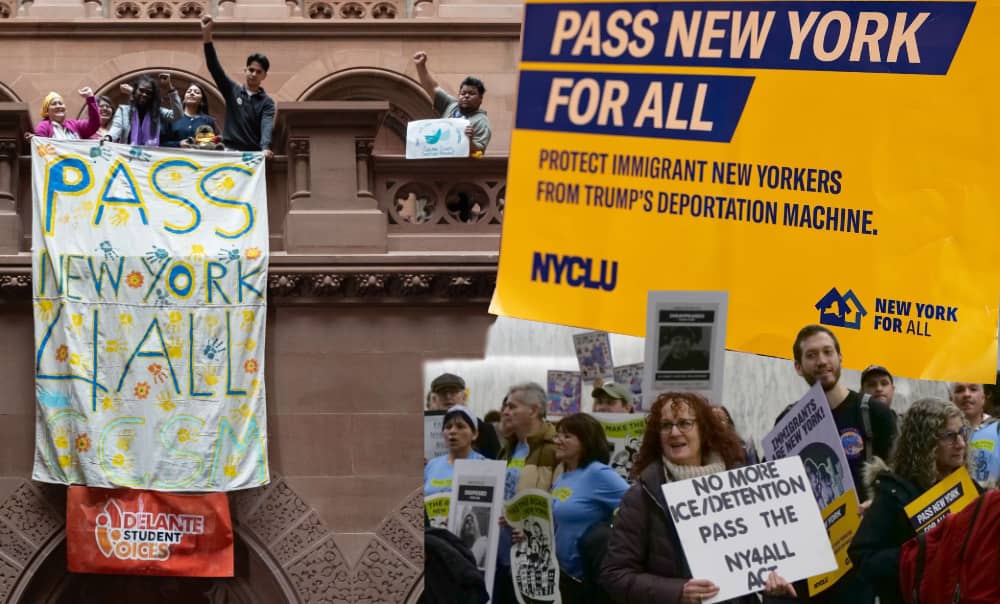
A February campaign by the NYCLU stated: “Pass the New York for All Act. Fight back against Trump’s mass deportation agenda and protect immigrant communities in New York.” That was back in 2020. The NY4All Act, if passed, would have prohibited the use of New York’s local and state resources to support federal immigration enforcement. That could have helped us stand in the courts with more challenges to the escalating inhumanity of the US deportation operations. The campaigns documented the social and economic benefits we would gain if New York’s communities did not cooperate with ICE. But no legislative action was taken.
Throughout the last six years, the cruelty of the detention and deportation machine has increased. Advocates like the New York Immigration Coalition, Make The Road New York, The Bronx Defenders, the Immigrant Defense Project, labor unions, the Association of Legal Advocates and Attorneys, and many other groups have continued to lobby Albany. They all demand the passage of the New York for All Act. In February 2025, NY legislators even reintroduced the Act because the guidance from NYC’s then-mayor Eric Adams was legally confusing. But no legislative action was taken.
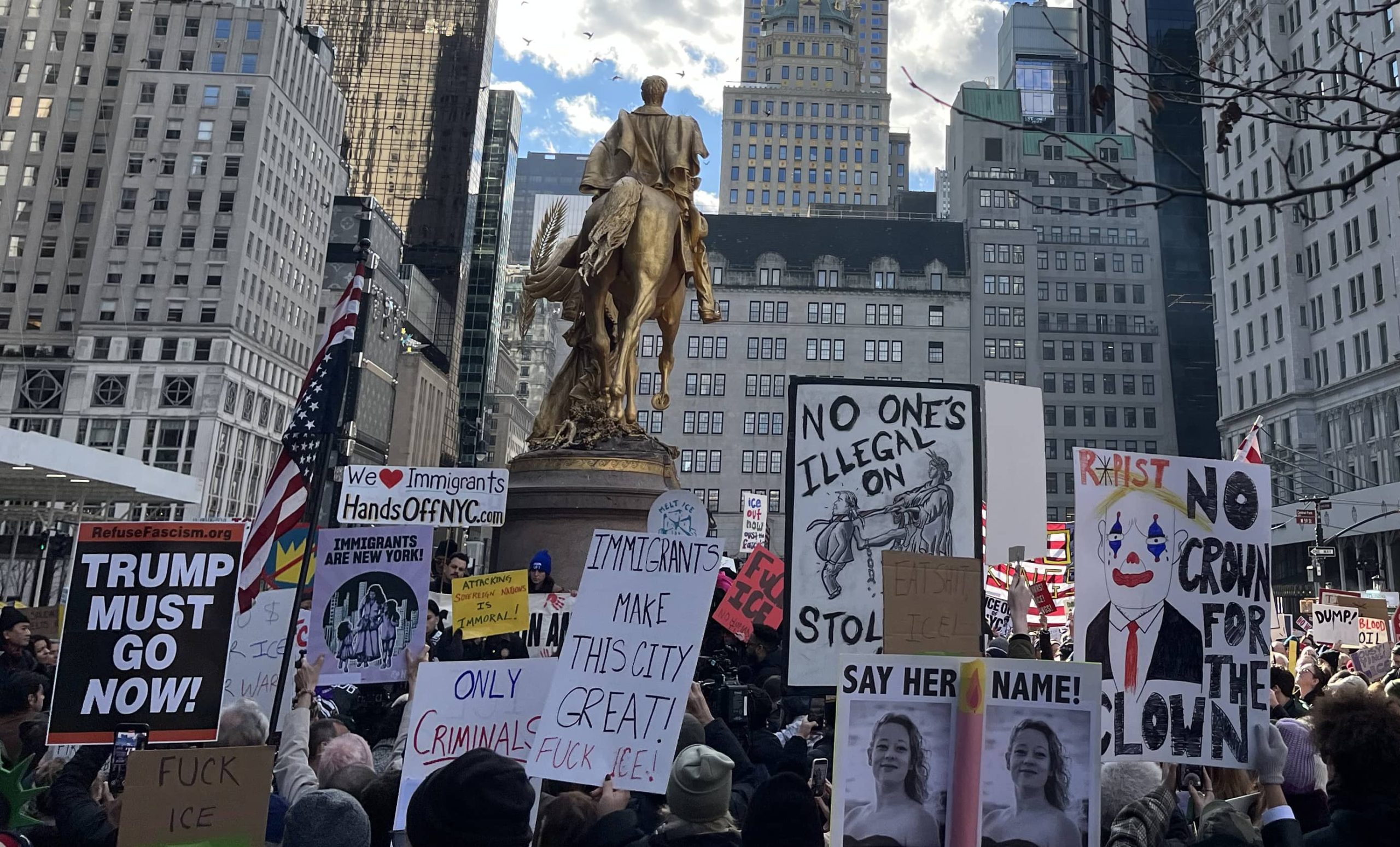
On January 12, 2026, after the murder of Renee Good by ICE agents in Minneapolis, a NY For All: March For The Disappeared rally took place in Albany. Advocates returned once again to the state capitol on January 26–just days after the ICE murder of Alex Pretti–to demand passage of NY4All. Then, at the end of last month, Governor Kathy Hochul suddenly proposed her own Local Cops, Local Crimes Act. The purpose of Hochul’s act is to end the ‘weaponization’ of local police against their own communities by banning the 287(g) agreements that require them to cooperate with ICE. Even though many organizations, like the Asian American Federation, support this as a first step, the overwhelming preference of all groups is to pass the more substantial NY4All Act.
There is concern that Hochul’s proposal might, in fact, preempt the NY4All Act and its more robust protections. As Assemblymember Dr. Anna Kelles pointed out, the 287(g) agreements that Hochul focused on are just one of the many proposals in the NY for All Act. Missing from Hochul’s proposal are additional safeguards, “designed to prevent immigration enforcement from happening through routine questioning, record keeping, database practices, probation operations, and behind-the-scenes information sharing.”
In addition to the NY4All Act, there are even more legislative proposals that Albany can pass to protect NY residents:
- Mandating End of Lawless Tactics (MELT) Act—banning ICE agents from wearing masks.
- Dignity Not Detention Act—ending private immigration detention in New York state.
- Access to Representation Act (ARA)—establishing the right to legal counsel in immigration proceedings in New York State.
- Building Up Immigrant Legal Defense (BUILD) Act—supports the ARA by strengthening and funding deportation defense legal services.
These many proposals are ready for the legislature to pass: let us demand our elected officials do more than just create media bites opposing ICE and, instead, take legislative action to protect our communities. A new proposal was even added this month, by Westchester’s State Senator Shelley Mayer, to prohibit ICE from gaining access to schools without a judicial order. The NYCLU, with the New York for All Coalition, published a press release urging Assembly Speaker Carl Heastie and Senate Majority Leader Andrea Stewart‑Cousins to work with the NY4All bill’s sponsors. One of the sponsors of the original 2020 New York for All Act said she had no explanation for why state Democrats have not pushed to vote on the bill:
“There is no reason to delay its passage any longer. As lawmakers, we have an obligation to not just speak out, but to actually pass legislation that will protect our immigrant communities.” —Julie Salazar, State Senator.
WHAT CAN WE DO?
- Demand that your representatives pass NY4All.
- Contact your representatives and also demand that they take action on the ARA and BUILD Acts.
- Read, support, and share Make The Road NY’s “Bold Agenda For A New Era.”
2. Sanctuary Keeps Us Safe: The Borders in Our Backyards
On a recent Saturday afternoon, you may have seen them on 37th Avenue or Northern Boulevard: neighbors out in front of local TD Banks, flyering. You may have taken a flyer in English, or Urdu, or Spanish, or Hindi or Chinese or Bangla. You may have gone into the TD Bank, as the flyer suggests, to complain to a manager about TD Bank allowing ICE to use their parking lot on Northern as a staging area for harassing and arresting neighbors in Jackson Heights, Corona, and Elmhurst.
The Trump regime’s mass deportation campaign—hyperfunded by citizens’ and immigrants’ tax dollars—is violating a whole lot of borders as they escalate their border wars against migration. The border between local private property and federal un/lawful operations is transgressed when ICE or CBP (Customs and Border Patrol) uses TD Bank or Home Depot property to launch the targeting and arrests of community members. The border between municipal policing and Department of Homeland Security (DHS) agents’ activities is violated when the federal government tries to coerce local police to participate in federal enforcement. (Governor Hochul, as reported above, has recently proposed legislation that would bar NYS police from cooperating with ICE).
Most profoundly, the border between targeting crime—of so-called “illegal” aliens—and systematically committing crimes is blown up when Trump’s ICE/ CBP minions engage in breaking and entering, jailing people who are never charged with a crime, murdering US citizens, and illegally holding thousands of US residents in detention deemed unlawful by US courts.
What is at stake in this reckless violation of borders between private and public, local policing and federal persecution, or fighting crime and carrying out crimes? The politics of state terror and generalized fear require that none of us feel there is refuge or a reliable haven from arbitrary, even fatal, federal government violence. A key reason that sanctuary laws are under attack by this federal government is precisely because they promise refuge from government harassment, surveillance, and targeting.
Sanctuary laws, including in New York City, try to affirm and regulate the border between community safety and federal immigration enforcement. Drawing on the power and sovereignty granted by the Tenth Amendment of the US Constitution, local jurisdictions argue that sanctuary laws protect immigrant witnesses and victims of crime, and encourage all of us to participate in police and judicial processes without fear. While there is a wide range of sanctuary policies across different cities, counties, and states, almost all are aimed at promoting economic vibrancy and public safety within local communities, preventing local or state agencies from sharing protected data about citizenship status with the federal government, and allowing local or state governments to determine their own priorities and resource allocations. None of the policies actively prevent federal immigration authorities from carrying out their lawful operations.
Now the Trump regime is challenging sanctuary cities and states in the courts. Why? To stomp across the borders that we have drawn around community safety and immigrant solidarity. The DOJ dragged New York City into court in July 2025, and just last week New Jersey was sued by the DOJ for its sanctuary policies.
This week, NY’s Attorney General filed an amicus brief defending New York City’s laws, stating, “Our city was built by immigrants, and this administration’s attempts to overturn local laws that protect them are unjust and unconstitutional.” On February 6, Mayor Mamdani signed an executive order strengthening the city’s sanctuary policies, requiring city agencies to comply with all relevant laws, and prohibiting ICE from entering city properties (schools, hospitals, shelters) without a judicial warrant.
“We keep us safe.” Let’s protect the borders between public assault and private space, between local jurisdiction and federal overkill. Between community safety and authoritarian threat.
WHAT CAN WE DO?
- Support Jackson Heights Indivisible’s (JHI) email campaign asking TD Bank to not allow ICE staging operations in its parking lot. Email TD Bank at CustomerAdvocacyandInsights@td.com or Thomas.Rigg@td.com
- Check JHI’s public calendar for local immigrant solidarity actions.
- Attend NYIC’s Neighborhood Defense / KYR training at LaGuardia Community College on March 17 from 12 – 1:30 pm
In solidarity and with collective care,
Jackson Heights Immigrant Solidarity Network (JHISN)
Follow @JHSolidarity on Facebook and Twitter and share this newsletter with friends, families, neighbors, networks, and colleagues so they can subscribe and receive news from JHISN.